Update 3/15/09: The NYTimes has released transcripts of interviews of those tortured at US "black sites."
The following published 06: I've meant to write about the decision by the US Congress last month to effectively legalize the torture of people. I haven't done so yet because of personal emergencies and time constraints. I've also been trying to weed through the various angles taken by the political and legal commentators on the issue. My take--strangely to me at least--always comes back to the ethico-religious perspective. ...
I say strangely because it seems to me that there are viable arguments from a pragmatic and ruthlessly mercenary perspective wherein torture can be justified. I do not agree with these, and I think they can be undermined logically, yet I think that people are rarely persuaded to act by either logical or rational arguments. That is, as I have argued before, when it comes to "skin for skin" as the Accuser in Job says, people will resort to distinctly seemingly irrational--although understandable--actions to save themselves.
Often, these avenues of saving oneself can occur against one's will. That is, biological and psychological forces take control of a person and the survival imperative becomes paramount in how one acts--and why one acts is often incommunicable, at least at the time. It is perhaps only after years of having done something that why you did what you did that the "reasons" you acted that way actually ever becomes sayable, to use a Wittgensteinian phrase in a rather superficial manner.
The Christian apostle Paul once had a chance to undergo torture for his belief in the Christian message he was hoping to spread throughout the world. Given the choice of suffering for his good news, Paul did something that his tormenters perhaps least expected. Paul invoked his Roman citizenship. Somewhat unique for a Jew of the time, Paul’s Roman citizenship brought with it a protection against the one thing that probably evoked one of the profounder fears in his contemporaries—the usual torture to elicit a confession that was normal operating procedure in the Roman provinces.
Roman citizenship brought with it the protection from mandatory torture. Besides the other economic and social privileges that came along with being a Roman citizen, this legal protection against being tortured—whether innocent or not—is perhaps the one right that stands out for us who look back over the millennia. That is, we take our protection from torture for granted, seeing it as the mark of a civilized nation.
No doubt, the Romans used the threat of torture as a coercive means of maintaining control over those who refused Roman rule. Indeed, this one right could be seen as a stick and its promise a carrot. How much subservience would a person give to the ruling powers if they’re faced with the instruments of torture?
In passing legislation that effectively legalizes torture, the US congress turned back the clock on civilization two millennia. Given the most likely fact that US citizens themselves could be tortured, this clock is set even farther back—back before the establishment of the Roman Republic, 2700 years ago.
This disturbing historical fact is further aggravated by the notion that the US has effectively set itself up as arbiter for determining who is and who is not a human being. This goes beyond a simple political dimension—it carries with it something of a metaphysical aspect that delegates to the US a power of life and death that in many religious or philosophical systems belongs to a transcendent power alone. It is this immense power over who’s determined to be human or not—who deserves the concern of human integrity—that led many early Christians in writings like the book of Revelation to characterize the Roman Empire as a Beast or demi-god that tries to usurp the power of control of the world’s maker.
The French thinker Simone Weil carried these images to their ethico-religious conclusions. Basing herself on the perception that humans turning humans into things--as they are in war or via slavery and torture—is the main feature of every evil regime throughout time, she appealed to a basic sentiment in humans that revulses from watching the suffering of others.
For Weil, the basic feature of the Beast’s method is to create an environment of illusion wherein people are alienated from their consciences. Dealing and doling out various fantasies, the Beast attempts to create in people a world free of pain and suffering or one where pain and suffering have no reality except as the cries of characters in a fantasy world without gravity of depth.
Weil’s appeal to primitive conscience is perhaps the last gasp of an unrepentant idealist. He was without a doubt a Platonist who attempted to integrate the Platonic world of ideas into political and social dialogs. For many post-modernists, this attempt already marks her work as trying to resurrect a defunct superstition of ghostly worlds where the disconnect between that world and this world creates an inherent illusion and self-deception. One places one’s will and its dispositions in that world rather than dealing with the world as it is in this world.
Be these philosophical questions be as they may, Weil’s central point about whether there’s a conscience and a human sentiment of sympathy for another’s suffering seems unreducible. Answering that question in the affirmative—whether via scientific research or based on introspective analysis—goes a long way in answering questions about why or why it’s not moral to torture others. Certainly, there are factors that come into play to undermine this basic human sentiment. In some religious contexts, it’s called original sin, in philosophy a matter of mistaking evil for the good.
Once you accept the basic notion of a human aversion to suffering of others, as well as the desire to make others suffer, then any time that such practices of condoning suffering and institutionalizing them becomes a matter of dealing a severe blow to what old-time humanists used to call the human image, and which various religious and philosophical apologists have termed the integrity of something that transcends the merely socio-biological human animal.
Related Link Against the Grain: Series on Christian Teaching and Torture: 1, 2, 3, 4
Read more!
Sunday, March 15, 2009
Torture and the Human Image
0
comments
Labels:
apocalyptic,
religion,
torture,
xtianity

Wednesday, November 12, 2008
Civilization@Risk
Is there anything that provides a grimmer testament to human frailty than the Abu Ghraib pictures now available on the web? When you see these pictures, many react with disgust, anger, horror, or perhaps pity. Maybe you even react dumbly and uncomprehendingly. After all, they are pictures of men stripped naked and put into positions that make no sense. You have to think the brute reality of their physical discomfort into the pictures. The pictures themselves don't breathe the sighs or the smell of bodies contorted into shapes and positions meant to humiliate and demean. Pictures don't bleed.
But there's more to a picture than what's seen. That we fill that unseen void with our own nightmares or lack of feeling or overblown sense of pity--is it there where the gulf between human and human eventually erupts and discharges its foul poisons? For no picture can grasp that image that eludes every camera, that sense of who we are and that no word will ever inscribe on paper or sand but whose carcass can taunt with nagging ignorance.
These pictures tell a mute story of desolation and desecration; the profane shock of nude men that have become nothing but masses of flesh and hooded mannequins. They elicit more of that final and ultimate irony: our safe securities are nothing but lies and self-deception. ...
One thing that the photos from Abu Ghraib do not document and perhaps cannot show is the fragile hold that custom and ritual have on our lives. You have to delve deeply into the literature to see the concerted regime undertaken by the torturers to reduce these men to mere zeroes. The awful truth revealed by this psychological desecration is that what binds us to each other is quite tenuous and that it breaks quite easily in times of crisis and stress.
Humans are indeed a product of their culture and environment. This is a sad truth that the torturers and their medical gurus know well how to exploit and destroy. To break someone down, attack, mock, and crush their most sacred customs and ideals. Isolate, intimidate, deafen with noise to disconstruct a human being into its most elemental parts. And when the human grovels at your feet begging for mercy, start to retrain it and make it compliant and scarred for life. In this condition they might even learn how to kill for you.
Humans can and will mistreat each other much like a bad dog trainer treats an untrained dog. Given the right circumstances and the right conditions, to paraphrase Simone Weil, humans are capable of the most despicable crimes. The problem is, she said, that most of us will not admit that truth to ourselves. Instead, we work under the illusion that we wouldn't do it, we couldn't do it. ...
Our leaders want us to believe that what will save us is something called civilization. The Pope, for example, has joined the choir of those singing the hosannas of western culture and civilization. (Also see 700 Club reporter's comments.) Along with Pres. Bush, the Pope tells us that Christianity itself is threatened by the terrorists. This choir makes common cause on the Scylla and Charydbis of secular relativism and Islamic fundamentalism.
Were we to sacrifice a billion lives on the altar of western culture, would it produce a society where these crimes would never again arise? Given the assumption of original sin shared by the Pope and Bush, they cannot guarantee any such thing. And given the inability of social and cultural constructs to ensure this, why should I care whether western civilization survives or not?
The Pope’s and Bush’s view makes the basis for individual salvation count on belonging to a group of believers; belonging to this group somehow works magically to obviate the consequences of individual evil--that is, just as long as I belong to the group I am saved. Like those terrorists that say their group is the one to belong to, civilization has now come to a war between what group guarantees salvation or not.
Nothing in culture or civilization will save me from having to face the evil over and over that might face me as a possibility. Never, until time itself ends. The trumpet blare to fight for and save civilization as though it means the salvation of myself is just as much a manifestation of nihilism as the nihilism that these politico-religious leaders say they are out to destroy.
Religiously minded nihilism destroys values and guts self meaning as surely and widely as does the nihilism of secularity. Both purvey a type of self-consciousness that means joining the herd. Like any other consumer movements, religious institutions cannot but mirror this process since they have bought into the presuppositions of nihilism itself. And they themselves are part of the problem.
There are millions of ways that religious nihilism accommodates with purely temporal productions a universal human desire for happiness. Not only does the loss of cultural and social roots create the types of nihilism and violence exhibited by various religious fundamentalisms--Islamic, Jewish, Xtian, and Hindu--civilization and the need to ensure its survival also produces various forms of fascistic political regimes that fill the ennui and despair with repressive and nihilistic gestures.
As Kierkegaard noted long ago, modern individuals face a stark choice: join the fundamentalist charge back to the "origins," the culture of mass mind (mirror image of secularism itself) and thereby lose your real self in mindless despair. Or one can choose to realize the temporality of existence and in radical self-choice disengage oneself from the surrounding world; self-consciously aware of one's eternal destiny.
The way of the solitary individual is a narrow gate that few will enter. The modern age is a time when the spiritual is gutted and enervated to the point that even understanding that one has an eternal self is a joke and a scandal. Unless you can regain primitivity your only health will be envy, resentment, and the anger of the mutant lashing out an alien world.
False religion and its call to group identity destroy the true desire for love and community. Merge into the faceless herd of civilizattional religion or respond to the task of becoming a self, an individual of true faith striving to attain a perfection that you know in dreams but that existence itself tells you is impossible.
Related Links
Read more!
0
comments
Labels:
disgust,
kierkegaard,
religion,
torture,
xtianity
Stanford Prison Experiment
Following up on the Milgram experiments, Zimbardo tried to see how normal people would react to being guards and prisoners. His findings surprised everyone, including himself.
0
comments
Labels:
behavior,
brainwashing,
evil,
milgram,
propaganda,
psychology,
torture,
zimbardo
"I'm Sorry, Wrong Answer; 450 Volts" :: Milgram's obedience to authority study: parts 1-5
A re-creation of the famous study originally done in the '60's. Until recently, no one was authorized to replicate it due to ethical considerations. However, in 2007, ABC News was granted such permission and did so with many of the original researchers and some of the actual participants.
New data was also added.
This is the remake that ABC News did. It's an extended version of the segment that runs on the ABC site.
The laughter or snickering or both is an interesting phenomenon that not only appears in this sequel to the experiment but in the original video as well. Milgram commented on this. My best guess now is that the laughter here is about as close to the "baring of teeth" and aggressiveness that laughter is supposed to be related to.
Read more!
0
comments
Labels:
ideology,
milgram,
propaganda,
psychology,
torture
Thursday, October 30, 2008
All That Oil and No Bush in Sight?
I repost the following in light of arch-conservative Milton Friedman's pronouncement that "of course" the war in Iraq is about oil:
The point I was making was that if there were no oil under the sands of Iraq, Saddam Hussein would have never been able to accumulate the resources which enabled him to threaten his neighbors, Iran, Kuwait, Saudi Arabia. And having watched him for thirty years, I was very fearful that he, if he ever achieved — and I thought he might very well be able to buy one — an atomic device, he would have essentially endeavored and perhaps succeeded in controlling the flow of oil through the Straits of Hormuz, which is the channel through which eighteen or nineteen million barrels a day of the world eighty-five million barrel crude oil production flows. Had he decided to shut down, say, seven million barrels a day, which he could have done if he controlled, he could have essentially also shut down a significant part of economic activity throughout the world.
The size of the threat that he posed, as I saw it emerging, I thought was scary. And so, getting him out of office or getting him out of the control position he was in, I thought, was essential. And whether that be done by one means or another was not as important, but it’s clear to me that were there not the oil resources in Iraq, the whole picture of how that part of the Middle East developed would have been different.
Reading over a recent Guardian Unlimited piece on Christopher Hitchens, I recalled Slavoj Zizek's comments that Hitchens has presented one of the best arguments for the so-called war in Iraq
:The one good argument for war against Iraq is evoked by Christopher Hitchens: The majority of Iraqis are Saddam's victims, and they would be really glad to be rid of him. He is such a catastrophe for his country that an American occupation in whatever form is a much brighter prospect for Iraqi citizens. We are not talking here of "bringing Western democracy to Iraq," but of just getting rid of the nightmare called Saddam. To this majority, the caution expressed by Western liberals cannot but appear deeply hypocritical. Do they really care about how the Iraqi people feel?
Of course, what Zizek gives with one hand, he takes away with another. While conceding that most western liberals are mealy-mouthed placaters when it comes to opposing real evil and tyranny, he also notes that the war with Iraq is not that kind of war--no matter what Hitchens avers. Indeed, for Zizek the Iraq debacle is symptomatic of western neoliberals and the social and economic imperialism imposed by this way of thinking.
It's an oversimplification of Zizek's argument, but it seems that he has always said that any war--no matter how noble or apparently altruistic in intent any war carried out by neoliberal countries, they will always be underpinned by less noble, more mercenary motives.
The war in Iraq is a case in point. The Bush admin has crashed and tumbled over numerous "reasons" for going to war like a drunk trying to maneuver an obstacle course.
First, we had weapons of mass destruction and the impending shadow of nuclear mushroom clouds. When that didn't pan out and no weapons were found and the nuclear threat was shown to have been based on a forgery whose origin is still unknown, the Bush admin reverted to some soporific talk of democratizing the Mideast.
Now Iraq that is slowly circling the drain into sectarian civil war, the Bush admin has supposedly dropped its mantra about staying the course in Iraq. But what has appeared unique in the new rhetoric and the old one's demise is something of a peek at the real reasons for this war and for the US presence in the Mideast.
Thomas Nadelhoffer at Truth to Power (echoing others) points to Bush's own recent statements about the reason to see the nasty deed done to the bloodiest nail and tooth:
You see, 'reasonable' citizens of the world look at these kinds of facts and conclude that we invaded Iraq in order to liberate the Iraqi people from an oppressive dictator. The delusional, paranoid, and conspiratorial, on the other hand, are crazy enough to conclude that the Bushie oiligarchy might have invaded Iraq for profit and oil.A day or so after I read Nadelhoffer's comments, I heard Pres. Bush voice the same argument again; that is, that if we allow the terrorists to take Iraq that they will gain access to Iraqi oil fields and thereby threaten US security. During his Oct 25 news conference, Bush said:
The fact that the fighting is tough does not mean our efforts in Iraq are not worth it. To the contrary, the consequences in Iraq will have a decisive impact on the security of our country, because defeating the terrorists in Iraq is essential to turning back the cause of extremism in the Middle East.Of course, few in the MSM picked up on this comment or the one quoted by Nadelhoffer (though I believe that CNN's Wolf Blitzer made passing reference to it but without pursuing its implication; CNN's own report of the news conference doesn't quote it).
If we do not defeat the terrorists or extremists in Iraq, they will gain access to vast oil reserves and use Iraq as a base to overthrow moderate governments across the broader Middle East.
And--of course--the idea is not a new one, that is, that the US' main objective in Iraq is to secure the vast oil field and reserves there. Noam Chomsky has been saying this since the beginning of the so-called war, as I have in speaking to various groups of people. Indeed, the idea that the US or another imperial power would go to war over oil was first voiced by Simone Weil in the late 1930s. I have linked several times to articles that deal with this issue, most notably the comments by former Republican strategist and insider Kevin Phillips.
While all of this may be true, I want to look at one phenomenon I have recently encountered when trying to discuss this notion about the US going to war over oil. From the beginning of the invasion I always heard people say that it cannot be about oil. That if it was about oil, it'd be ... something.
The reason I put an ellipsis there is because when people say that it can't be about oil and then are asked why it can't be, they are often speechlessly left saying< "It just can't be...". One of the more articulate responses about why it can't be is because if it is then it's wrong. That if soldiers are dying for oil it's ... just wrong.
On the face of it, there's nothing unreasonable about a country that depends on oil to run its industrial infrastructure on oil trying to secure its sources for this valuable resource. In a world where Machiavellian maneuvering displace banalities about morality, the idea seems perfectly rational, indeed overwhelmingly rational. Many people, however, simply do not want to face several factors: 1) the immense role that oil plays in our lives, 2) the effects that having no oil would have on their lives, and 3) the desire to simply deny reality when it becomes apparent when the reality is staring them in the face.
Certainly, leftists have not made enough of the oil-over-war meme. In the rather over-used phraseology of an over-worked corporate hack, leftists have not "educated" the public in this aspect of 1) the war and 2) the role that oil plays in everyday life. Yet, beyond this practical, procedural observation, there's the existential fact that even should the idea gain some discussion in the public sphere whether people would believe it, want to believe it, or simply tune it out because it is unbelievable, conspiratorial sounding, or too brutally honest that they'd rather believe anything else except that.
I have a penchant for naivety. I respect the desire to see good in all things and to trust those who tell me something. I take seriously Kierkegaard's admonition that when faced with uncertainty involving hate or love, it always incumbent to choose love:
"[E]xistence must be so arranged that you do not with the aid of certainty in knowledge slink out of revealing yourself in judging or in the way you judge. When deception and truth are presented as two equal possibilities in contrast to each other, the decision is whether there is love or mistrust in you." -- Kierkegaard, _Works of Love_Yet, this type of stance towards life does not rule out a common sense, critical eye on the machinations of the power mongers. Indeed, as Kierkegaard would have been the first to point out, those who attempt to deceive and falsely pass off truths that exploit our deepest anxieties must indeed be exposed for the liars and corrupters they are.
That argument has the distinction of giving the leaders of this country a benefit of the doubt. Imagine, on the other hand, that the scenario depicted in the movie Syriana of oil running out is not paranoid delusions. Then the leaders of this country could be seen as acting ethically, if by that you mean for the benefit of the whole. Yet, by hiding the truth of the danger and by lining the pockets of the wealthy oil barons, that ethical dimension begins to diminish as the level of corruption grows.
Ethically, the empire's leaders should level with the American public. Not in the saccharine and sanguine terms that GW tried to do several months ago with his talk about energy dependence. This talk should be as hard-bitten and to the bone as possible. It should be as black and white as possible with all the finer shades of grey included but not for the sake of cushioning the blow of the truth but to make the true light of that truth stand in its proper background.
My guess is that the truth here will be immensely bitter. Facing the facts would entail a complete redirection of the life of the community--away from excessive consumerism and take-it-all while you can life styles. It would mean a massive sacrifice of immediate pleasures and gratifications on such a large, painful scale that the US might actually look like a Spartan nation rather the ostentatious Athens that it now does.
Such an undertaking would guarantee future generations of our children at least a future. And if it is done right, that future would not have to look so spartan nor so bleak as a world in crisis because it can't feed its thirst for oil and blood might otherwise look.
My guess, though, is that there are few politicians who have the grit to bring these truths to reality for an American public more willing to delude itself because of its inability or its refusal to face the bare-knuckled ethical problems. The reasons for this are many and include the way that the republic is organized to leave a preening mass in the dark while the so-called insider elite finds its entitled glimpse of hardcore realities reason enough to govern.
The problem is that this position in the past has allowed them to moderately profit from their insider knowledge. Now, however, the lid has come off and the profit-taking and massive plunder of the public treasure has given them a taste for more and ever more. The restraint that a Protestant ethic once inculcated in the leadership has worn away and the profiteers of the republic have nothing to stabilize or stem their greed.
Related Links Read more!
0
comments
Labels:
kierkegaard,
torture
Wednesday, September 10, 2008
The Cages of Birds in a Fat House
Like cages full of birds,
their houses are full of deceit;
they have become rich and powerful
and have grown fat and sleek.
Their evil deeds have no limit;
they do not plead the case of the fatherless to win it,
they do not defend the rights of the poor.
Should I not punish them for this?”
declares the Lord.
“Should I not avenge myself
on such a nation as this?
“A horrible and shocking thing
has happened in the land:
The prophets prophesy lies,
the priests rule by their own authority,
and my people love it this way.
But what will you do in the end?
--- Jer. 5:25-31
In a recent poll, 90 percent of Iraqis expressed growing despair in what's become a civil war in their country. Their psychological distress no doubt reflects what some have described as hell. (Also, see this essay on "The Creation of Hell.")
What is even more apparent, though, is that the US public has little comprehension of the daily terror and uncertainty of this life in Iraq. Perhaps many think of Iraq's civil war along the lines of America's own ghettos where gangs fight over turf and where innocents are killed.
I have argued in the past that many Americans willingly suppress their awareness of these realities. Perhaps it is out of apathy, busyness, or even a malicious disregard for the suffering of those we consider the enemy.
I would argue, though, that all of these excuses are manifestations of a form of despair that is spiritual and ethical in nature and that represents an evil so great that it creates the conditions for greater evils.
Talk of what led up to the war rarely broaches issues that you can characterize as spiritual. Even those religious commentators who don't simply spout the rhetoric of Xtendom facing down the enemies of civilization and Christian culture usually frame their discussion in political terms that reflect a liberal vocabulary that seems empty to me, if simply because that vocabulary is spiritually vacant.
The spiritual malaise that led to this war originates in fear and the reaction that people exhibited at the 911 attack exhibited little public virtue, as the Machiavellians might put it. Instead of facing such atrocity with any semblance of courage, the country's leaders responded as so many bullies whose worst fear had come to light: their own feelings of inadequacy and weakness.
Nor did they exhibit anything that you might call religious courage. To speak of a religious courage opposed to an ethical courage may appear odd, yet it is easy enough to cite examples of this kind of courage. The early Christian church martyrs exhibited just such courage. In the face of immense oppression and persecution, not to mention torture, these martyrs faced the possibility of extinction with joy and hope. They did not react in violence, nor did they band together to wreak vengeance.
As much as Americans hate to think that there's any meaning to corporate sinfulness—relying instead on some corrupt image of the monadic individual--this war and its aftermath must bring to consciousness exactly that realization of sin perpetrated by a horde. After all, the majority of people in the US backed this war until it started going bad. Many voted for the man who perpetrated the fiasco.
Until Americans begin to plumb the depths of their spirits and acknowledge their complicity in this monumental crime against the Iraqi people, they will never solve the problem of terror.
In all the religious rhetoric that the Xtian preachers spout--even those from the Left--few invoke the words and message of the Hebrew prophets. This is shameful. For those prophets like Jeremiah inveighing against imperial pretensions and injustice made in the name of a nation state point not simply to the leaders but also the corrupt and spiritual blindness of an entire nation.
These words might seems to echo the more fanatical cries of the Jihadis. I can only say that Americans must stand up to the hate-filled and unjust violence purveyed by these fanatics. But to do so, they must take the road of faith and repentance, with an open heart disciplined by failure and the experience of imperial folly. But not only must they hear the fanatics in the street outside but they must also hear the voices of those they invite into their own homes.
Americans must begin to see their world as larger than the environs of US borders. They must begin to see themselves as world citizens where the actions that they perform in their food market or gas station can potentially affect the lives of others. Americans must reject their narcissistic egotism that sees the world in their own image and begin to see that others are different and believe differently.
True justice demands not that we see the world as having the same desires, needs, and dreams as we do. It demands seeing ourselves in the nothingness that is common to us all in our most painful and powerless moments. It is embracing that nothingness and taking it into our hearts and forming our will around the contours of its freedom and liberating breath.
As the prophet Jeremiah reminds us, any God that’s worth its/his/her salt demands justice. If that justice does not include the less fortunate and those forgotten by us in our busyness, then that simply means that we refuse to listen to the calls for justice.
It is obvious that the leaders of this country—whether left, right, or center—borrow an old grammar and vocabulary whose story will result in instituting the machinery of injustice. For the new world that is taking shape through war and struggle, the old stories do not work any longer. They are fairy tales that the nation-state nanny tells its cowed and fearful children to keep away the terrors of night.
But the terror is real; the boogeyman does have teeth and does eat children. Like so many stories of family and personal tragedy show, often the perpetrator is someone known, a relative and no stranger. The beast sits in the heart of the very fathers and brothers and mothers who are meant to protect us but whose hearts have been warped by temptation and corruption to betray and terrorize their own.
Indeed, the prophet is right. The prophets lie, the priests rule in their own name and we do indeed love it.
Read more!
0
comments
Labels:
christianity,
iraq,
religion,
torture,
xtianity
Wednesday, May 30, 2007
Educing Information, ie How to Make Torture Sound Like You Went to Harvard
(via Psyche, Science, and Society) EDUCING INFORMATION, Interrogation: Science and Art, Foundations for the Future
Read It! It'll change your life.
Read more!
0
comments
Labels:
torture
Sunday, March 11, 2007
Totrture: The Ugly Face In the Mirror
My daughter is becoming more politicized by the day. After recently proclaiming that Adam Smith's Wealth of Nations is globalization and neoliberal manifesto, she has expressed some surprise at the facts as I related them to her about the torture of so-called enemy combatants at Guantanamo Bay.
While I have yet to express my concerns about her interpretation of Smith, I will set down some links to the torture machine set up by the Bush admin for her further research.
Most recently, Psyche, Science, and Society has provided some reading material on the famous Stanford Prison Experiment studies, which seemed to conclude that many people--from all walks of life--can turn from baby-faced boy/girl next door to concentration camp guard days.
From the Associated Press (via Psyche):
Past president of the American Psychology Association, Zimbardo is best known as the author of 1971 Stanford Prison Experiment, in which 24 male college students assumed the roles of prison guards and prisoners for $15 per day.Even more germane to our discussion, the following report shows how clinical psychiatrists tortured inmates at Guantanamo. Many of the men at this facility were turned in for a ransom far from the battlefield and they are suspected of having no links to organized terror groups.
Participants — who had no criminal records and seemed psychologically “normal” when selected — flipped coins to determine who would be a guard and who’d be a prisoner. By day two, guards were going far beyond keeping prisoners behind bars: They stripped prisoners naked, cloaked their heads with paper bags, shaved prisoners’ hair and dressed them in frilly smocks.
The two-week experiment had to be canceled after six days because the guards became dangerously sadistic. At least five prisoners had nervous breakdowns — crying, screaming, begging for release from the makeshift dungeon on campus.
For a taste of what this torture entails, consider the following from an article by Steven Mile published in The American Journal of Bioethics:
According to the Army investigation, the log covers a period in the middle of al-Qahtani’s interrogation that began in the summer of 2002 and continued into 2003. For eleven days, beginning November 23, al-Qahtani was interrogated for twenty hours each day by interrogators working in shifts. He was kept awake with music, yelling, loud white noise or brief opportunities to stand. He then was subjected to eighty hours of nearly continuous interrogation until what was intended to be a 24-hour “recuperation.” This recuperation was entirely occupied by a hospitalization for hypothermia that had resulted from deliberately abusive use of an air conditioner. Army investigators reported that al-Qahtani’s body temperature had been cooled to 95 to 97 degrees Fahrenheit (35 to 36.1 degrees Celsius) and that his heart rate had slowed to thirty-five beats per minute. While hospitalized, his electrolytes were corrected and an ultrasound did not find venous thrombosis as a cause for the swelling of his leg. The prisoner slept through most of the 42-hour hospitalization after which he was hooded, shackled, put on a litter and taken by ambulance to an interrogation roomfor twelve more days of interrogation, punctuated by a few brief naps. He was then allowed to sleep for four hours before being interrogated for ten more days, except for naps of up to an hour. He was allowed 12 hours of sleep on January 1, but for the next eleven days, the exhausted and increasingly non-communicative prisoner was only allowed naps of one to four hours as he was interrogated. The log ends with a discharge for another “sleep period.”The effects of this form of psychological torture are devastating. Reports that I have linked to before show that many of those released after this torture suffer from permanent personality disorders. Click on the label for torture to see several of these articles.
Related Links Read more!
0
comments
Labels:
torture
Wednesday, January 03, 2007
War Porn: A New Genre of the Dead
The spectacle of the tyrant, the most despised man on earth--as Americans like to think of their country--is over. The tyrant is dead, long live the tyrant. America the tyrant killer, the castrater of dictators, the lyncher of Babylon, regains its renown for frontier justice in a shoddy, sometimes despicable, affair that the politicians call justice, though a few call it what it is: a piece of theater whose genre has increasingly become known as Iraqi snuff films. ...
Like many an egotist, I imagine, who blogs, I watch my sitemeter readings religiously. Perhaps the best interpretation of this is that I--with my background in marketing and business writing--want to perform a minute by minute audience analysis so I can gauge the reading habits, the likes and dislikes of those poor souls who happen upon these pitiful postings.
Early on in this blog's evolution, I picked up on articles that piqued my fancy and either provided a blurb about the piece or simply quoted it and provided a link. One of those pieces was on an article about Iraqi war porn, which was first brought to my attention by Helena Cobban. I wrote some chatter about it and provided a link to the pages where these XXXXXXXX porn pictures were (once) housed.
(Also see Occupation, Sex, Murder, and Prositution, and Trophy Video.)
If I were to rate the most entered page on my blog--according to my maniacal site meter reading habit--it would have to be this posting about Iraqi porn. I know this because sitemeter provides a listing on the search terms that the visitor used on the search engine that pointed them to my blog posting. I can only imagine their consternation when they see that the posting contains some tripe about how immoral this type of porn is.
I first became aware from a Law and Order: CI show that there's a subculture that's grown up around this type of porn. The issue is rather tangential to the storyline of the show, but it's interesting nonetheless that the phenomenon has reached a level where it can form part of the action of the characters in the plot.
The genre of War Porn itself became known in the wake of the Abu Ghraib torture revelations. The couple involved in that torture were filming their acts and hording them, along with their own personal BDSM porn.
The fascination of BDSM porn is best exemplified by the David Cronenberg's film, Videodrome. There the main character (played by James Woods) is a small-time cable owner trying to find content that will increase his audience share. The famous scenes of moderate masochism with Blondie singer Deborah Harry is only a prelude to more and more violent forms of sadomasochism.
In one scene, the James Woods character is watching the torture of naked women and says something along the lines of, "I can't take my eyes off of it. There are no production costs. It's genius."
The moral of the story is that the signal carrying the can't-take-your-eyes-off-it video causes cancerous tumors in the viewer. The whole thing turns out to be the effort by a zealous Christian-style group who wants to kill off anyone who doesn't have the moral sensibility to react in revulsion at the pictures and instead becomes hooked on it like heroin.
I doubt that our own theocrats are smart enough to carry off anything similar to the one shown in Videodrome, especially given their anti-scientific prejudices. Yet, the underlying premise--that a normal, god-loving individual will find such acts shameful and therefore will turn in revulsion--that our god-given shame shields us from such temptations, is one that many Xtian believers assume, though they rarely state it.
(See my postings on Martha Nussbaum's work [here, here, and here]. She has documented this type of argument that is marshaled by those on the right to defend a conservative legal agenda.)
Yet, the film's message makes a powerful statement about the attraction of violence to a sensory-hungry public whose jaded palates crave more and more stimulating images that go farther and farther into depicting the dehumanization of other human beings.
Having said this, let me make a confession. I wanted to see the execution of Hussein on television. I think that it should've been beamed into every household in America and the world. If the man was a monster, and American justice was triumphing in having this execution go forward, then there should have been no qualms about televising it.
Perhaps this is the lesson then: Americans are so dishonest that we can't or won't face the products of our own violence in Iraq. Instead, we want to cover it up, hide it away, make like it didn't happen. But this type of repression is how neuroses form, not to mention psychoses.
Or is the repression itself an indication of the mass psychosis that realizes itself in a delusory world where the horrible deaths of men, women, and children become fantasy attractions for a libidinous tyranny that refuses to acknowledge its own depravity?
And maybe Videodrome is more realistic and prophetic than I imagine.
PS Sorry to all you folks on bloglines who'll see this posting twice; but anyway: I just remembered something I heard on a show dealing with Richard Ramirez, the so-called Night Stalker, who terrorized LA during the mid-19080s. According to one source interviewed for the expose, as a young teen Ramirez used to visit a former ViteNam vet with whom he did drugs. The Vet also showed Ramirez pictures that the Vet had taken of his rape, torture and mutilation of Vietnamese women.
With the prevalence of war porn on the web, it makes you wonder how many young Ramirez's are being formed for future night stalkings and that unique brand of American terrorist, aka serial killer.
Read more!
2
comments
Labels:
fascism,
iraq,
rape,
torture
Wednesday, December 20, 2006
Agenda for Liberty or Oppression?
In response to Pat Lang's excellent list of agenda items for broader policy and diplomatic efforts to bring peace to the Mideast, I wrote the following.
I express my own concerns with your agenda in terms of what Machiavelli would call liberty. As you will know, Machiavelli defined liberty as the balance of interdependencies within a social complex. This means that one party should not have more power than another and their interests should accord with the interests of all. One sign of an oppressive system is that where one party has creates one-way dependencies. Being inordinately dependent on one side is the recipe for corruption and loss of liberty. ...
With this definition in mind, I recall the Marxist Zizek's comments relating to the invasion of Iraq. For Zizek, American leftists were akin to those mealy-mouthed accommodaters of Stalin and totalitarian regimes in cold war eastern Europe.
That is, while the Iraqis suffered torture and terrible persecution, leftists sat comfortably and securely in their western liberal legal systems, looking blandly at the atrocities of the Hussein regime while they cast aspersions on perhaps one of the only chances that these people might have to finally escape that oppression.
Yet, Zizek notes that while the hypocrisy of western liberals and leftists is rank, the problem with the US invasion is that it serves US capitalist and political self-interests, most notably those of big oil.
With this in mind, the invasion by the US simply tried to consolidate the hegemonistic imperial designs of those stealth interests that really control the US political system.
With these comments in mind, I think that the US will have to go a long way in assuring all participants in this grand symphony you propose that it does indeed have more than its own interests at heart.
Unfortunately, the history of the US in the region does not harbinger any good in this direction. US foreign policy in the Mideast has always been geared to creating client states whose service to the US is implemented in terms of a one-way dependency. As Machiavelli was keen to show, creating such unequal dependencies is a sure sign of servility and corruption.
Read more!
0
comments
Labels:
torture
Tuesday, December 05, 2006
Daily HotShots! 5*2*06
Snowy days bring bad drivers who think that cars make great snowmobiles; white landscapes, horses decked with blankets of snow, rabbits and their tracks in the front yard. I am trying to stay abreast of changes in the political world while keeping in focus personal alignments with spiritual realities that I cherish.
Is secularism part of a greater historical movement to a newer more spiritually advanced civilization? Or are we going to hell in a hand basket? That indeed is the question from my perspective.
100,000 mercenaries in Iraq One of the major threats to a democratic republic is power in the hands of private groups and organizations who operate outside the are of public debate. Mercenaries operate at the behest of those who pay them, not the general good. When will the MSM cover this story?
Following up on the Iraq Fiasco with the CIA's Political Islam Expert Yes, the CIA does have Islam experts. No doubt, they were considered too biased when the Bush admin. ranted and raved for war in Iraq like a bull in heat.
"the politics of the last atrocity" You want straight talk, no spin, no BS on Iraq? Here it is. Now, can you handle the truth? And what you gonna do about it? It's worse than you think. ....
Video Is a Window Into a Terror Suspect’s Isolation The treatment of so-called Dirty Bomber Padilla is getting some coverage in the MSM and rightly so. The physical aspects of torture are always the ones that people glorify. The psychological techniques, though, are perhaps even more barbaric. I know, what could be worse than having your entrails pulled out of your body as you watched? I guess you have to have a soul to understand.
The U.S. Has a History of Using Torture Speaking of torture, it seems that the methods used at Guantanamo and countless unknown tortuaries around the world were begun and refined in the Philippines many decades ago.
'Mugged by Magic Realism' after 911 An excellent little tongue-in-cheek analysis of what's wrong with the neocon agenda.
The Billionaires Club Okay, you know I wear pink pajamas if you've been reading this blog for some time. But hey, as Grissom says, I just go where the evidence leads me. This study in world wealth distribution says something, doesn't it?
The Jihad: An Ironic Contrast with the CrusadesAnother excellent installment in Laura Rosen's series on the Crusades and Islamic reactions. If you haven't seen the other installments be sure to take a gander. This section investigates the ideological similarities and differences between the religious rationales of the protagonists.
Religion and Intolerance This posting provides links to two extensive studies of 1) religion and suicide bombers and 2) religion and intolerance.
Precis of Heidegger, Language, and World-disclosure Over at Eteraz I've been discussing some of Heidegger's ideas on technology. If you're not familiar with that guy, here's a relatively decent overview of his thought.
Emergency ethics — Michael Walzer! Ethicist Walzer explores how much backtracking we can do to justify just about any act.
Merely Christian? Reflections on C.S. Lewis's Apologetics After 60 years by N.T. Wright Anyone familiar with the Christian tradition has to acknowledge the power of CS Lewis' Everyman approach to religious issues. Writing in that wonderful plain style that's the mark of both style and intelligence, Lewis glided easily between imagination and theology. If you ever get a chance, see the movie Shadowlands, based on Lewis' late-in-life marriage and eventual loss of his beloved. It made even such a cynic as I get water in the eyes. Anyway, in this piece, the good Bishop of Durham asks whether Lewis' theology has withstood the advances in historical critical findings in biblical research. Excuse me Bishop, but as much as I respect your scholarship, the power of the imagination is much more relevant to the life of religion than historical-critical jots and tittles.
Biblical Studies Carnival XII Speaking of those pesky biblical historians, take a look at the recent carnival of numerous blog writings on the most up-to-date research in the area. IE Search for the Historical Jesus 4.0--but seriously, this is often a stimulating and informative area of public discourse.
history and the end of the story When do you know that you've got "the rest of the story," as Paul Harvey used to say? In other words, when do historians know where and when to stop in their collection of data?
Read more!
0
comments
Labels:
mercenaries,
torture
Wednesday, November 22, 2006
Daily HotShots! 22*11*06
Just a day before the turkeys thaw and the table's set for our yearly family sit-down. I'll be working all night tonight so it's gonna be late tomorrow when we sit down. Football will take a back seat to sleep.
Bush: I would understand if Israel chose to attack Iran - Haaretz - Israel News Don't go to sleep with this guy at the wheel. To mix metaphors, does this guy's psych nurse get any sleep? Who knows how dangerous he is to himself and others around him.
Sacrifice Israel to Win Iraq Despite the (intentionally?) provocative title, this posting suggests a quite modest proposal. It will earn the ire of many rabid Zionists but it suggests like a sacrifice of Israel, only the return of illegally occupied Palestinian territories.
civil war in lebanon If you've read my postings here for some time, you will remember that civil war in Lebanon is one of the potential causes that Israel will use to justify attacking Iran. I know, I'm paranoid--and anti-semitic to boot. .....
Israel ups the stakes in the propaganda war And you thought that war was about killing people. Wake up and smell the coffee, look at your newspaper and see the naked breakfast served up by the propaganda machines. Ho Chi Minh said this years ago--the Israelis and the Americans understand this quite well. Heard about the Pentagon's own internet propaganda effort? Look it up.
Grim prognostications from the dismal science Okay, I am what you'd call socially critical humanist/existentialist cynic. Economic arguments for change take a back seat to ethical and self-actualization issues in the bizarre book I read. Still, if you think you're sitting on a nest egg worth maybe $200K plus--ie, your house--this article is going to be a real bummer to read. Since I am semi-nomadic, this means little to me, although those dear to me will think I am being paranoid when I bring up facts like these.
US Special Forces Manual Ever wonder what those black ops guys do for a living? Want to see the reality behind fictional accounts like The Unit (CBS)? Well, even with most of the manual unavailable for public perusal (otherwise I'd have to shoot you), this description gives some insight. What I find a bot unsettling is that I think this guy is saying that special ops teams operate in the continental US. I thought that was illegal.
CBS on the "Group of Weirdos" Who Ran the GOP House So what's wrong with the press coverage of the carnage and disastrous undertaking in Iraq? How come the press doesn't cover the neocon putsch? This article suggests it's a matter of the press' sense of civility. They just don't want to talk brass tacks. I like this article because it calls the liberal mumbling points to task while taking the gloves off ... Have I used enough cliches yet?
Has a fresh look at 118-year-old evidence revealed the true face of Jack the Ripper? The century old fascination with this serial murderer deserves more comment. But seriously, if the main suspect is supposed to be a Polish immigrant, how come this guy looks... Arab! Talk about historical irony. I'm having flashbacks here evoking Orwell's 1984 and his description of the uber-enemy Goldmann.
The myth of the selfish gene Gritty gut check about our most basic nature or a way to salve guilty consciences and pin responsibility onto deterministic processes? That was a mouthful but you know what I mean, right?
The Weaponized Phallus (and five easy-to-remember steps) Okay, language is just one of those things that reflects the faults and unseen designs of deception--not to mention unheralded anger, violence, and baser instincts.
Thousands Of Evangelicals Rally To Reclaim Wal-Mart's "Biblical" Heritage Thank God for Walton beer, soda, and smiley faced-welfare. Do I hear an amen? Give me a shout-out!
Roskies on Neuroscientific Challenges to Free Will Those pesky academics have nothing better to do than doubt their own existence? Maybe they're right. Seriously, I am less free than I think; I am more free than I think--put that through your biological computer once called the mind.
Book Review: Overblown! Saying that the so-called war on terror is hyperbole might get some stony stares. Saying that the threat from terrorists is all hype and empty propagandizing could get you an ass-whipping. This guy's thesis that that is indeed the case is not exactly new, but it does have facts and facts and many more facts to back it up. The American Prospect blog beat me to it.
More Book Talk: Zen and the Art of Mo-Cycle Maint. The cult classic that tore up the book charts in the early 80s is still drawing readers. My son just read it and I had some time eliciting any meaning for him from my hazy memories. My memories of the work included more of a story of why I read the book in the first place: a fellow student dying from cancer recommended it; he eventually left school but his motorcycle sat unused near the back door to the kitchen all year. At night I'd hear a motorcyclist pass the Santa Fe foothills where the college sat like some ghostly reminder of the spirit that had passed. (The interview with Pirsig is here.)
Movie Review: Pan's Labyrinth I love the use of fantasy to present serious subjects. What better way to explore fascism than through the unwinding nightmares that plague the individual and communal unconscious? How long do I have to wait for it to get on Sundance or IFC? Not long I hope.
On-line Vote Against Torture There are so many reasons not to sign this petition aren't there? It won't do anything; it's not real political action; it's by a religious group. But then there's so much wrong about torture. Besides what you done about it that could really stop it?
In Memoriam: Robert Altman The man was a genius--and had a wicked wit, something I find amenable. MASH is still the funniest movie that quickly comes to mind when I think of such things. Needless to say, I hated the TV show based on what's a masterpiece movie. McCabe and Mrs. Miller set the next stage in how people did westerns, right Clint? As it is, for those who think that art has no impact on the "real world," I can tell you that MASH added much to the growing anti-war movement against VietNam. This goes to show that irony and satire can still play a part in how people develop their moral and political views. Did you ever doubt it?
Read more!
Sunday, November 19, 2006
Notes on Cultural Pain, Liberty, and Military Paradigms
In an interview on Meet the Press, Jim Webb said something that I think is crucial for future use of the military in relationship to terrorism. He said that military might must only be used after diplomacy fails. That's probably part of what's become known as the Powell doctrine, a policy that the Bush/Cheney/Rumsfeld stratagem in Iraq has exuberantly derided with disastrous results.
Rumsfeld in particular seems to have spearheaded this effort at decapitating the Powell doctrine. In his effort to modernize the military, he's emphasized the integration of technology into the fighting units, expecting thereby to make units smaller but increasingly lethal by way of their ability to pinpoint the enemy and concentrate not only infantry firepower but augmented by air support. (See this LA Times article, which I saw after I wrote this posting.) ...
Of course, much of this is known to many who are on the ground. The efficacy of the approach has proven itself in the fact that few insurgents are willing to take US troops on in head-to-head fighting. They simply don't have the will or firepower to engage US troops at this level. Another result of this focus is that the attrition rate on US forces is low. Maximizing troop protection is a laudable objective in any form of warfare.
Another facet of US military strategy is that of massive lethality which I suggest informs the way that the US military strategizes. The very use of the phrase shock and awe used to describe the initial attacks on Iraq bear this out. The idea here seemed to be that the attack would stun the enemy into such shock that their will to fight would dissipate. Indeed, much of American strategy in Iraq has followed this model, with Falluja coming most quickly to mind.
I think the psychology of this strategy must be questioned. I do not know what studies, if any, this strategy is based on but it has so far been disproved dramatically in Iraq. Anyone familiar with history, however, could have seen how mistaken the policy is.
It appears that those who formulated this strategy are working under the paradigm of nuclear devastation. That is, the US holds within its power gargantuan military might in its nuclear arsenal and that fact of immense destructive power has infused the very strategy and thinking that goes into how the US faces its foes. After all, this thinking might go, no one is going to defeat us--if worse comes to worse, we can simply wipe them and their future generations from the face of existence.
The question is, how does this underlying assurance of destruction guide the unconscious thinking and planning that goes into military leaders' actions? I suggest that it has infused the entire Cheney/Rumsfeld war paradigm--from battle strategy to torture regimes.
I would like to know where this strategy has ever worked, however. It seems that humans have shown over and over that they are willing to die (and kill) to the last person if they believe that the stakes are high enough. Perhaps this has to do with cultural variables such as tribal versus individualist ethoses, but I imagine that these variables might prove less different than at first sight they seem.
One example that most Americans should know includes the use of massive force against Native American. In its expansion across the American continent, the US government relied on massive military superiority to quell and subdue Native American tribes. Contrary to the expected results, many groups and individual within the native population were willing to experience extermination rather than accept defeat and witness the death of their societies. Those who did not were forced into concentration camp style reservations. That experience shows that some humans are willing to die en masse--even to cultural death--to survive.
The psychological aspects of using massive lethality are probably incalculable. While one culture might buckle under the pressure of such lethal destruction, others would find such force more incentive to fight. The variables that come into play are perhaps more cultural than baldly biological.
With regard to the Iraq war, it appears that the US architects sorely underestimated the response of Iraqis to the use of such force. These architects were perhaps taking into account the fact that Iraq had withstood an 8-year war of attrition with Iran, a decade of economic sanctions imposed by western nations where over half a million people died, and decades of cruel tyranny by Saddam Hussein.
I do not have the exact quote available, but during his testimony before the Senate Armed Services Committee, Iraq supreme commander Gen. Abizaid spoke briefly on Iraqi society’s ability to sustain pain. Until I find a transcript of that testimony I must rely on my impression of what he meant. It appears that US military commanders factor into their formulations of war an idea of how much pain and suffering a group of people or society can absorb. In Abizaid's estimation, it seems that US military architects underestimated that "absorption level" of Iraqis.
In his analysis of what elements are required for a republican form of government, Machiavelli considered cultural and behavioral factors such as those exhibited by the Native Americans and the Iraqi insurgents. For Machiavelli, it is factors such as these that show how much a particular grouping of humans will be able to "get" the notion of republican freedom. That is, who is willing to go to their deaths rather than accept others telling you what to do and imposing laws and prohibitions by fiat or force from outside.
Ultimately, these cultural factors will also determine how much a group can grasp and understand the interplay of forces that go into maintaining that "mixed polity" where the differentiated groupings that fall out from the workings of "fate" work together to protect the society as well as make it go forward.
These formulations may sound as though they buy into the argument put forward by those who say that the Muslims are not ready for democracy or that Islam is somehow immune to it. In fact, the resistance to US hegemonistic actions in the region, their resistance to an imposed peace by US forces, and the continuing fight suggest otherwise.
On a larger level, it seems that these cultural variables are not biologically determined. Instead, they result from various historical forces. As much as those forces are part of what go into the formation of social groupings in the first place, these forces also seem to play a large role in helping various groups develop the practices and behavioral responses required to encourage various styles of democratic institutions, traditions, and practices.
In the past, these features of human existence have been left to the vagaries of chance and happenstance. With the availability of historical awareness, however, the ability for humans to take control of those processes and inculcate them becomes a feature of human existence.
Related Links (all found after I wrote the above)
Read more!
0
comments
Labels:
iran-war,
torture
Tuesday, November 14, 2006
Daily HotShots! 14*11*06
Setting up the Kierkegaard Carnival today, resorting to googling for contributors now. Have found several quite good pieces, not to mention Kierkegaard's MySpace entry (I kid you not).
The news is filled with more jockeying among the technocrats for power. One sign of idealistic--probably utopian--light is the suit brought against Donald Rumsfeld for war crimes.
Per usual, Glenn Greenwald is carrying on a great debate about torture and eternal damnation of prisoners in the US.
Why the Baker commission on Iraq doesn't matter Look at that statement by Panetta--about people "in the know" knowing how bad it is in Iraq for years.
First Things: Social Corruption It's not very often that you find the terms of the so-called "culture war" presented in such sociable terms. The nice thing about this is that it cuts to the nub of the emotional issues that really drive the more high-falutin rhetoric.
For Evangelicals, Supporting Israel Is ‘God’s Foreign Policy’ I find it somewhat ironic--of course, I see everything in terms of irony these days--that the universal message of the early Christian church has apparently come full-circle and includes only the US and Israel.
Netanyahu: It's 1938 and Iran is Germany; Ahmadinejad is preparing another Holocaust This not news. Netanyahu has been finding Nazis under every bush for years. Besides, he hopes to unseat Olmert when the latter's government implodes from charges of corruption. OTOH Israel has been sending mixed signals about its plan to bomb Iran, hoping perhaps to draw the US into the fire. How perfect would that be? Whether Repubs or Dems are in power, there're few politicians that are going to stand up to the Israel Lobby when Israel's "existential" viability is at stake.
Islami Samizdat - Shaykh Daoud Online: An Essay on Redhouse's Pamphlet on the Ottoman Caliphate Interesting essay by a Muslim Tory on what the caliphate could possibly mean in the modern world.
The Top 10 Books on the Crusades
Promising historical reading on a subject that Islamaphobes and jihadists have attempted to twist to their own interests.
The Bush Regime from Elections to Detentions: A Bootstrapped Moral Economy of Carl Schmitt and Human Rights by David Abraham A somewhat forbidding title that hides a pretty clearly argued analysis of the corrupt Bush/neocon morality.
The Gospel According to Bush A very good discussion of some of the theologico-political premises upon which much of Bush's rhetoric rests.
Who Will Pay for Iraq and When? So why hasn't this been exploited by the Dems? While I'm usually averse to making moral arguments based on economics, from my growing appreciation for republican Machialvellism I think someone should start discussing this issue. Or is this a cluster-bomb waiting to blow up in the Dems face? That is, when the notices go out, who's going to have to pay the bill and who'll get tagged with being responsible for raising taxes to pay for it? Perhaps the Dems deserve everything they get, since they seemed to go along with the Iraq charade for so long.
Why Intellectuals Love Defeat (h/t Blackfive) I lve the "you can't handle the truth" nature of much of this branch of the Right's apologists. Not exactly anti-intellectualism this. Obviously, the author here means Leftist intellectuals, not the Right intellectual he quotes.
The dark side of the 'Good War' Explores the truly terroristic methods used by all sides in WWII. Makes you wonder how many years it'll take to learn about the atrocities committed in US name during this Iraq war. Can you say Falluja?
The Name of the Genre: Philosophy Meets Mystery One of my favorite books is Eco's Name of the Rose. I cut some teeth on Dorothy L Sayers' detective novels. Doesn't Chesterton's Father Brown rate some mention? And what about that rather opportunistically titled detective novel, A Philosophical Investigation? Wittgenstein forms the basis for the so-called rationale of the criminal there. We're even supposed to feel sympathy for him since he's killing other serial killers. Oh... spoiler alert.
Read more!
0
comments
Labels:
iran-war,
kierkegaard,
torture
Tuesday, November 07, 2006
HotShots!

The Elections, National Security Policy, and Wars If the Dems win the midterm elections, will they work with Bush? Or will there be a constitutional meltdown that could equal a bloodless purge not seen since the heydays of the fascist demise in Germany?
'Allah is my Lord and yours': Talking with Ahmadinejad The President of Iran's challenge to George Bush to live by his faith was treated as a joke by much of the press, if they even mentioned it. But really George, what would Jesus do?
"Christian" politics Evangelicals love to quote CS Lewis. But would good old CS turn over in his grave thinking about the devil's pact the Religious Right has made with the Beast, Ubu-Bush?
A Brief History of Wedge Politics An excellent review of the way politics is machined in the US--all to guarantee that certain ruling class interests are not challenged."What is called politics is comparatively something so superficial and inhuman, that practically I have never fairly recognized that it concerns me at all.....I have not got to answer for having read a single President's Message. A strange age of the word this, when empires, kingdoms, and republics come a-beggin to a private man's door and utter their complaints at his elbow! I cannot take up a newspaper but I find that some wretched goverment or other, hard pushed, and on its last legs, is interceding with me, the reader, to vote for it, - more inportunate than an Italian beggar." -- Henry David Thoreau, "Life Without Principle."
The lessons of Iraq 'state-building' Another decent posting by the commie atheists at Lenin's Tomb.
THE COMING CONSTITUTIONAL SHOWDOWN Okay, let's assume that the Reps don't intimidate, steal, deceive their way out of a Democratic win today. What might the Dems do to bring some real accountability to the political landscape, especially in getting the White House to account for its unconstitutional actions during the last six years?
Religion and Politics Analyzes recent Newsweek and Time cover stories on religion and politics--notes the odd fetish many Xtians for things sexual rather than social justice. Thank God Jesus wasn't that uni-dimensional, huh?
Religion and the Profane Investigates the intersection between the notions and how they play into the political.
Science & faith work together, Pope says The guy's got nute. While I don't believe it for a minute, it's good to hear the old dude say it and put some of the more odious neo-creationists in their place.
Dawkins Interviews Haggard Seriously. Hear the two go at it...
The Top 50 Books That Have Shaped Evangelicals In case you had some spare reading time... These are what you might call "light"reading, written for popular consumption, which might explain their ability to "shape" evangelicals.
The New Testament and the 'State' Some will say that this piece by the good Bishop of Durham is dated, perhaps hearkening to days of a liberation theology that had already been brutally oppressed by secular and religious authorities. On the other hand, you could say that the hope it conveys in staid, pedantic terms cannot never be suppressed because it always lives in people's hearts.
Read more!
Friday, November 03, 2006
Daily Hotshots!
 Disclaimer: Irony alert
I'm adding a new feature to the blog: Daily HotShots! Following in the footsteps of Born at the Crest of the Empire, Defense Tech, and Juan Cole, I find this synoptic quick-see at articles I'm reading somewhat more efficient and perhaps more effective than posting separate entries.
Reminder to Voters: Neocons Want to Bomb Iran Steve Clemons links to an article by a neocon brain whose assessment of failure in Iraq entails invading Iran. No shit...
Aljazeera.Net - Pandemic fear over new bird flu strain Reports that a new, vaccine-resistant Bird Flu has mutated and raised the anxiety levels of epidemiologists who've been prophesying a worldwide pandemic for some time now.
God and the Welfare State - The MIT Press Book purports to document the history of the Religious Right in various strategizing and ideas of religious and political leaders opposed to the Welfare State.
Long Sunday: The Liberal Manifesto An excellent counter-counter-argument by jodi dean against the liberal manifesto formulated by Ackerman et al. as a riposte to the Euston Manifesto.
BBC NEWS | UK | Security firms 'abusing Iraqis' More reporting on the running amok of private security forces--aka mercenaries--in Iraq.
Fears over huge growth in Iraq's unregulated private armies More on western mercenary armies in Iraq.
Clifford Geertz Obituary A giant in the field of ethnography has died. I cut my teeth on several of Geertz's writings and have an unpublished paper somewhere critical of Geertz's notion of religion as a cultural system. I also studied with one of Geertz's native American pupils, Alfonso Ortiz.
The Myth that Low Taxes and Liberty Go Hand in Hand Provides historical background of anti-tax movements, showing that the present political movement against taxes is a recent phenomenon and is contrary to historical trends in post-Revolutionary America.
INTERVIEW-US tactics swelling Al Qaeda in Iraq-Sunni moderate Interview with Iraqi moderate that suggests that al-Qaeda has gained immensely in regions of Iraq where previously they were effectively non-existent.
Common Article 3, Torture, and Specific Intent Argues that inconsistencies in recent torture legislation leave open the possibility that the international laws against war crimes will be broken. It's a more subtle analysis than mainstream news reports of the various international conventions that apply and how the recent torture legislation passed by the Congress is inadequate.
How Can A Democrat Talk To An Islamist Posted by one of my hate-filled, irrational Muslim, this article explains what strategy might actually work in stemming the tide of Islamism in the Mideast and (I hope) around the world.
The Washington Note - Dismantling Cheney's Control Argues that job #1 if the Dems win Tuesday is to cut the Cheney-Rumsfeld cabal off at the knees--as they say in the corridors of power.
Movie Review: Syriana Another piece by Ali Eteraz; read it, you'll find something surprising.
How neoconservative moralism works Tries to get a proper perspective on the neconservative political philosophy and related issues.
Read more!
0
comments
Labels:
iran-war,
mercenaries,
religion,
torture,
xtianity
Tuesday, October 31, 2006
Language Empire and Media Lies
Don Cupitt has made a career of espousing a religious message that often shocks the pious with its anti-christ vibrado. The heart of Cupitt's assault, following much of recent philosophy, is that what has been depicted as a supernatural world is actually the working of language--invisible machinations that determine and define the outlines of our lives. For Cupitt, the invisibility we often attach to otherwordly entities is actually the result of language and its ability to seemingly control events.
Unseen concepts and notions are anthropomorphized into gods, goddesses, and demons in various types of human, especially nomadic. With the rise of the centralized agrarian state, these powers were invested in one entitity whose attachment to the social, cultural, and political structure is always operative if bot always apparent. The divinity of the ruler reflects the absolute and all-powerful divinity in this other world. ...
Given the emphasis by contemporary philosophers and theologians on the power of language in shaping beliefs and actions in the world, it's always important to stay tuned to the ways that those in power manipulate language and use it to enforce unjust and oppressive political maneuverings.
Lenin's Tomb reviews a recent book by Lila Rajiva, THE LANGUAGE OF EMPIRE: Abu Ghraib and the American Media. According to the Tomb:"Ideology", says Lila Rajiva, "prevents the citizens of the state from recognising its violence and allows the state to rewrite the general terrorising of a population through detentions and torture as the inevitable and just operation of law." That's in her excellent book The Language of Empire, an examination of American state violence and political culture in light of Abu Ghraib. The ideology, in Rajiva's account, derives from the myth of Prometheus, America as a rebel taking on the international political and legal establishment lodged atop Mount Olympus. America stealing fire from the world powers to give to the powerless, those states with weak capacity. This myth doesn't so much conceal as provide a semi-coherent story to account for a global system of bribery, coercion, dependency and corruption.
Read more!
The empire prefers weak states, of course, dictatorships with few of the traditional capacities of modern bureaucratic nation-states, ones that are bought off by the IMF, World Bank, DEA and CIA, ones with weak legitimacy and little accountability to the domestic populace. Hence, you help a general to power in Indonesia, let him butcher a million people, carve up the economy in private sessions with leading multi-national CEOs, encourage the general's family to skim billions off the top of 'development' loans based on exorbitant estimates for construction plans that go nowhere.
0
comments
Labels:
media,
torture
Sunday, August 20, 2006
American Psychological Association Waffles on Torture
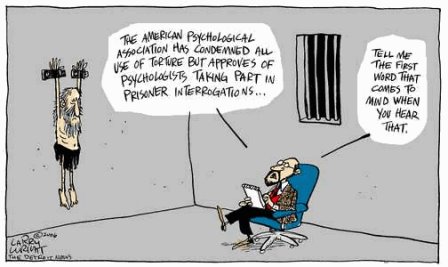 It seems that American psychologists have taken up the US President's habit of bad thinking. That is, we don't toture (but we do). ...According to Stephen Soldz:
Thus, last week’s “victory” at the APA Convention is largely a figleaf used as a PR stunt to blunt criticism of psychologist participation in coercive interrogations. Nothing substantive has changed, so far.Read more!
0
comments
Labels:
torture
Saturday, July 22, 2006
I Will Die More Tragically Than You
The nationalist not only does not disapprove of atrocities committed by his own side, he has a remarkable capacity for not even hearing about them. ~ George OrwellOthers' deaths affect us in many ways. The death of a loved one is naturally more painful than the death of a stranger down the road, on the other side of town, in other countries. You might even use that old cliché of rings created by a rock thrown into a pool to envision this. The rings near where the rock hits the water are the ones we love most and affect us emotionally more than those farther away from the center. ...
Noting that Israel had a right to defend itself, Bush said, "Sometimes it requires tragic situations to help bring clarity in the international community... And it is now clear for all to see that there are terrorist elements who want to destroy our democratic friends and allies, and the world must work to prevent them from doing so." --President Bush to reporters at the White House, July 18, 2006.
There's something true in the idea that we love ourselves more than anything else in the world. I could be unconcerned and indifferent to the death of the world, but it seems absurd to think that I would not care about my own death. The same thoughts and feelings associate themselves with the deaths of those that are of my flesh and bone of my bone.
Yet, there are cases where even the bonds of family and affection break down. Some of the more harrowing stories from history describe circumstances in which famine, plague, war, and so on eat at these bonds like a dissolving acid. Growing up, I read about the Ik, an African tribe whose social and cultural framework had been decimated by colonialism and natural disasters. The Ik were committing social suicide, part of which included starving parents stealing the food from their own children.
The notion of how much an individual loves themselves is immortalized in those terrifying words spoken by the Accuser to God concerning Job:
And the Accuser [Hebrew shatan, which means accuser] answered the LORD, and said, Skin for skin, yea, all that a man hath will he give for his life. But put forth thine hand now, and touch his bone and his flesh, and he will curse thee to thy face.Strike down a person's children, destroy their property and leave them destitute. But touch a person's very skin and they will turn and repudiate all they love and even the sacred itself.
The Accuser's bitter truth that all humans love themselves and their lives more than anything is played out over and over in numerous action movies and cop shows. Many of the plots of these stories involve the threat of violence to get at the guilt of a perpetrator. What does it say about our society that artists play out in innumerable permutations this very sad fact about human life?
The love of self seems inborn to human beings. If there's one thing you can say, it is that humans will always gauge their actions in accord with how others and the world fit into an individual's needs and goals. The Accuser's words are terrible because they show how deeply this self-love goes, even to the destruction of those closest to us as long as we ourselves escape whole and alive.
No doubt, it is something like this understanding of human self-love that informs the various reasonings for torture that the current war on terror has brought to light. Perhaps a more egregious form of rationalizing how much a human will give up facing death comes to light in comments made by Harvard law professor Alan Dershowitz in reference to defining who or what a civilian is in war and how to determine whether some civilians' death are more tragic than others.
Dershowitz writes:
There is a vast difference — both moral and legal — between a 2-year-old who is killed by an enemy rocket and a 30-year-old civilian who has allowed his house to be used to store Katyusha rockets. Both are technically civilians, but the former is far more innocent than the latter. There is also a difference between a civilian who merely favors or even votes for a terrorist group and one who provides financial or other material support for terrorism.Dershowitz places his comments in the context of recent accusations against Israel about a supposed disproportionate response to the extremist Islamic Hezbollah's capture of Israeli soldiers at the Lebanon-Israel border.
Finally, there is a difference between civilians who are held hostage against their will by terrorists who use them as involuntary human shields, and civilians who voluntarily place themselves in harm's way in order to protect terrorists from enemy fire.
These differences and others are conflated within the increasingly meaningless word "civilian" — a word that carried great significance when uniformed armies fought other uniformed armies on battlefields far from civilian population centers. Today this same word equates the truly innocent with guilty accessories to terrorism.
These accusations have come from many sectors--media, government, politics. For example, breaking with what is perceived as the US refusal to engage with Israel in cutting back its invasion's ferocity, British Foreign Office minister Kim Howells said:
"I very much hope that the Americans understand what's happening to Lebanon. The destruction of the infrastructure, the death of so many children and so many people. These have not been surgical strikes.Dershowitz's point, of course, makes much legal sense. In terms of legal analysis, his argument may in fact be the answer. As a matter of law it might even hold sway at one time or another in either domestic or international legal decisions.
"And it's very, very difficult I think to understand the kind of military tactics that have been used.
"You know, if they're chasing Hezbollah, then go for Hezbollah. You don't go for the entire Lebanese nation."
One could note, however, that just because it is a matter of law does not make it moral or just. Laws have often made such distinctions as Dershowitz makes--laws that eventually were found immoral. South Africa, for example, passed laws that discriminated between different categories of humans and, depending on whether they were black, white, or colored, had distinctly different penalties applied for the same crime.
My counter-example is not analogous to Dershowtiz's but more analogous examples could be found. But these examples will not be found unless there is something more important discovered. The important factor that is missing from Dershowitz's ruminations brings me back to suffering Job.
What many tend to forget when they read or re-read Job is that it is not a book trying to "justify the ways of God to man." It is, rather, more about Job and how he reacts to his suffering. As I have noted, the assumption among many is essentially in agreement with the Accuser; that is, if you attack a person so it hurts and threatens their very existence they will give up everything and everyone, even to the extinction of their own humanity.
But Job does not do this. Instead, Job's suffering brings out in him a growing awareness not only of his suffering but the suffering of those others who are invisibly persecuted among us. Job, the rich, religiously righteous man, comes to see and identify with those whom he used to believe were suffering because they had somehow sinned against God. Yet Job--sinless Job--himself suffers. Seeing that it is not because the poor and dispossessed sinned but because of the injustice of others, Job realizes that he and they are indeed one.
Men move boundary stones;This change of consciousness, the realization that in his power he had blinded himself to the suffering of others is brought about in Job through his suffering. In realizing that suffering levels one to equality with all others--that in suffering we are one, Job can begin to understand a justice that transcends self-interest and self-love. He begins to see that only through maintaining an existence that does not separate from suffering but maintains the link to suffering can he begin to act justly.
they pasture flocks they have stolen.
They drive away the orphan's donkey
and take the widow's ox in pledge.
They thrust the needy from the path
and force all the poor of the land into hiding.
Like wild donkeys in the desert,
the poor go about their labor of foraging food;
the wasteland provides food for their children.
They gather fodder in the fields
and glean in the vineyards of the wicked.
Lacking clothes, they spend the night naked;
they have nothing to cover themselves in the cold.
They are drenched by mountain rains
and hug the rocks for lack of shelter.
The fatherless child is snatched from the breast;
the infant of the poor is seized for a debt.
Lacking clothes, they go about naked;
they carry the sheaves, but still go hungry.
They crush olives among the terraces*;
they tread the winepresses, yet suffer thirst.
The groans of the dying rise from the city,
and the souls of the wounded cry out for help.
But God charges no one with wrongdoing. {Job 2-12)
Dershowitz's argument--though set in terms of legalistic spectacle--ultimately fails to appreciate the depth of suffering of others. In trying to characterize the sufferings of others, he attempts to carve out categories of suffering that will eventually denude people of their pain. Ultimately, these distinctions would begin to benefit those in power to justify the indiscriminate killings of innocents simply because they fall into categories that Dershowitz hopes to brand as less tragic than others.
The vision of Job, however, refuses to level suffering to categories. For Job, all sufferers suffer equally, no matter their circumstances. Whether they learn from that suffering is no matter for others to determine. Less so is it any person's part to pass judgment on the ultimate justice of their individual projects and enterprises. Acting in full justification for what we feel and believe is just, the final judgment on that is reserved for a much larger vision and horizon than a mere human or even collection of humans can ever hope to attain.
---------------
In The Portrait of the Artist as a Young Man, the author James Joyce's alter ego has a discussion about the use of the word tragedy used by newspapers to describe the deaths of people. Joyce makes the rather pedantic argument that though someone's being run over by a horse and carriage is regrettable, it is not tragic. That concept is related to specifically aesthetic categories used in drama and theater. The death of Oedipus is in no one comparable to the death of someone in everyday life.
Without subscribing to Joyce's pedantic brilliance, I think his comments apply to times when lawyers like Dershowitz rhetorically use the term to describe the deaths of civilians killed in war. The category of tragedy is not the right one to use n this context; the categories are justice and injustice. And to conflate the two categories merely shows the confusion that Mr. Dershowitz has in determining an appropriate way to think and act in the present world of "asymmetric warfare."
Update 1 According to Nicholas Blanford ( via War & Piece):
A UNIFIL officer said that the Israelis had told them they would not hinder cars travelling north on main roads. But the overwhelming evidence Sunday suggested that cars were being attacked regardless of their occupants and direction of travel.
"They have been hitting civilian cars all over the place," said Peter Bouckart of Human Rights Watch, who had just returned to Beirut from Tyre. "I have been in many war zones, but this is one of the most dangerous places I have seen.
Update 2 Lenin's Tomb writes:
But this is the lingua franca of the 'war on terror'. One is used to such guardhouse lawyering over the use of torture, over the destruction of marketplaces in Baghdad, over the use of death squads and so on and on. This is the cheap alchemy of capital, whose norms are ductile, glittering generalities, frequently to be melted down and refashioned. Capitalist morality valorises the ruling class's interests while endlessly condescending to, ridiculing, demonising and anathematising opposing interests - and capital pays a class of entertainers and scribes and polemicists and, yes, lawyers to obscure this, to persuade you that you have something to gain in this, that you have a vital stake in the arms industry, in keeping the fuel-deathlock economy running exactly as it is, in abandoning your right to a decent pension and paying instead for renewed nuclear weapons while working yourself to an early grave. Your are to be persuaded that British ruling class interests in the Middle East are 'our' interests. This class has a keen sense of audience: radio shock-jocks raise hysterical alarums about "the Muslim threat" (which is to do with im'grants n stuff), while liberal columnists expatiate about womens' rights, free speech (and "the Muslim threat" thereto).Update 3In Haaretz, Ze'ev Maoz writes:
In the war on terror, capital takes the leap of openly trying to redefine what is human and what is not, openly trying to resuscitate racist discourse. It resolves its crisis of profitability by slashing the wage bill and plundering resources, and binds you libidinally to this process by reminding you that your family will never be safe until we tame the Middle East with its cartoon collection of mad religious fanatics, Oriental dictators and rising brown tides. In this, Israel plays its part as it always has: from Iran to Nicaragua, from Afghanistan to the Maghreb, Israel is richly rewarded for being the global adjuvant to imperialist power, a role its founders sought for it since day one. By pounding Lebanon, it does what the US is temporarily restrained from doing, fighting a proxy war against Iran and Syria, two states in the Middle East not amenable to US bribery or sanctions. And the moral code for this rampage is: Never Makes Excuses for Terrorism; Israel Has a Right to Defend Itself; White Kids are More Human Than Brown Kids.
There's practically a holy consensus right now that the war in the North is a just war and that morality is on our side. The bitter truth must be said: this holy consensus is based on short-range selective memory, an introverted worldview, and double standards.It is now for someone on the Moslem side to admit something like this. Until all sides recognize their guilt, all the diplomacy in the world will not work.
This war is not a just war. Israel is using excessive force without distinguishing between civilian population and enemy, whose sole purpose is extortion. That is not to say that morality and justice are on Hezbollah?s side. Most certainly not. But the fact that Hezbollah ?started it? when it kidnapped soldiers from across an international border does not even begin to tilt the scales of justice toward our side.
Update 4 Via Mojo Blog, Prime Minister Fuad Siniora’s questions about the justice of the Israeli invasion of Lebanon:
"what future other than one of fear, frustration, financial ruin and fanaticism can stem from the rubble? ... Is the value of human life less in Lebanon than that of citizens elsewhere? Are we children of a lesser God? Is an Israeli teardrop worth more than a drop of Lebanese blood? ... Can the international community continue to stand by while such callous retribution by the state of Israel is inflicted upon us? ... Is this what is called legitimate self-defence?"Update 5 (via Juan Cole) Mitch Prothero Wties at Salon:
Throughout this now 16-day-old war, Israeli planes high above civilian areas make decisions on what to bomb. They send huge bombs capable of killing things for hundreds of meters around those targets to destroy them, and then blame the inevitable civilian deaths -- the Lebanese government says 600 civilians have been killed so far -- on "terrorists" who callously use the civilian infrastructure for protection.
But this claim is almost always false. My own reporting and that of other journalists reveals that in fact Hezbollah fighters -- as opposed to the much more numerous Hezbollah political members, and the vastly more numerous Hezbollah sympathizers -- avoid civilians like the plague. Much smarter and better trained than the PLO and Hamas fighters, they know that if they mingle with civilians, they will sooner or later be betrayed by collaborators -- as so many Palestinian militants have been.
Update 5 Jerusalem Post reports:
The man who wrote the IDF code of ethics, Professor Asa Kasher, has indicated that in the current circumstances in southern Lebanon, provided the appropriate precautions are taken, it may be "morally justified" to obliterate areas with high concentrations of terrorists, even if civilian casualties result.
"I don't know what the truth is about the circumstances," Kasher stressed. "But assuming that we warned the civilians and gave them enough time to leave, and that the civilians who remained chose, themselves, not to leave, then there is no reason to jeopardize the lives of the troops," he told The Jerusalem Post on Thursday.
Update 6 According to Mojo today:
See also the New York Times yesterday, in which Israel's Justice Minister, Haim Ramon, announced that "all those now in south Lebanon are terrorists who are in some way related to Hezbollah." "In some way related"? Hezbollah, of course, is more than a militia, and employs some 250,000 Lebanese in various capacities, including schools, grocery stores, and orphanages.Update 7 CounterPunch reports:
A booklet published in 1973 by the Central Region Command of the Israeli army subscribes to this same doctrine. In it, the Command's Chief Chaplain writes:Related Links
"When our forces come across civilians during a war or in hot pursuit or in a raid, so long as there is no certainty that those civilians are incapable of harming our forces, then according to the Halakhah they may and even should be killed Under no circumstances should an Arab be trusted, even if he makes an impression of being civilized In war, when our forces storm the enemy, they are allowed and even enjoined by the Halakhah to kill even good civilians, that is, civilians who are ostensibly good. [7]
- Bush, Blair Urge Multinational Force
- Israel, Hezbollah Militia Clash Along Border
- Froomkin on Bush's Lighter Side
- Condi's War
- Condi's War
- Cease-Fire Now
- In Shelter of Hospital, No Refuge
- Analysis: Chance for U.S. to Broaden the Stakes
- Remember Amalek: What the Bible says about fighting terrorism
- A lethal non sequitur
- Rice Seeks 'Durable Solution' to Conflict
- Iran -- Instigator or Bystander?
- Air Power Won't Do It
- It's Disproportionate. . .
- . . . No, It's Survival
- Letting Lebanon Burn
- Desolation won't bring any peace
- Torn to Shreds
- Backstage at the Crisis
- ‘Horrible Beyond Words’
- Alan Dershowitz uses holocaust logic to defend Israel from war crimes charges
- Civilian Toll Mounts in Lebanon
0
comments
Labels:
iran-war,
religion,
torture,
xtianity

 Posts
Posts