News+and+politics religion philosophy the cynic librarian: nihilist-politics
Showing posts with label nihilist-politics. Show all posts

Sunday, September 16, 2007

Excursus: Original Sin and Politics

In response to the following comments by Dr. Sinthome@Larval Subjects,

All of this, of course, is a variant of the theory of original sin. There are certainly secular and theological variants of such a position. Social conservatives will often remind us that man fell as a result of pesky woman (personally I like it when women try to get me to do things I’m not supposed to do, but that’s me), and that for this reason it is sheer arrogance or pride (sin of sins!) to imagine that we could improve this world. Tend your garden, be devout, and wait for the next. Secular variants might make some appeal to human nature or innate biology as that which renders us intrinsically inimical to such arrangements. Nevermind what ethnography might show about alternative economies and social arrangements. “Nonsense!” screams the self-assured biosociologist. Of course, those bio- psychologists and sociologists never bother much with ethnography or anthropology– After all, humans are biologically identical regardless of when and where they live, demonstrating that human nature is the same in all possible universes.

The rhetorical dimension of these arguments are clear enough. By appealing to a fundamentally flawed nature, we bar any attempt to transform society a priori. All social transformation is necessarily doomed to failure and horror because humans are necessarily flawed and horrible. Often I’m inclined to agree. Between what I’ve heard from my patients– you do learn a thing or two about people in analysis –and what I’ve observed, we’re a pretty vile lot. Nonetheless, I am not convinced by claims that such social transformations are doomed to horror. I do, however, find myself wondering whether psychoanalytic political theory does not end up unwittingly repeating this narrative of human nature. Is not the psychoanalyst saying precisely the same thing when he claims that there’s an irreducible real, that there’s always the swerve of drive, that we’re always duped by the unconscious? As a result, is not psychoanalysis an inherently conservative ideology? The question isn’t rhetorical.
I wrote: As to your comments on original sin, drive, and the political: a Kierkegaardian religious understanding of this would suggest that you can’t have a free and just society until there’s equality. Given sinfulness, though, and human finitude, that is impossible. Only God has the ability to see each in an equal way, without socio-cultural accretions occluding one’s view.

On the other hand, through an awareness and continuing awareness of sinfulness and the attempt to stay on guard vis a vis that sinfulness, one can begin to follow the commandment to love neighbor and enemy. This only occurs, of course, when one realizes that given other circumstances and contingencies I would or could indeed be in the same situation as that other. Yet, it’s only with an awareness of something that provides a transcendent horizon, where nothing is ever final and ultimate in this life except death that I can find the motivation to realize the ethical and moral imperatives of that awareness.

Death is the horizon within which all things in some way gain a proper perspective. Kierkegaard doesn’t so much see death as a drive, as he does as a shirking of responsibility in one regard, an easy way out in another. This lines up with one aspect of despair, but only the passive despair that despairs of ever being oneself. Because we can’t be who we are, especially who we think we should be, then we want to die.

Westphal in his book on God, Guilt and Death, marshals Freud and Kierkegaard, throwing in Heidegger to boot, to examine the relationship between the transcendent desire to be who I am–eg, a good person, a fulfilled person–and the facing of death. In face of that, there’s a form of resentment that forms and humans begin to take out their resentment on themselves and others. Using this framework, Westphal analyzes Freud’s atheism in terms of his father’s sheepish responses to antisemitism.

Westphal has noted in another work that Kierkegaard’s political attitude begins from within the notion that all is questionable and nothing is absolute. He calls it Religiousness C, which is a form of ideology critique that takes to task any ideology that might set itself up as absolute and beyond question. At the same time, the motivation behind such critique is the awareness of sinfulness and that this brings with it an identification with the persecuted other.

Others have taken the Kierkegaardian insights in secular directions: early Marcuse, Heidegger, Sartre, Habermas, and Matustik. Most demythologize sinfulness and replace it with supposed secularized cognates. Matustik is the most consistent and most Kierkegaardian.

In her analysis of how Heidegger (mis)appropriated Kierkegaard, Patricia Huntington notes that Heidegger de-ethicizes Kierkegaard’s category of authenticity. He turns it into an ontological category, eschewing the ontic, and by doing so identifies the authentic self with an ethical substrate borne by culture and social institutions, as well as wayward ontologies. In doing this, Huntington, argues, Heidegger abstracts authentic being and thereby identifies coming to know myself as who i truly am with fate. In this regard, only some are born to be great and true selves, while others are minions of the great They.

Kierkegaard does not ontologize authenticity in this way, aware as he is that sinfulness is an individual event of personal history. The task of regaining a true self is never identified with that realm of historical sin which he recognizes as original sin and which, it seems, Heidegger inappropriately identified as a form of necessary historical unfolding.

I would suggest that the Xtian Right makes the same category mistake that Heidegger did. That is, they ontologize original sin, thereby making the problem of modernity a problem of ethos. Therefore, you want to change what’s wrong with America or the world, you must change the ethos. They do not follow, obviously, Heidegger’s route of destruktion, but instead do so via various strands of natural theology, whether Thomistic or Calvinist/Lutheran.

--------------------------------------------------

Unlike thinkers before or after him, Kierkegaard understood the compelling nature of thinking through problems about what it means to be a human being. He also understood the passion that is faith and how it can bring peace and understanding in a world where all values and traditions have become empty.

For Kierkegaard, sinfulness is a state in which we are prone or motivated to sin. This state psychological in the sense that sinfulness occurs when we relate ourselves to others and the world through thoughts, desires, and behavior. The way we desire something determines how we think about others and what we do in the world to accomplish those things that will bring us happiness.

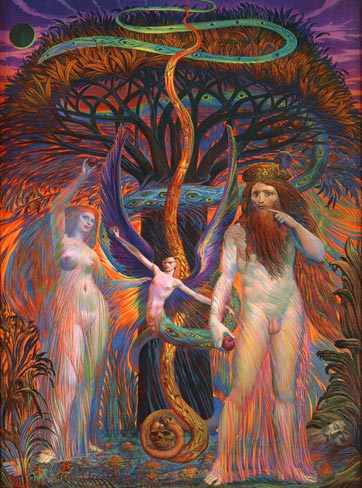
In Christian theology, the main source of human unhappiness is original sin. According to this way of thinking, the reason we can't be happy is because we are prone to sin; this means that we ultimately short-circuit all those things that might bring us happiness. Supposedly, this goes back to the original man, Adam, and his mate Eve. When they ate of the tree of knowledge of Good and Evil, which God said not to do, they sinned and were kicked out of Eden, or Paradise.

It is this original sin that some theologians say stains our personalities from birth. We are born in original sin. We are genetically engineered, so to speak, to sin, according to this view. There's some type of psycho-genetic disposition hardwired into us to do evil.

Kierkegaard disagrees with this theological understanding of sin. The origins of sin begin and end with each person. We are not hardwired to do evil. We are, though, born into a world of sin. This is the result of sins by people that have accumulated over time and in history.

For Kierkegaard, the springboard for individual sin occurs when people are afraid to face and oppose this world of sin. The world as we know it conditions who we are. While genetics plays a large part in who we are, so does the influence of society, culture, family and so on. But there is something built into the human spirit that can see the deception and hypocrisy, the evil in the world. This is what Kierkegaard calls the Nothing.

The Nothing is where we see our freedom to be who we are. It is the "possibility of possibility." We see an infinite world of possibility and we are dizzied by the things we see and could be. The world, ourselves, and those around us change and become either larger or smaller in comparison to this great world that could either be or not be. That it will be--for us at least--depends on our letting it be in one way or another.

In crises such as adolescence and other significant stages in personal growth, we realize that we have the freedom to either accept or refuse to accept society's rules and customs. We are not predetermined in the whole-sale way that some scientists might say we are. We are not simply biological cyborgs with "wet computers" as brains.

We have the natural capacity to form a distance from our environments and societies. We do not need to be what society or family or friends say we have to be. Indeed, we can to a very large extent shape and mold the very material conditions that life has thrown our way. Biology and genetics are materials to be used in fashioning a self that exhibits independence and joy.

But there is an inherent anxiety that accompanies this process. It's a risky endeavor fashioning a self from nothing. It takes courage and hard work. It takes standing up to people whom you love and respect and perhaps telling them that their way of looking at the world is either not your way or perhaps even wrong.

This creates anxiety, because people find support and safety in the rules and restrictions imposed by their societies. But by not thinking about whether these rules and customs are right or wrong, I simply join the crowd like everyone else. I do not form any relationship to the world except one that everyone else agrees with. They are not mine. Potentially I can wander aimlessly through life, never facing life's problems honestly and authentically. Life's problem is no problem as I let what others think provide the answers.

For Kierkegaard, this is an abuse of the freedom we have to choose responsibly. This type of choice is important, because if I don't do this then I am not acting ethically; I am not using the freedom to be who I am responsibly. In doing this, I also cannot be the type of human being who knows what it means to live as an individual. I only know how to live in a crowd. But crowds are notoriously amoral entities.

An ethical and moral environment is one wherein people associate with each other as individuals. For it is only as individuals who have understood themselves separately from the sinful world that they can come together to address the injustices created by that sinfulness.

The demonic arises when you reject the freedom to act in a free and responsible way, ethically, to the situations that life throws your way. The freedom to choose makes you anxious because there are no textbook answers to the way that you should respond to events. There's no recipe book on how to act ethically. If you have not cultivated the individual awareness that not only are you motivated at times by self-deceit and unconscious desires and motives, you will take the easy way out and run away from the problem.

This outlandish, if not absurd, claim comes in Kierkegaard's book on original sin, sinfulness, and the demonic. The work is a psychological look at how people gain an awareness of themselves as individuals. In doing so, they must face their freedom to be who and what they are.

As I have argued (following Kierkegaard) a main form of despair is the person who is aware they have an eternal side to them but who want to reject it and instead make something out of themselves that spites God. This person is in defiance against God because they are not happy with their place in life or with their

The reason that many who make the argument for the President's courage and going against public opinion sometimes invoke Kierkegaard's name is because he seems to assert something of the same kind. That is, the individual, one who really believes in what they are doing because they know it is right and true, will do everything in their power to accomplish that. Yet, as Kierkegaard noted, it is only within the confines of religious belief and the relationship that someone has with God that this view makes sense.

Following what either others tell you to do or giving in to self-deceit. The Christian way of life, according to Kierkegaard, is to recognize this sinful disposition and to inculcate a way of encountering the world that is ethical because responsible. Responsible because self-critical, self-critical because I have identified the freedom that comes from critical awareness of the socio-cultural norms that breed injustices and inequality.

Back to Index Read more!

Friday, September 14, 2007

Texas George Rex Judas (4c)

I ended the preceding section on the idea that humans do not act in a vacuum; that all human actions and self-understandings are done in terms of social conventions and structures that have determined us from the time we come from the womb. The Great Man theory, however--one supported by Pres. Bush and his followers--supposes that we do indeed act as separate entities, as though our individualness is somehow isolatable from a socio-cultural environment.

I have argued that not only is this impossible but that it is dishonest and can lead in some instances to a form anti-ethical action that Kierkegaard describes as "demonic." The problem with most theories of individualism is that they isolate some essence that seems to be private and independent of others. Kierkegaard is sometimes interpreted this way, as I noted above. But what Kierkegaard discusses is not an isolated individual essence but rather a psychological state that critically assesses the values and customs of any socio-cultural matrix.

There is nothing like a soul or ineffable substance that does this. Instead, we as psycho-biological entities develop the capacity to critically understand our environments in a way that shows both inter-dependence and independence. As this shows, my own independence comes from interdependence just as my interdependence relies on my independence.

The soul is one aspect of the duality that we as bodied entities are. When I formulate who I am in terms of possibility and necessity, imagination and genetics, I take an attitude towards these two poles of my (past and future) history. This way of seeing or understanding the world is a third element whose nature is neither body nor soul. Its existence exists to evaluate how the two other elements interact and how one balances them. It does so by way of various actions and linguistic formulations that bring cognitive awareness as much as they do behavioral alignment. That is, through a process of formulating in words what it is I want to be and how I will accomplish that, I undertake to do what it is that I have formulated linguistically.

This way of putting the situation is obviously inadequate. It only gives a simplistic skeletal description of the way that we as humans act and think. Yet it points up several important dimensions for understanding what the nature of the Bush "revolution" is about. That is, these considerations show that like Genet and others, Bush et al. attempt to define their missions and actions in terms of isolated entities whose overall perspective is destructive of community.

This is so, because individuals are not isolated in this way, and when they act as though they are, they become ghosts and wraiths of real selves. Consequently, any society built around such actions and understandings will eat at the very foundations of any viable community.

Kierkegaard tries to outline a mode of facing life with courage and self-knowledge that short-circuits the this demonic way of seeing or understanding life means. As I noted in the previous section, one way of denying one's responsibility that Kierkegaard was keen on combating is to put the onus of responsible choice onto history.

This means that I say that I had no choice, that history and circumstances forced me to do such and such. This type of rationalization will go so far as to say that the choices I make are somehow substantiated by history to be; that history will somehow bear me out, that I will be vindicated by historical events.

In this context, Kierkegaard pointed to the politician who appeals to history to defend his or her decision. Kierkegaard writes:

When a headstrong person is battling with his contemporaries and endures it all but also shouts, "posterity, history will surely make manifest that Is poke the truth, then people believe that he is inspired. Alas, no, he just a bit smarter than the utterly obtuse people. he does not choose money and the prettiest girl or the like; he chooses world-historical importance--yes, he knows very well what he is choosing. But in relation to God and the ethical, he is a deceitful lover; he is also one of those for whom Judas became a guide (Acts 1:16)--he, too, is selling his relationship with God, though not for money. And although he perhaps reforms an entire age through his zeal and teaching, he confounds pro virili [to the very extent of his powers], because his own form of existence is not adequate to his teaching, because by excepting himself he establishes a teleology that renders existence meaningless. (Kierkegaard, Postscript, trns. Hong, pp 136-137)
It is this notion that one is only responsible to some abstraction like "history" that displays Bush's ultimate Judas self-perception. The impending chaos and meaninglessness of human life implied in such statements and view have become apparent, I think, in the destruction and human suffering currently visited upon Iraq by this man's actions. But these considerations--in the light of Kierkegaard's comment call for further analysis, which I take up in the next section.

Back to Index Read more!

Tuesday, September 11, 2007

Texas George Rex Judas (Table of Contents)

This provides a serialized listing of the posts on Texas George Rex Youda.

Index of Postings on Texas George Rex Judas

These postings explore not only the phenomenon that is George Bush the man but also the state of mind of those who might identify with him and his theocratic agenda. While the postings are heavy in irony and humor, they do so from a viewpoint that strives to invest malaise with significance, chaos with a structure that does not violate its integrity.

There's a lot of Kierkegaardian background to this analysis. I have tried to keep the jargon to a minimum. Yet, the background noise of so much of modern life requires a reworking and attunnement to things that one might otherwise miss. Kierkegaard is a good dissolvent for what I once heard someone call "cognitive dissonance."

Just as a side-note: It's interesting how a person can become a phenomenon. Bush as a person is probably a minuscule thing. As President, he becomes an amorphous thing that can be pulled and tugged into all kinds of silly-putty configurations (consider 1 and 2). For example, at Pat Lang's blog, I gave the following analysis:
One of my favorite scenes in Lawrence of Arabia is when the commanding field surgeon enters the Damascus "hospital" housing dead and dying Turks. The conditions are so horrendous he berates 'awrence, shouting at him "Outrageous! Outrageous." Then the nurses and others move in to clean up the crap and mess left by 'awrence's nostalgic trip to being Alexander.

I just wish Petraeus and others (perhaps even a Senator or 2) would act in this way towards the crap-house Bush has created in Iraq. While I admire a guy like Petraeus who's willing to clean out the latrines as part of his duty, I am hoping that at the same time he's pointing out to Der Deciderer what a real f*-up he is.

Following on the attempt to psychoanalyze Bush in a previous post, I'd note that Narcissism from a Freudian analysis occurs at the same time as potty training. The Narcissist is pathologically fascinated by his/her own bodily functions and by-products. In a strange way, they see it as somehow themselves. (Need I mention the rumored predilection of Bush for flatulence jokes?)

One wonders how much Mama Bush changed baby Bush's nappies. As he went along in life Der Deciderer could certainly count on Mama and Papa Bush to clean up his messes. Then he met up with Rove, another person willing to clean up the mess--or at least smear it in ways that made Der Deciderer look like he was a prom queen and not Carrie.

Anyway, part of the message to Bush and others are things that Petraeus and Gates have left out of their quantitative analysis of Res-Iraq: over 2 million refugees; the lie that is falling body count; the ethnic cleansing.

And yes, the fact that nature indeed does hate a vacuum, and the vacuum of Iraq is sucking in all the ill-winds that the modern nation-state and colonialism tried to bottle up.
And who's the REAL Bush? That is indeed the question. Why it matters should really only be of importance to himself. That it concerns all of us at this time is unfortunate. As I say, the meat of these postings is not so much an attempt to get at the real George Bush as it is to identify a state of mind that afflicts many more than Bush himself. The scary thought, of course, is that might not be a REAL George Bush.

Update: I Cite points to an article at truthout that captures the tenor of the betrayal discussed in this series of posts. While the writer seems shaken by an impending sense of catastrophe, I think that he's on to something that must be stated much more clearly I suggest below that what has taken place is a betrayal of the very principles that make community possible. This can be seen as a form of soft fascism, as Richard Sennett sees it; but it is something more fundamental at work, something that ranges from seemingly innocuous things like more mistrust among people towards strangers to a cynical manipulation of public perception via distorted news stories about what's really happening.

William Rivers Pitt writes:
The joke: people say Bush and his people want to raze the core nature of the country itself by wrecking the Constitution, and they're correct. People say Bush and his people are enriching their friends beyond dreams of avarice at our actual expense, by way of war-inflated oil prices; war-captured Iraqi oil infrastructure; the orgiastic plunder of Treasury money through calamitously unsound tax cuts for Bush's pals; and through an Iraq war profiteering scam so unutterably corrupt that it bends the very light. That, and more besides, is what people say, and they're correct.

But all that, along with everything else the Bush crew has done, just isn't enough for them. What Bush and his people really seek, at bottom, is to destroy the basic definition and literal existence of reality itself. They want to destroy reality, rebuild it according to their own blueprint, so the sum and substance of this new reality will accept as axiomatic the idea that lying, stealing and wholesale carnage are badges of integrity and moral clarity. In other words, our comprehensively understood reality today would be replaced by whatever madcap anti-reality currently exists within the walls of 1600 Pennsylvania Avenue.
JDean at I Cite adds her very academic and perhaps over-intellectualized take on what Pitt is talking about. I try to take a more pragmatic approach, using concepts and language that still hold meaning for people, though that meaning itself may be indefinable. By providing ana analysis using this mythology one can perhaps gain an insight into phenomea that are profpund just because they are so obvious. Obvious and yet insidious because they threaten unravel a social fabric and pit people against each other in fratricidal warfare.

Update: (via Born @ the Crest of the Empire) -- From AP
Just over half of the white evangelicals who attend church at least weekly said the war was the right decision and the extra troops were helping, while about four in 10 said the war is a success — well more than Catholics and Protestants measured in the survey.

Slight majorities of conservatives saw success in Iraq, a troop increase that is working and a war that was the right choice, a third of them or more answered each question negatively.


Related Links Read more!

Monday, April 16, 2007

The Politics of Rampage: Virginia Tech

As I write this, very little is known about the mass school killings at Virginia Tech University. The media, of course, are playing the numbers game and calling it the worst rampage on a campus in history.

One fact that might be germane is that the killings fall within a few days of the anniversary for the Columbine School massacre. Few news commentators are yet making that connection, and maybe it will not hold up and be simply coincidental.

In something of a conspiratorial manner, I'll reiterate my own suspicions that the events are connected and point you, dear reader, to several postings I made after Columbine and killings on the Red Lake Indian Reservation.

I hold by my contention that these incidents have a political dimension to them that few if any have ever taken seriously. This political aspect is eminently nihilistic and as such its core is the idea that there is no message, there is little intelligible sign that one can follow back to a recognizable "political" message.

This anti-politics itself will grow and spread in the future. While it feeds on adolescent angst and catastrophes, the empty heart of its message is a way to transcribe a sign of pain and rebellion on the iron walls of infinite nothingness.

I could go on to discuss a Habermasian analysis of adolescent socialization and the diremption of lifeworld and system. Some of that comes out in my analysis in "We Can Be Heroes." Yet, I am loathe to proclaim such an easily convertible explanation whose tidiness and neatness misses much of the terror.

There are, perhaps, better readings of these incidents than the one I have provided. One avenue of analysis is along the lines of nihilism, whose essence Heidegger has said, we cannot yet think. Perhaps he's right, perhaps wrong.

As you might guess, I think a Kierkegaardian analysis is apt. In this framework, though, we have to begin to understand original sin in the way he formulated it (contra the traditional theology) as well as his discussion of the nothing and despair.

What makes these discussions political is that they are religious tracts aimed at the political, meant to undermine a political regime wherein the state and the ruling religion support each other in falsifying existence.

Related Postings

Read more!

Tuesday, June 13, 2006

We Can Be Heroes

The following was written many years ago; I offer it as a historical oddity. It's premise is still valid--to my mind--but I'd rework and clarify my definition of the political.

Though nothing
Will keep us together
We could steal time
Just for one day
We can be heroes
For ever and ever
What d'you say

Heroes by David Bowie

Jonesboro, Arkansas. Littleton, Colorado. The pictures of young men strolling school hallways coldly and brutally shooting classmates like targets in a video game makes the blood run cold. The senselessness make the crimes so much more alien. These weren't kids who grew up surrounded by violence and despair--at least the kind we normally associate with killers, people say, as though children who do grow up in such surroundings are somehow allowed to be able to kill.

But the crimes in Colorado, Oregon, Arkansas, Pennsylvania differ from kids killing other kids over drugs, and spring from different causes. These are even more disturbing to contemplate than so-called gang violence, although it seems horrendously callus to think of children killing children as having gradations of terror. The disturbing factor in the school-yard killings is what I will call the political dimension of the crimes. This is a controversial position I hope to maintain in the following paragraphs, as well as the circumstances and repercussions of such a view, if true.

Confession of a Coulda Been Terrorist

I admit that I do not find incomprehensible the actions of the children committing the school yard slayings. I've felt similar anger. I fed on similar scenes of carnage in my adolescence. To say this does not mean I condone what they did--never. But it does mean that I have been in a psychological place and similar circumstances where that kind of violence was a possibility for me. To confess this means I can understand it.

I grew up in a town just north of the Mason-Dixon line surrounded by factories and farmland. I helped my grandparents bring in the hay, wheat and corn every summer. My father worked in an aluminum factory while my mother worked full-time as a hospital admissions clerk.

I spent my pubescence in the throes of the civil rights marches and the anti-Vietnam War protests. For several years, my favorite films were A Clockwork Orange and If. A Clockwork Orange has a perennial aura about it. Its stylized violence and vision of the future, spans generations. My teenage son loves A Clockwork Orange.

I don't think my son's seen IF, less known than Kubrick's classic. In the context of school yard killings, it is a prophetic film. Amazingly so.

IF director Lindsay Anderson's vision of two working class boys living a series of meaningless, desolate acts in an upper class boarding school, echoes the existential nihilism of Sartre and Camus. The emptiness and grainness of the film echo the lack of values that many felt in those days. This is an aspect of the glorious years of the 60s and early 70s that the image of flower power, free love, and peaceful idealism gloss over. There were also those who were drawn down darker paths where emptiness and despair lived.

Anderson's film carries on the British literary tradition of angry young working class males striking out at a society they found empty with hypocritical optimism and the decline of British influence around the world, as reflected in plays and films like Look Back in Anger. Yet, IF is noteworthy for its almost stultifying lack of eloquence. One could watch Richard Burton declaim eloquently John Osborne's words and feel moral outrage and perhaps even sympathy. Yet, Anderson's heroes have no fine moments or climactic scenes raw with emotional power. Emptiness builds on emptiness until the final brutal and bloody scenes, where the two boys lure their schoolmates' parents at graduation ceremonies into a courtyard below and mow them down with machine guns from the rooftops.

My fascination with IF was just that--mesmerized infatuation with the notion of committing a single act that would be unfathomable and seemingly incomprehensible. It would mean nothing except the raw sense of emotion that I felt during that moment of power and liberation. My freedom in that instant would stand as a testament to its power--power beyond words and beyond understanding. The ultimate power, of course, is when we hold the key to a meaning that we believe others cannot reach.

Where's the violence in all this? Well ten years of drug and alcohol abuse, black outs, aimless wandering from job to job, long periods of complete anti-social alienation and seclusion. All this time wracked by sadistic imagery and violent feelings, mainly taken out on myself, but always there below the surface. These experiences make me keenly aware of what these young men must've felt and thought when they entered those schools, ready to kill and be killed.

Beyond Words

President Clinton's words after Jonesboro present a telling testament to today's political discourse. "We don't know now and we may never fully understand what could have driven two youths to deliberately shoot into a crowd of their classmates." The President's words intone a theodicy that only a man whose religion is politics could say. I don't say that disparagingly. I refer to a possible way of understanding religion and politics in the modern world--much as the German philosopher Hegel did.

For the President, the youth of the criminals, as well as the nature of the crimes, questions very deeply held beliefs about human nature and the boundaries that define social cohesion.

These crimes are unthinkable for children. The planning, the premeditation, the predation, all point to a threshold of unthinkability surpassing the cognitive skills or even the moral resources that children are normally expected or understood to possess. Children should not be able to formulate actions that transgress these thresholds. That they could and did formulate these actions is incomprehensible, non-thinkable.

In the President's words, supernatural boundaries are transgressed; boundaries that define a properly functioning and moral society. The president's words are the shadow of a great anxiety. To break the sacred bonds that hold society together threatens to throw us into an abyss of fear and anarchy. His words try to fill in the abyss by ruling out comprehending the boys' actions. That is, by saying the actions are somehow of a supernatural order, we cannot ever hope to lay hold of the reasoning behind their acts, since there was no reasoning.

An important notion in modern America is the idea of a child's natural-born innocence. This innocence, in normal circumstances, should protect them from the possibility of murder. William Golding's novel, Lord of the Flies, depicts human nature in a different light. In Golding's novel, left to their own devices children can and will perform greatly savage acts. Golding's book is perhaps as shocking a revelation to commonly accepted notions about children as was Freud's discovery that children are sexual beings. The socially constructed nature of innocence throws us back onto the seemingly terrible vision of having no basis in reality on which to formulate a positive, irrevocably and eternally transparent, basis for moral behavior.

The problem with Golding's depiction and Freud's, however, is that they appear to say that these are permanent features of human nature. But is there such a thing as human nature? Or do we perform certain acts given certain social, political, economic circumstances? What we should realize is that human nature is not solidified, and while in some circumstances children might act like the ones in Lord of the Flies, in other situations they will act differently. As the poet William Blake was keenly aware of, innocence is often a function of social injustice and status quo.

Political Nihilism

Several months after the rampage at Jonesboro, a strange web site appeared on the Internet. Filled with discussion of cannibalism, serial murders, and anarchist diatribes, the site valorized the perpetrators of the school yard killings as revolutionaries.

Of course, it is easy to dismiss this web site as an expression of simple aberrance. The youthful creators of this web site, however misguided, saw the acts at Jonesboro as politically revolutionary. Why or how could someone look at life this way? Is it the confusion of unbalanced young minds, the joking of demented pranksters?

Political acts often involve groups of individuals exhibiting organized behavior to reach recognizable goals. Terrorism is a political act if it has a political goal such as overthrowing a government. The problem with Jonesboro and Littleton is that there is no identifiable goal. This lack of a clearly defined goal comprises what I call the nihilistic or randomness and emptiness of the actions.

Nihilism as political expression acts in direct opposition to political categories simply by opposing no counter-claims of any kind. Often, the nihilist terrorist makes completely absurd statements. It is the seemingly irrational nature that is the essence of nihilism. The violence ann the irrationality testify to the validity of the action. The violent act itself--in whatever form--is a statement of political belief. Indeed, as Albert Camus showed in The Rebel, the ultimate nihilistic act is to commit an act with no goal and no reason--a defiant bloodstained hand thrown in the teeth of what the rebel perceives as an ultimately unjust existence. Nihilistic opposition to the state is an opposition to the injustice of existence as a whole.

Some of this can be seen in the utter inability of the young men at Jonesboro to defend their actions or even to begin to describe how or why they acted the way they did. The most detailed account of the inner workings of their minds was provided by Klebold at Littleton. His rambling pages espouse everything from contradictory hatreds to some form of personal superiority to other human beings, somewhat akin to Nazi eugenics theories. The nagging question that rises from these pages, however, is still Why?

Postnational Identity

I think there's much to Camus' interpretation of political nihilism. Yet, the cultural milieus of the American teenagers and what they did before they committed these acts shows some commonalties that bring into focus sociological factors that Camus does not discuss. These factors provide the possibility of better understanding these acts on a critical and existential plane.

The key similarity is that the perpetrators of these crimes grew up in communities undergoing a clash between modern technological values and older, more traditional communities. The Littleton teenagers lived in a traditionally agrarian and ranching community that had recently become the suburban homes for Denver. The older boy at Jonesboro had lived in the city for most of his life and had moved to the more traditional community. Classmates reported him as idolizing inner city gang behavior.

The term culture war is not new in American political jargon. Beyond the cant of this term, this clash is best characterized as the clash between Christian-based value system and the more fluid, less clearly defined values of modern technological society. While the former stresses stability and rootedness, the latter recognizes fast-paced change and innovation. Instead of views and opinions passed down from generation to generation, you have every value scrutinized and tested under a microscope.

The clash can be seen in the way women's roles have changed and how this change is greeted in rural America. Traditional America sees women who seek non-traditional life-styles as either transgressing sacredly ordained roles, or seeking special rights that give them a unique social or economic status or political advantage. The animosity directed at women in such enclaves of our society can be strong, bitter, and hidden.

The issue of guns is another example of the conflict between different ways of viewing what is the right way to live one's life. In rural communities guns are seen as a rite of passage. To take away a gun is in a way to take a person's identity from them. For urban dwellers, however, there are no such rites of passage. Guns are simply a symbol of violence used in murders and other crimes.

These examples point up the notion that a vacuum exists in American culture. Children exposed to this vacuum, I am arguing, find it difficult to develop a sense of self that sustains them and provides a solid base upon which to develop a strong sense of who they are. Many children are able to make the transition through this vacuum. Yet, others do not. Those who do not fit in or are marginalized in the way that the Littleton teenagers were or even the older Jonesboro boy show how explosive living in that vacuum can be.

This type of reaction is not new. The reaction against Americanism in Islamic countries exhibits is just as violent. And the religious fundamentalist response is also important to see. What we are seeing in America is a reflection of this type of fundamentalism, but with a characteristically American twist. It has many guises--from the self-styled super-men at Littleton to the wannabe gangsta at Jonesboro. We see a form of life emerging that attempts to create self-awareness from a cultural context lacking stable values while seeking some form of coherence and meaning.

In Postnational Identity, Martin Matustik analyzes the political, cultural and psychological underpinnings of modern-day ethnic strife in Eastern Europe. For Matustik, communism was an ideological system that tried to answer all existential and socio-political questions. Its failure caused immense despair individually, since the beliefs and socio-political structures that developed around the ideology were stripped away and people were left little meaning upon which to base their actions.

Seeking a valid meaning in the face of this ideological collapse, countries and individuals moved away from systems that promised universal solutions, supposedly based on certain scientific principles and facts. Nationalistic and racial mythologies took their place. Personal identity became identified with group identity. But what is someone to do? People need a meaning their acts. For many, the collapse of communism proves how the search for certainty and absolute truths in politics cannot be based on science. Instead, they must be found in a set of values that play on differences between peoples. What sets apart is certain, and what is the same as I--culturally, physically, politically--has a psychological appeal.

Matustik proposes that we develop what he calls "open identities." People exhibiting this form of individuality would not accept any social or political institution as final and absolute, realizing, however, the need for socially responsible action. This type of individual would always remain open to the possibility that any previously accepted values are open to critique and change. On the social level this means multiculturalism and democratic socialism.

On the personal identity level, it means non-dogmatic, existentialist attitudes that confront life as a continuing and open possibility for change and redefinition. Such attitudes would enable individuals to accept difference in others, while maintaining a sense of self that did not disintegrate in the face of challenges to accepted norms from various cultural, scientific, and interpersonal encounters. The emphasis is on continued ethical responsibility to the Other--"naked openness of the face to the nakedness of the other."

For Matustik, the political and individual aspects are imperative. One must live an open society that is willing to challenge previous beliefs based on new evidence and democratic debate. But to stabilize this social form, one must have individuals who withstand an ever-changing challenge to personal self-perception. For Matustik, this means accepting the existentialist notion that identity has no pre-given basis in objectivity, but is a continuous exercise of will in the face of ever-new possibilities for meaning and self-awareness.

On the Brink

America has seen the advent of modern nihilistic terrorism not only in its schools. Self-styled militias and white supremacists, acting alone, have committed terrible acts to undermine the legitimacy of the ruling powers. The narrative that underlies the motivation for these acts presents an image of identity that stresses sameness and group solidarity. The political nihilistic response is even less well defined, taking its imagery and motivation from urban culture to video games to so-called goth life-styles to Nazi romanticism.

What these phenomena share is their response to a cultural schism in America wherein traditional values are undermined by rational debate and technological regimentation. The human animal seeks meaning in the face of the failure of traditional values. When these are not found, the potential violence is great. We must foster institutions and personal life-styles that remain open to change and difference among individuals. Without this, we will see continued violence and the eventual destruction of democratic values by fascist/nihilist factions.
Read more!

Monday, December 19, 2005

"When I'm God, everyone dies"

Two California teenagers were arrested before they were able to carry out a massacre of their schoolmates and then commit suicide. Reminiscent of the Columbine atrocity, wherein a dozen students were killed, these California students hoped to copy the Columbine killers whom they idolized....

When asked to explain why, the students told police:

The boys told investigators that they planned to kill Quartz Hill students who had made fun of them, using guns and homemade explosives, then commit suicide, Brown said.

On Friday, deputies at the sheriff's station in Lancaster displayed a page from the 15-year-old's notebook with the scrawled message: "When I'm God, everyone dies."
I have written about this type of teenage angst in a lengthy essay. I'm not satisfied with the various psychological and sociological explanations privded so far for why students kill other students.

Is it society that creates such dark and secret spaces where kids like this can hide and lose themselves? Is our society so narcissistic that it repels anyone else who's different so much that they react violently to a scoiety that rejects them as much as they reject it?

After a student on the Red Lake Reservation killed himself and 10 others, I wrote the following poem:
I am not you
I am not him
or her or them
I am I
I am not
what you think

I see worlds where pain's joy
I track blood like a zombie
I am the pain I feel
and the pain I am is you

a word with no sound
empty and void
no word
to say who or what I am
no word to say what I did

tears and blood and
wordless tornado
that tunnels in dust
and repels the sun

this story that's me
the key
that I am
unlocks nothing
but a voiceless yell
that fills the red air

I go nowhere now
and take you with me
my pain my fear my joy

I do not want this pain alone
we can share
there where I am not
where you are not
we are not
------------------------------------------------
I cannot go
I will not
I am not what I am

I do not want this body
I do not want you
I do not want me
I do not want I
Read more!

Sunday, September 11, 2005

Texas George Rex Judas (2b)

The modern world and its many crises that I mentioned in the last post has attracted the attention of many thinkers, past and present. For Kierkegaard, with these crises should come the realization that I have a freedom to be different from what these my social, family and cultural environment are trying to make out of me. I can be something different from what I was born into and what my environment is telling me to do/be. From within the midst of these crises, I can begin to see what Kierkegaard calls the eternal--the possibility to become an individual who takes responsibility for his or her actions in an ethical way.

I will explain what Kierkegaard calls "distance" in the next section. For now, it might help to see that it is an inward relationship (Kierkegaard calls it "inwardness") to the world that I form in various attitudes and emotional and psychological motives towards the world. Contrary to the connotation of the word :inward", this is not a drawing away from the world, but rather a realization that how I think and believe determines how I act toward and in the world.

It is this distance from my environment that create a psychic space in which I can inhabit the values and morals that my society wants me to accept. Unlike others who might unquestioningly accept what their society says to do, say, or think, I can accept those things but consciously and with full understanding of why I do so. More importantly, because I have critically understood what the values mean, I can understand how best to accomplish them in a real, honest, and authentic way.

Important to becoming a real person is knowing what historical forces have shaped me into what or who I am. Those things that are never apparent but must be questioned to be understood. If I do not question them, then I am at their mercy and potentially can act in ways that are irresponsible since I never had the courage to look their truth in the eye. While we can never attain total self-transparency--which is the origin of what psychologists, philosophers and religionists call guilt--I must attempt to understand these forces at work from the world and via unconscious and semi-conscious drives.

My history, therefore, includes not just natural and socio-cultural events, but also those acts that I enact. If I choose to run away from the truth of my history--whether personal or socio-cultural--then I run the risk of becoming demonic, in Kierkegaard's way of looking at things. The demonic hates the truth,as much as it hates what is good. And truth for individuals involves being conscious of those things that influence us in our actions and make us culpable or not--not just in the eyes of the courts but in the eyes of our own consciences.

While one might not believe in an afterlife, you could believe that you must do and say what is right simply because it is the right thing to do. But also because you must be aware that you are not only responsible for what you do in a selfish way but that your my actions affect and impact others now and in the future. If I act irresponsibly, without consideration of how my acts will affect others, I will act unethically. But acting ethically entails understanding that my actions and how I do them have repercussions far beyond their immediate effect for me, my family, or even my nation.

For Kierkegaard, not only is the eternal involved with the idea of possibility, it is also about the future. In a religious sense, this implies an after-life. But religiously or not, the future is where I project where I will or can change based on an assessment of my past behavior. The future is always open as an ethical span within which I can act in a way that engenders more and more sincerity and honesty with myself and towards others. The future is where I will enact what conscience demands in terms of living a life geared to doing what is right.

For Kierkegaard, then, we must live in the present because it affects how I will act in the future. A person without any possibility or notion of the future, as possibility, will be acting not only unethically but also sinfully. We must inhabit time in all dimensions in order to attain that for which I exist. Shirking one dimension, or remaining unconscious of the ethical and spiritual demands of a being who finds meaning in time, is demonic.

Pres. Bush's statement about death and his apparent concern with either a final reckoning in an after-life or, at a minimum, of how his present actions will affect the future of others mirror in a very real way the descriptions of the demonic as Kierkegaard lays them out.

It is from this final perspective that Kierkegaard's understanding of original sin begins to come into play for understanding Pres. Bush's demonic personality.

Back to Index

Next Section Read more!

Tuesday, September 11, 2001

Texas George Rex Judas (4b)


What I will suggest in the following is that Pres. Bush's new-found interest in history and his previous statement are all of a piece. That is, both Bush statements about history exhibit a reluctance to accept responsibility for his actions. By this I mean an inward responsibility, a psychological and spiritual awareness that he is indeed part of a community. And his reluctance to do so exhibits that Judas-like disruption and destruction of the very motives that bring about concord and understanding between neighbors, which the Christian Testament says is the primary commandment.

To make this point, I rely once again on Kierkegaard. In his analysis of what he calls "inwardness" and its relationship to the study of world history, Kierkegaard shows that there is nothing in the external world that can serve as proof for a person to act ethically. I might appeal to history as a reason for why I act or for a belief. Kierkegaard argues, though, that I'd be appealing to something hypothetical. For however precise historical methods get, they will always be approximations.

Kierkegaard uses this analysis of the chasm between truth and world history to show that ultimately any decision to act--and the motives driving me to act--in the right way is always open to question. This openness to question involves both why I do something and what my motives for doing it are. This follows from the idea that we are transient beings who do not have access to absolute truth. We can believe that something is true and right, but we can never prove it beyond a shadow of a doubt. We can act as though what we do is the right thing to do, but we must always face the possibility that it is not.

Because of this potential for acting on less than honest and authentic motives, other than the passion to follow what I believe is right and good as well as true, I must remain vigilant about how I am acting. This "how" relates to "why" I am acting in the sense that my motivations for doing something are just as important as why I do it.

How does this make sense? There are many examples that might show that the reason for doing something is tainted by less than ethical motives. I might pay my taxes because it's the law but not because I owe something to the community that sends my children to school, paves the roads, or provides health care for the indigent. I can say I love someone and carry through the external actions of a loving spouse but do them without either true emotion or perhaps true love.

So Kierkegaard sets a high standard on what it means to be an ethical person. We must not only do the right thing but we must do it for the right reason. Reason here means motive and desire. Of all those things that might sway me to follow unethical demands or make even more questionable decisions, motive is paramount. There simply is no way around the fact, as Kierkegaard sees it, that acting ethically in the world is a risky and daunting business.

Of course, Kierkegaard could be wrong. Even worse, acting ethically does not get easier; the more we become aware of our interrelatedness with others as well as God, our responsibility and awareness of how deeply we are enmeshed in interrelatedness becomes more and more profound. It becomes more and more strenuous and impossible. But it is an impossibility, Kierkegaard believes, that belief in God can help you shoulder and confront. It's an eternal task that is ultimately never over until death.

Because of this strenuousness and objective uncertainty, we are prone to want to blame someone or other, usually outside of us, for making us do what we do. Blaming events or perhaps society is a well-known strategy used by criminals and non-criminals alike. These strategies of evading responsibility to being who we are in our actions and behavior lead to diverse forms of despair according to Kierkegaard. There are three main forms, the most prevalent of which is unconscious despair. For Kierkegaard (whom Thoreau unknowingly echoed years later) most humans lead lives of despair that they know nothing of.

Equally true, though, is the fact that we never make decisions in a vacuum. Ethical action is never simply the great and isolated act of an individual standing above or outside the community, as conservatives and others might lead you to believe. Given the social nature of our very selves, we must always be prepared to justify those decisions in rationally determined ways. No one has God's ear, and because of this, decisions affecting the welfare of others must include them in what I intend to do.

The latter comments are important for two reasons:

    1) Kierkegaard is often interpreted as being someone who advocates the "Great Man" theory of individualism. This is the theory that the crowd is always wrong and to find the truth I must isolate myself from it to formulate true and authentic acts. Kierkegaard does believe that the crowd is wrong. He does not, though, think that we only act as members of a crowd. Instead, we can, as individuals, act as members of a true human community.

    In fact, the only way to get to that community is by becoming individuals in the way that Kierkegaard describes. As some scholars note, another way is for people to debate issues rationally. This brings people out of their shells, so to speak, and gives them a platform on which to exhibit that individuality that is crucial to authentic community.

    As a correlate to the Great Man theory, there seems to be the notion that moral decisions are made in isolation from the concerns and interests of others. This view sinks very deep into the American psyche. Yet, any time spent reflecting on this shows that no one makes decisions without in some way being influenced by others. The point that people who try to talk about the isolated individual is that one must ultimately accept responsibility for one's actions.

    This is true, but an authentic decision is one made from an inward awareness not only of individual responsibility but also with the awareness that I make those decisions as part of a community. The community I grow up in has shaped me as much as I hope to shape it. The honest individual has simply become conscious of these influences and thereby critically assessed the good and the bad in them.

    2) Supporters of Pres. Bush's decision to go to war often say that he is courgaeous for standing up to public opinion and not simply following the dictates of popular sentiment. In this scenario, the President is often pictured as one who's acting for the good because he knows it's the right thing to do, whereas public opinion is based on ignorance and even justifies itself just because it is somehow popular. "They're just doing it because others are doing it," expresses this sentiment.

    Needless to say, the question begged here is whether the President is right or not and whether public opinion is always or even most of the time just such a doing or following what others say to do or think. Public opinion is not always the opinion of a crowd, a faceless, mindless, mass that knows nothing except supericial feeding at the consumer trough.

    There's no doubt that someone who stands up in the face of criticism--especially that of a crowd of unthinking and faceless ones--might exhibit courage. On the other hand, it could also be syubborness or a desire not to admit one is wrong or ignorance. Any number of things are possible. So, just because the President is willing--for one reason or another--to go against the grain of public opinion in no way says that what he is doing is the right way or not.

    As I have argued, perhaps tediously, Kierkegaard would say that there is simply nothing, nothing, to support the view that a decision you make is abolutely and inherently right. Indeed, to make any comment o the contrary and try to justify your actions will not only embroil you in a betrayal of the reasons spurring you to act but ultimately betray the very notion of existence itself.

Needless to say, on the way, you will also betray those who inhabit the planet with you.

Back to Index

Next Section
Read more!

Texas George Rex Judas (2a)


Bush's statement about history and death, though, might strike a believing Xtian as nihilistic as well. Though I have many arguments with Xtians, I do think they have an understanding of the fundamentals of their faith. One of those fundamentals is that there's an accounting for one's deeds after death. The idea that you'll be dead and not have some sort of settling up with God about what you did would strike such a believer as indicative of an atheist, not a religious person, especially a Christian.

While I am not going to debate the existence of an afterlife, I do think that the Xtian fundamentalist would have a point. Kierkegaard, a religious thinker by any measure, once wrote:

To study the demonic properly, one needs only to observe how the eternal is conceived in the individuality. ...[W]hoever has not understood the eternal correctly, understood it altogether concretely, lacks inwardness and earnestness. (CA, trns. Hong, p. 151)
The eternal here can mean a life--in some form--that continues after death. But Kierkegaard's point is that one's relationship to that concept of eternity will determine who and what I am and how I act in this life toward myself, others, and the world. If I see the world and its meaning in a certain way, I will act honestly and sincerely with the world and others or not. My motivations determine whether I act ethically or not.

One way that Kierkegaard understands eternity is as possibility. That is, the individual--I or you--is comprised of dualities, necessity and eternity, actuality and possibility. The eternal, in this sense, means all those things that I imagine and see as potentially open to me to become. As indicated, the eternal is infinite; just as possibility is infinite. Everyday life brings the problem of bringing the infinite demands of conscience and dreams and other terms of possible behavior into relationship with the other side of the equation: necessity or actuality.

Actuality includes the world I am born into in all its dimensions. These aspects make me who I am before I even begin to attain a sense of who I am. They include genetics, environment, biology, physiology, and social and cultural constraints. These things determine who and what I am. They are the necessary, the actual, as I encounter them in becoming human.

Just as the world has a natural, political, and social history, individuals have histories too. The individual's history is comprised of the history of the world as well as of those behaviors I enact in response to that other history.

To become an individual is not an easy matter, according to Kierkegaard--something many adolescents know all too well. But it's not only teens who experience crises of identity and motivation. Throughout life most humans encounter problems--personal and social--that undermine their understanding of the world.

The modern world seems to pose more of these identity problems than traditional societies. This fact has posed the major issue for many religionists and political thinkers. Since a society requires stable identity-forming processes and thereby stable personalities to function, the dissolution of such processes throws traditional cultures into disarray and breeds certain forms of alienation and nihilism.

As part of what sociologists call the socialization process, we find not only family and friends trying to tell us what to do or be, we also experience biological and psychological drives pushing and pulling us in different directions. But the modern crises of identity, creates crisis after in this regard.

Back to Index

Next Section Read more!

Texas George Rex Judas (4a)

It's now time to bring together the loose strands of this study. As I note in the preface to this series of posts, this study can be seen as not just an analysis of George Bush but also a study of those who find in Bush an exemplar of their own theo-political aspirations. This is a blanket statement and obviously over-generalized, yet it is only meant to orientate a deeper and more profound investigation.

The last post ended with comments about the relationship between the imagination, art, and actuality. This is an important point to bear in mind when it comes to the study of evil. As I have mentioned in previous remarks at this blog, the nature of evil is never as spectacular and insidious as those devised by artistic renditions lead us to believe. In real life, the life we live with others, evil often goes unnoticed because it simply blends in with the background of everyday life.

This "blending in" exhibits the moral ambivalence or neutrality of what we take as the routine processes of ordinary life. In most cases, these are simply taken for granted and rightly so. In extreme cases of breakdown, however, this neutrality takes on a more insidious character and quaility. Think, for instance, of those who went about their 'normal" lives while Jews were carted off from next door to concentration camps.

One can also think of the revelations that sometimes come out about people's double-lives. One often hears in the news about a serial killer or rapist whom others express surprise about because they were "just ordinary" folks.

Hannah Arendt has probed the disturbing aspect of everyday life in what she famously termed "the banality of evil." In her study, she explores how a person like Adolph Eichmann could perpetrate his monstrous machinations of exterminating millions of Jews while apparently living the life of a normal, hard-working technocrat. Eichmann's defense, of course, was that he was following orders and simply "doing his job."

Philip Zimbardo, "the psychologist who conducted the classic Stanford Prison Experiment" puts some meat on this demonic side of the normal and everyday:

The systematic torture by men of their fellow men and women represents one of the darkest sides of human nature. Surely, my colleagues and I reasoned, here was a place where dispositional evil would be manifest. The torturers shared a common enemy: men, women, and children who, though citizens of their state, even neighbors, were declared by “the System” to be threats to the country’s national security — as socialists and Communists. Some had to be eliminated efficiently, while others, who might hold secret information, had to be made to yield it up by torture, confess and then be killed.

Torture always involves a personal relationship; it is essential for the torturer to understand what kind of torture to employ, what intensity of torture to use on a certain person at a certain time. Wrong kind or too little — no confession. Too much — the victim dies before confessing. In either case, the torturer fails to deliver the goods and incurs the wrath of the senior officers. Learning to determine the right kind and degree of torture that yields up the desired information elicits abounding rewards and flowing praise from one’s superiors. It took time and emerging insights into human weaknesses for these torturers to become adept at their craft.

What kind of men could do such deeds? Did they need to rely on sadistic impulses and a history of sociopathic life experiences to rip and tear the flesh of fellow beings day in and day out for years on end?

We found that sadists are selected out of the training process by trainers because they are not controllable. They get off on the pleasure of inflicting pain, and thus do not sustain the focus on the goal of extracting confessions. From all the evidence we could muster, torturers were not unusual or deviant in any way prior to practicing their new roles, nor were there any persisting deviant tendencies or pathologies among any of them in the years following their work as torturers and executioners. Their transformation was entirely explainable as being the consequence of a number of situational and systemic factors, such as the training they were given to play this new role; their group camaraderie; acceptance of the national security ideology; and their learned belief in socialists and Communists as enemies of their state.
It is this moral vacuum of routine and bourgeois life-styles that has led philosophers like Kierkegaard to explore the life behind the scenes. That is, he studied what Martin Heidegger called the "They", the crowd of faceless others given to following rules and customs without questioning them. I have given some taste of this in my analysis of the eternal and the demonic in section 2. Without coming to consciousness as a responsible human being, we run the risk of taking on these practices and thereby conspire unwittingly--but no less culpably--to perpetrate evils whose monstrosity we may never know in this life.

Having said this, I need to link the demonic in with the contention that George Bush is a type of Judas. I have tried to show that taking responsibility for one's actions includes being aware of the future and the effects that what one does has on that future. Bush, a confessing Xtian, has said it doesn't matter about history since he'll be dead. He's also, however, supposedly taken a recent interest in history and made statements to the effect that it will prove his decisions vis a vis Iraq (and Iran?) right.

There's an apparent disconnect here. Has Bush finally realized that he does indeed have an eternal dimension to his self? Has he, perhaps, woken up to the reality that the future--at least in terms of external history--is indeed important and that he should take cognizance of it?

Back to Index

Next Section Read more!

Texas George Rex Judas (1)


"Brothers, the Scripture had to be fulfilled which the Holy Spirit spoke long ago through the mouth of David concerning Judas, who served as guide for those who arrested Jesus ..."

(With the reward he got for his wickedness, Judas bought a field; there he fell headlong, his body burst open and all his intestines spilled out. Everyone in Jerusalem heard about this, so they called that field in their language Akeldama, that is, Field of Blood.)

"For," said Peter, "it is written in the book of Psalms,
" 'May his place be deserted;
let there be no one to dwell in it,' ... " (Acts 1:16)


President George Bush has been talking a lot about history lately. In a recent speech before assembled war veterans, he compared Iraq to Vietnam, asserting that Vietnam was a loss we could've avoided. The assumption of his speech is that he does not intend to lose Iraq in the same way. In a similar way, he asserted that Korea was lost for lack of will, and this lack now plays out in the form of a divided Korea, with the evil north playing roulette with visions of nuclear Armageddon.

There's much disagreement about Bush's analogy comparing Iraq with Vietnam and Korea. The historians have lined up on both sides of the issue. While I agree with those who see the speech as another piece of fallacious reasoning, that is not the important point that I'll make below. Nor is it that Bush is wrong or right about history. Instead, it's a rather simple, though highly nuanced proposition that I'll make: that by invoking history as final arbiter of whether his decision to go to war Bush is saying something analogous to Judas selling Jesus to the highest bidder.

Politicians, you might think, always appeal to history when the going gets tough. When they unpopular decisions that the public disagrees with, they will say that history will vindicate them. I don't know how many politicians have actually said this. Nor do I know which ones said it. I am willing to bet, though, that Abraham Lincoln rarely if ever made such statements. In the context of what I say below, when and where such statements were made might mitigate somewhat the moral culpability of someone appealing to history in this way.

President Bush has made several statements that appear to line him up with those who assert that history will prove them right. He has famously said:

Asked by Woodward how history would judge the war, Bush replied: "History. We don't know. We'll all be dead."
Such words almost come across like a Yogi Berra quip, one of those oh-so-obvious truisms that they're funny because quirky, yet also somehow profound because it's just--you know--true.

Yet, this statement verges away from Berra's goofy naivety. Given the context and the subject, the comment borders on the supercilious. I would even argue that it gravitates to nihilism, where that means a way of seeing the world as unimportant and empty and thereby fungible.

The philosopher Nietzsche called religious people, especially Xtians, fundamentally nihilistic. he meant that they see the world as just a vale of tears and suffering, with ultimate reality existing in some other realm like heaven. Bush's purported Christian views might support a Nietzschean interpretation of his remarks. What I will suggest below, though is that they can be seen from within an authentic Christian framework as demonic.

When I spend some time with Bush's words reverberating in the silence, they begin to take on a slightly demented hue. For a man driving down the highway of history, the words veer like a drunken car towards an abyss and appears almost hell-bent on driving over. While such a view might give a Stephen-King-like dimension to Bush's saying, there's a deeper sense than simple horror flicks that the man's words, and ultimately his actions, have the character of the demonic.

Back to Index

Next Section

Part 2 Read more!

Texas George Rex Judas (3)


Judas is a prototypical villain in Christian theology and secular mythology and history. Characterized as the epitome of evil, he haunts Dante's description of Hell as the ultimate sinner. Gnawed by one of the faces of Satan in Dante's vision, he symbolizes for the great Italian poet not only the the betrayal of God's Son but of the very principles that make human society possible. Alongside him is the Roman Senator Brutus, assassin of Caesar.

For Dante, Judas and Brutus both betrayed God--Judas betrayed God's eternal plan for humanity, Brutus betrayed the Roman Empire. For Dante the Empire was the supreme government and had been set in place by God to usher in the New World spoken of in the Gospels.

In recent literature, no one has plumbed the depths of Judas' betrayal more profoundly and more hauntingly than the French playwright and novelist, Jean Genet. In his novels, the theme of betrayal is a constant. In homoerotic and narcissictic terms, Genet's main characters act as fantasy characters of his own desires and passions. In his resentment at society's hypocrisy toweards his homesexuality and his early childhood of severe poverty, he has them carry out the ultimate evil act. For him, this is betraying the trust and love of others.

Genet was a life-long criminal--mostly petty thievery. His fantasy novels depict a world peopled by the Paris underworld and explorations of the criminal mind. What's compelling in Genet's portrayal of criminality is that he believes in evil for evil's sake. It is obvious that his hatred of society--perhaps for its disgust at his homosexuality--was so deep that he was motivated to commit the ultimate evil, the ultimate crime.

But Genet's evil intentions are not just aimed at the bourgeois world that rejected him outright. It is also directed at the idea of society itself, the very principle that brings people together in a bond that cannot--must not--be betrayed. Though he obviously identifies with criminals whom he knew so well, he also knows that no one is more hated among criminals than a snitch--a Judas. For Genet, therefore, Judas represents the ultimate evil being and his act of betrayal is an act in defiance of God for it undermines all good that God could mean for humans. The ultimate good, of course, is eternal and lasting love and friendship.

It is this intimate bond of friendship that Judas symbolizes not just for Genet but for other writers. Jorge Borges explores the temporal dimensions of Judas' betrayal. For Borges, Judas is a keystone in the eternal plan such that someone must be sacrificed for God's plan to work. In a mirror image of Jesus' sacrifice, Judas himself is a kind of sacrifice that enables that eternal act. For Borges, the profoundly ironical nature of this anti-sacrifice has metaphysical implications that call into question the human understanding of God's benevolence.

It is these dimensions of temporality and social bond that Kierkegaard discusses in his elaboration of the demonic. The virtue of Kierkegaard's understanding is that it tries to capture and express life as it is lived, in all its triviality, boredom and everydayness. Kierkegaard understands the tendency of fiction and works of art to project falsely stylized pictures of the world. Because of this aestheticization of life, the real nature of actuality is not captured by art. Only an idealized, static picture arises from art. While these works can teach much about possibility, they eventually lead to an imaginary reality of pure possibility that is simply unlivable and finally unethical.

Projecting into possibility the human striving for dignity and wholeness is at the basis of being who are are. As discussed before, possibility is the eternal aspect of human personality. Humans must balance in an unending work of passion the interplay between possibility and actuality. To allow one aspect to gain dominance is to falsify not only our understanding of the world but also ourselves. This unbalanced understanding will eventually affect the way we treat and value others.

As I noted in the previous section, the human being must understand him or herself as beings in time. They must understand that history forms them as much as they form it. Our understanding of ourselves and the world is paramount in this effort to engage our temporality. We accept the past in order to live towards the future in the present.

This ever-intensifying living in the present is a matter of passionate pursuit for what will outdo everything that would limit falsely or expand unconscionably our effort to be who we are. The effort demands an ever-vigilant undertaking not only not to deceive myself about why I do what I do, but also to accept responsibility for how I act and undertake that confrontation and engagement with the world.

One way that I can refuse to accept this responsibility is to say that something or other made me do what I did. Children obviously do this. Criminals often blame something or other for their behavior and actions. Kierkegaard understands that the demonic intersects with not only betrayal of oneself but also God. Judas, therefore, from this perspective symbolizes the propensity of all humans to run away from their duties to others and themselves as well as God. But Judas' betrayal is profound in that it rejects the very idea of what it is that would enable people to live together in a loving and compassionate way. Genet was right to focus on Judas as not only a narcissist but also an extreme anarchist, perhaps the only pure form of evil possible in this world.

I will take up the figure of George Bush and Judas in the next section, trying to show how Bush's interest in history is an attempt to flee from the truth of his actions in Iraq and thereby not only as a form of the demonic but a Judas-like act that betrays the true bases of human community.

Back to Index

Next Section Read more!