Update 3/15/09: The NYTimes has released transcripts of interviews of those tortured at US "black sites."
The following published 06: I've meant to write about the decision by the US Congress last month to effectively legalize the torture of people. I haven't done so yet because of personal emergencies and time constraints. I've also been trying to weed through the various angles taken by the political and legal commentators on the issue. My take--strangely to me at least--always comes back to the ethico-religious perspective. ...
I say strangely because it seems to me that there are viable arguments from a pragmatic and ruthlessly mercenary perspective wherein torture can be justified. I do not agree with these, and I think they can be undermined logically, yet I think that people are rarely persuaded to act by either logical or rational arguments. That is, as I have argued before, when it comes to "skin for skin" as the Accuser in Job says, people will resort to distinctly seemingly irrational--although understandable--actions to save themselves.
Often, these avenues of saving oneself can occur against one's will. That is, biological and psychological forces take control of a person and the survival imperative becomes paramount in how one acts--and why one acts is often incommunicable, at least at the time. It is perhaps only after years of having done something that why you did what you did that the "reasons" you acted that way actually ever becomes sayable, to use a Wittgensteinian phrase in a rather superficial manner.
The Christian apostle Paul once had a chance to undergo torture for his belief in the Christian message he was hoping to spread throughout the world. Given the choice of suffering for his good news, Paul did something that his tormenters perhaps least expected. Paul invoked his Roman citizenship. Somewhat unique for a Jew of the time, Paul’s Roman citizenship brought with it a protection against the one thing that probably evoked one of the profounder fears in his contemporaries—the usual torture to elicit a confession that was normal operating procedure in the Roman provinces.
Roman citizenship brought with it the protection from mandatory torture. Besides the other economic and social privileges that came along with being a Roman citizen, this legal protection against being tortured—whether innocent or not—is perhaps the one right that stands out for us who look back over the millennia. That is, we take our protection from torture for granted, seeing it as the mark of a civilized nation.
No doubt, the Romans used the threat of torture as a coercive means of maintaining control over those who refused Roman rule. Indeed, this one right could be seen as a stick and its promise a carrot. How much subservience would a person give to the ruling powers if they’re faced with the instruments of torture?
In passing legislation that effectively legalizes torture, the US congress turned back the clock on civilization two millennia. Given the most likely fact that US citizens themselves could be tortured, this clock is set even farther back—back before the establishment of the Roman Republic, 2700 years ago.
This disturbing historical fact is further aggravated by the notion that the US has effectively set itself up as arbiter for determining who is and who is not a human being. This goes beyond a simple political dimension—it carries with it something of a metaphysical aspect that delegates to the US a power of life and death that in many religious or philosophical systems belongs to a transcendent power alone. It is this immense power over who’s determined to be human or not—who deserves the concern of human integrity—that led many early Christians in writings like the book of Revelation to characterize the Roman Empire as a Beast or demi-god that tries to usurp the power of control of the world’s maker.
The French thinker Simone Weil carried these images to their ethico-religious conclusions. Basing herself on the perception that humans turning humans into things--as they are in war or via slavery and torture—is the main feature of every evil regime throughout time, she appealed to a basic sentiment in humans that revulses from watching the suffering of others.
For Weil, the basic feature of the Beast’s method is to create an environment of illusion wherein people are alienated from their consciences. Dealing and doling out various fantasies, the Beast attempts to create in people a world free of pain and suffering or one where pain and suffering have no reality except as the cries of characters in a fantasy world without gravity of depth.
Weil’s appeal to primitive conscience is perhaps the last gasp of an unrepentant idealist. He was without a doubt a Platonist who attempted to integrate the Platonic world of ideas into political and social dialogs. For many post-modernists, this attempt already marks her work as trying to resurrect a defunct superstition of ghostly worlds where the disconnect between that world and this world creates an inherent illusion and self-deception. One places one’s will and its dispositions in that world rather than dealing with the world as it is in this world.
Be these philosophical questions be as they may, Weil’s central point about whether there’s a conscience and a human sentiment of sympathy for another’s suffering seems unreducible. Answering that question in the affirmative—whether via scientific research or based on introspective analysis—goes a long way in answering questions about why or why it’s not moral to torture others. Certainly, there are factors that come into play to undermine this basic human sentiment. In some religious contexts, it’s called original sin, in philosophy a matter of mistaking evil for the good.
Once you accept the basic notion of a human aversion to suffering of others, as well as the desire to make others suffer, then any time that such practices of condoning suffering and institutionalizing them becomes a matter of dealing a severe blow to what old-time humanists used to call the human image, and which various religious and philosophical apologists have termed the integrity of something that transcends the merely socio-biological human animal.
Related Link Against the Grain: Series on Christian Teaching and Torture: 1, 2, 3, 4
Read more!
Sunday, March 15, 2009
Torture and the Human Image
0
comments
Labels:
apocalyptic,
religion,
torture,
xtianity

Wednesday, November 12, 2008
One Nation Under Urizen (God)

When Eternals spurn'd back his religion;
And gave him a place in the north,
Obscure, shadowy, void, solitary.
Eternals I hear your call gladly,
Dictate swift winged words, & fear not
To unfold your dark visions of torment.
-- Blake. "Urizen"
I missed a posting on William Blake's 250th birthday a few weeks ago. Sadly, because I cut my prophetic teeth on Blake. I respected his poetry and vision so much that my second son's middle name derives from the poet. Due to a very busy schedule and some anxiety about the future, I couldn't get off the floor to say thanks to a person whose work fprmed much of my adolescent psyche.
Much of Blake's poetry was directed at what he deemed the demonic side of the Enlightenment. Locke and
Hume were targets of his sarcasm and venom.
These memories are roused by this response to Mitt Romney's speech on mormonism and religion the other day.
Geoffrey Stone writes:
To be sure, there were traditional Christians among the Founders, including such men as John Jay, Patrick Henry and Samuel Adams. Most of the Founders, however, were not traditional Christians, but deists who were quite skeptical of traditional Christianity. They believed that a benevolent Supreme Being had created the universe and the laws of nature and had given man the power of reason with which to discover the meaning of those laws. They viewed religious passion as irrational and dangerously divisive, and they challenged, both publicly and privately, the dogmas of traditional Christianity.Stone's message here is important. As he says, the common understanding that is gaining steam in popular culture is that the US was founded by Xtians. Stone's points show the misunderstandstood and superficial historical record on this.
Newt Gingrich, for example, is showing up on the talking-head sphere with a CD and book, "Rediscovering God in America: Reflections on the Role of Faith in Our Nation's History." In conjunction with Huckabee's rise and Romney's attempt to align his Mormon heritage with evangelicalism, it behooves us to keep the historical record in mind.
Without a doubt, the Deist religious view espoused by the so-called founding Fathers was of the form that Blake attacked to his dying breath. For the poet, those who espoused rational light and clarity only did so to blind us to the darker recesses where the starving children and dead bodies huddled and were buried. For Blake, humans could only be spiritually healthy when they balanced reason with imagination and the emotions.
A more nuanced historical view than the one presented by Romney et al is that even their religious views are built against a background of Enlightenment assumptions. Like the shrill ghost that Bush is quickly becoming, these politicians may mouth anti-enlightenment rhetoric when they rant against secularism, the Republican foreign policy agenda assumes Enlightenment principles.
This point itself may be one of those things that liberals and conservatives either like to forget and perhaps don't even know. As with many things, the dividing point between the two does not emanate from a complete difference of world view but rather from a shared world-view parts of which each party emphasizes at the expense of others.
The importance of Blake and other of those who rebelled against the dictatorship of Reason is that there must be a regeneration of vision, a new world, where love and forgiveness are placed at the highest pinnacle--far ahead of reason and prudence.
Related Link Read more!
0
comments
Labels:
religion,
xtianity
Civilization@Risk
Is there anything that provides a grimmer testament to human frailty than the Abu Ghraib pictures now available on the web? When you see these pictures, many react with disgust, anger, horror, or perhaps pity. Maybe you even react dumbly and uncomprehendingly. After all, they are pictures of men stripped naked and put into positions that make no sense. You have to think the brute reality of their physical discomfort into the pictures. The pictures themselves don't breathe the sighs or the smell of bodies contorted into shapes and positions meant to humiliate and demean. Pictures don't bleed.
But there's more to a picture than what's seen. That we fill that unseen void with our own nightmares or lack of feeling or overblown sense of pity--is it there where the gulf between human and human eventually erupts and discharges its foul poisons? For no picture can grasp that image that eludes every camera, that sense of who we are and that no word will ever inscribe on paper or sand but whose carcass can taunt with nagging ignorance.
These pictures tell a mute story of desolation and desecration; the profane shock of nude men that have become nothing but masses of flesh and hooded mannequins. They elicit more of that final and ultimate irony: our safe securities are nothing but lies and self-deception. ...
One thing that the photos from Abu Ghraib do not document and perhaps cannot show is the fragile hold that custom and ritual have on our lives. You have to delve deeply into the literature to see the concerted regime undertaken by the torturers to reduce these men to mere zeroes. The awful truth revealed by this psychological desecration is that what binds us to each other is quite tenuous and that it breaks quite easily in times of crisis and stress.
Humans are indeed a product of their culture and environment. This is a sad truth that the torturers and their medical gurus know well how to exploit and destroy. To break someone down, attack, mock, and crush their most sacred customs and ideals. Isolate, intimidate, deafen with noise to disconstruct a human being into its most elemental parts. And when the human grovels at your feet begging for mercy, start to retrain it and make it compliant and scarred for life. In this condition they might even learn how to kill for you.
Humans can and will mistreat each other much like a bad dog trainer treats an untrained dog. Given the right circumstances and the right conditions, to paraphrase Simone Weil, humans are capable of the most despicable crimes. The problem is, she said, that most of us will not admit that truth to ourselves. Instead, we work under the illusion that we wouldn't do it, we couldn't do it. ...
Our leaders want us to believe that what will save us is something called civilization. The Pope, for example, has joined the choir of those singing the hosannas of western culture and civilization. (Also see 700 Club reporter's comments.) Along with Pres. Bush, the Pope tells us that Christianity itself is threatened by the terrorists. This choir makes common cause on the Scylla and Charydbis of secular relativism and Islamic fundamentalism.
Were we to sacrifice a billion lives on the altar of western culture, would it produce a society where these crimes would never again arise? Given the assumption of original sin shared by the Pope and Bush, they cannot guarantee any such thing. And given the inability of social and cultural constructs to ensure this, why should I care whether western civilization survives or not?
The Pope’s and Bush’s view makes the basis for individual salvation count on belonging to a group of believers; belonging to this group somehow works magically to obviate the consequences of individual evil--that is, just as long as I belong to the group I am saved. Like those terrorists that say their group is the one to belong to, civilization has now come to a war between what group guarantees salvation or not.
Nothing in culture or civilization will save me from having to face the evil over and over that might face me as a possibility. Never, until time itself ends. The trumpet blare to fight for and save civilization as though it means the salvation of myself is just as much a manifestation of nihilism as the nihilism that these politico-religious leaders say they are out to destroy.
Religiously minded nihilism destroys values and guts self meaning as surely and widely as does the nihilism of secularity. Both purvey a type of self-consciousness that means joining the herd. Like any other consumer movements, religious institutions cannot but mirror this process since they have bought into the presuppositions of nihilism itself. And they themselves are part of the problem.
There are millions of ways that religious nihilism accommodates with purely temporal productions a universal human desire for happiness. Not only does the loss of cultural and social roots create the types of nihilism and violence exhibited by various religious fundamentalisms--Islamic, Jewish, Xtian, and Hindu--civilization and the need to ensure its survival also produces various forms of fascistic political regimes that fill the ennui and despair with repressive and nihilistic gestures.
As Kierkegaard noted long ago, modern individuals face a stark choice: join the fundamentalist charge back to the "origins," the culture of mass mind (mirror image of secularism itself) and thereby lose your real self in mindless despair. Or one can choose to realize the temporality of existence and in radical self-choice disengage oneself from the surrounding world; self-consciously aware of one's eternal destiny.
The way of the solitary individual is a narrow gate that few will enter. The modern age is a time when the spiritual is gutted and enervated to the point that even understanding that one has an eternal self is a joke and a scandal. Unless you can regain primitivity your only health will be envy, resentment, and the anger of the mutant lashing out an alien world.
False religion and its call to group identity destroy the true desire for love and community. Merge into the faceless herd of civilizattional religion or respond to the task of becoming a self, an individual of true faith striving to attain a perfection that you know in dreams but that existence itself tells you is impossible.
Related Links
Read more!
0
comments
Labels:
disgust,
kierkegaard,
religion,
torture,
xtianity
Wednesday, September 10, 2008
The Cages of Birds in a Fat House
Like cages full of birds,
their houses are full of deceit;
they have become rich and powerful
and have grown fat and sleek.
Their evil deeds have no limit;
they do not plead the case of the fatherless to win it,
they do not defend the rights of the poor.
Should I not punish them for this?”
declares the Lord.
“Should I not avenge myself
on such a nation as this?
“A horrible and shocking thing
has happened in the land:
The prophets prophesy lies,
the priests rule by their own authority,
and my people love it this way.
But what will you do in the end?
--- Jer. 5:25-31
In a recent poll, 90 percent of Iraqis expressed growing despair in what's become a civil war in their country. Their psychological distress no doubt reflects what some have described as hell. (Also, see this essay on "The Creation of Hell.")
What is even more apparent, though, is that the US public has little comprehension of the daily terror and uncertainty of this life in Iraq. Perhaps many think of Iraq's civil war along the lines of America's own ghettos where gangs fight over turf and where innocents are killed.
I have argued in the past that many Americans willingly suppress their awareness of these realities. Perhaps it is out of apathy, busyness, or even a malicious disregard for the suffering of those we consider the enemy.
I would argue, though, that all of these excuses are manifestations of a form of despair that is spiritual and ethical in nature and that represents an evil so great that it creates the conditions for greater evils.
Talk of what led up to the war rarely broaches issues that you can characterize as spiritual. Even those religious commentators who don't simply spout the rhetoric of Xtendom facing down the enemies of civilization and Christian culture usually frame their discussion in political terms that reflect a liberal vocabulary that seems empty to me, if simply because that vocabulary is spiritually vacant.
The spiritual malaise that led to this war originates in fear and the reaction that people exhibited at the 911 attack exhibited little public virtue, as the Machiavellians might put it. Instead of facing such atrocity with any semblance of courage, the country's leaders responded as so many bullies whose worst fear had come to light: their own feelings of inadequacy and weakness.
Nor did they exhibit anything that you might call religious courage. To speak of a religious courage opposed to an ethical courage may appear odd, yet it is easy enough to cite examples of this kind of courage. The early Christian church martyrs exhibited just such courage. In the face of immense oppression and persecution, not to mention torture, these martyrs faced the possibility of extinction with joy and hope. They did not react in violence, nor did they band together to wreak vengeance.
As much as Americans hate to think that there's any meaning to corporate sinfulness—relying instead on some corrupt image of the monadic individual--this war and its aftermath must bring to consciousness exactly that realization of sin perpetrated by a horde. After all, the majority of people in the US backed this war until it started going bad. Many voted for the man who perpetrated the fiasco.
Until Americans begin to plumb the depths of their spirits and acknowledge their complicity in this monumental crime against the Iraqi people, they will never solve the problem of terror.
In all the religious rhetoric that the Xtian preachers spout--even those from the Left--few invoke the words and message of the Hebrew prophets. This is shameful. For those prophets like Jeremiah inveighing against imperial pretensions and injustice made in the name of a nation state point not simply to the leaders but also the corrupt and spiritual blindness of an entire nation.
These words might seems to echo the more fanatical cries of the Jihadis. I can only say that Americans must stand up to the hate-filled and unjust violence purveyed by these fanatics. But to do so, they must take the road of faith and repentance, with an open heart disciplined by failure and the experience of imperial folly. But not only must they hear the fanatics in the street outside but they must also hear the voices of those they invite into their own homes.
Americans must begin to see their world as larger than the environs of US borders. They must begin to see themselves as world citizens where the actions that they perform in their food market or gas station can potentially affect the lives of others. Americans must reject their narcissistic egotism that sees the world in their own image and begin to see that others are different and believe differently.
True justice demands not that we see the world as having the same desires, needs, and dreams as we do. It demands seeing ourselves in the nothingness that is common to us all in our most painful and powerless moments. It is embracing that nothingness and taking it into our hearts and forming our will around the contours of its freedom and liberating breath.
As the prophet Jeremiah reminds us, any God that’s worth its/his/her salt demands justice. If that justice does not include the less fortunate and those forgotten by us in our busyness, then that simply means that we refuse to listen to the calls for justice.
It is obvious that the leaders of this country—whether left, right, or center—borrow an old grammar and vocabulary whose story will result in instituting the machinery of injustice. For the new world that is taking shape through war and struggle, the old stories do not work any longer. They are fairy tales that the nation-state nanny tells its cowed and fearful children to keep away the terrors of night.
But the terror is real; the boogeyman does have teeth and does eat children. Like so many stories of family and personal tragedy show, often the perpetrator is someone known, a relative and no stranger. The beast sits in the heart of the very fathers and brothers and mothers who are meant to protect us but whose hearts have been warped by temptation and corruption to betray and terrorize their own.
Indeed, the prophet is right. The prophets lie, the priests rule in their own name and we do indeed love it.
Read more!
0
comments
Labels:
christianity,
iraq,
religion,
torture,
xtianity
Friday, January 04, 2008
Underestimating the Xtians
Conventional wisdom of the talking heads is that Huckabee's win seems a fluke. Many of these commentators on the left, like Chris Matthews, say that unlike Iowa, the rest of the country has less evangelical voters. Therefore, Huckabee will not do as well and is probably just a one-hit wonder.
Chris Matthews laughed at Huckabee's lack of current affairs knowledge last night on MSNBC. I think Huckabee might have the last laugh here. For it seems that Matthews is as blind as a bat when it comes to understanding the breadth and depth of the evangelical population. For instance, just in April, the NYT reported:Johnson and his fellow Christian right activists speak of "values voters," but most of these voters are evangelical Protestants. Evangelicals have a disproportionate part in what pollsters call the "God gap" between the two parties. They make up a quarter of the population—around 75 million people—and a far higher percentage of them are frequent churchgoers than are mainline Protestants and Catholics. Furthermore, the group as a whole has for a decade voted Republican in much greater proportion than the other two groups. In 2000, 68 percent of evangelicals voted for George Bush; in 2004, 78 percent of them did. Last summer, polls showed that the war in Iraq, corruption, and the administration's response to Hurricane Katrina had brought the evangelicals' approval ratings for Bush and the GOP down by twenty points in just two years. But on the last Election Day they turned out in their usual numbers, and over 70 percent of them voted for Republican congressional candidates. White evangelicals have, in other words, become the GOP's most reliable constituency, and they normally provide about a third of the Republican votes.
Where do people like Matthews think all of these people live? I imagine that he and others think they are distributed throuout backwoods and rural America, so-called Red America. It is my experience, though, that the evangelical movement is far and wide and includes urban areas as much as those traditionally believed by the Left to be "religious."
Perhaps someone has done more in-depth demographic analysis of the geographical distribution of evangelicals. I am open to correction and perhaps will do some research on it myself in the next few days.
Matthews and others like him seem to have no clue about Huckabee's appeal. I think Howard Fineman gets it, He even coined a phrase that I imagine he will begin using in his articles, :the politics of intimacy." Huckabee is a charming, disarming person in his interviews. He diverts attention away from polarizing stereotypes and runs hits at the center of the humanity of his questioners.
This is a new take and powerful tack on how to deal with the media and seems especially suited to media-centered coverage. For now, I will coin my own term for Huckabee's approach. He is the "Being There" candidate. Much like Chauncey Phillips in the novel and film of that name, he evokes a sense of sincerity and disingenuousness that belies cynicism so rampant among the media pundits.
Update via Washington Note: Not exactly an objective view but effective anti-Huckabee ad.
Read more!
0
comments
Labels:
religion,
religion-politics,
xtianity
Sunday, September 16, 2007
Excursus: Original Sin and Politics
All of this, of course, is a variant of the theory of original sin. There are certainly secular and theological variants of such a position. Social conservatives will often remind us that man fell as a result of pesky woman (personally I like it when women try to get me to do things I’m not supposed to do, but that’s me), and that for this reason it is sheer arrogance or pride (sin of sins!) to imagine that we could improve this world. Tend your garden, be devout, and wait for the next. Secular variants might make some appeal to human nature or innate biology as that which renders us intrinsically inimical to such arrangements. Nevermind what ethnography might show about alternative economies and social arrangements. “Nonsense!” screams the self-assured biosociologist. Of course, those bio- psychologists and sociologists never bother much with ethnography or anthropology– After all, humans are biologically identical regardless of when and where they live, demonstrating that human nature is the same in all possible universes.I wrote: As to your comments on original sin, drive, and the political: a Kierkegaardian religious understanding of this would suggest that you can’t have a free and just society until there’s equality. Given sinfulness, though, and human finitude, that is impossible. Only God has the ability to see each in an equal way, without socio-cultural accretions occluding one’s view.
The rhetorical dimension of these arguments are clear enough. By appealing to a fundamentally flawed nature, we bar any attempt to transform society a priori. All social transformation is necessarily doomed to failure and horror because humans are necessarily flawed and horrible. Often I’m inclined to agree. Between what I’ve heard from my patients– you do learn a thing or two about people in analysis –and what I’ve observed, we’re a pretty vile lot. Nonetheless, I am not convinced by claims that such social transformations are doomed to horror. I do, however, find myself wondering whether psychoanalytic political theory does not end up unwittingly repeating this narrative of human nature. Is not the psychoanalyst saying precisely the same thing when he claims that there’s an irreducible real, that there’s always the swerve of drive, that we’re always duped by the unconscious? As a result, is not psychoanalysis an inherently conservative ideology? The question isn’t rhetorical.
On the other hand, through an awareness and continuing awareness of sinfulness and the attempt to stay on guard vis a vis that sinfulness, one can begin to follow the commandment to love neighbor and enemy. This only occurs, of course, when one realizes that given other circumstances and contingencies I would or could indeed be in the same situation as that other. Yet, it’s only with an awareness of something that provides a transcendent horizon, where nothing is ever final and ultimate in this life except death that I can find the motivation to realize the ethical and moral imperatives of that awareness.
Death is the horizon within which all things in some way gain a proper perspective. Kierkegaard doesn’t so much see death as a drive, as he does as a shirking of responsibility in one regard, an easy way out in another. This lines up with one aspect of despair, but only the passive despair that despairs of ever being oneself. Because we can’t be who we are, especially who we think we should be, then we want to die.
Westphal in his book on God, Guilt and Death, marshals Freud and Kierkegaard, throwing in Heidegger to boot, to examine the relationship between the transcendent desire to be who I am–eg, a good person, a fulfilled person–and the facing of death. In face of that, there’s a form of resentment that forms and humans begin to take out their resentment on themselves and others. Using this framework, Westphal analyzes Freud’s atheism in terms of his father’s sheepish responses to antisemitism.
Westphal has noted in another work that Kierkegaard’s political attitude begins from within the notion that all is questionable and nothing is absolute. He calls it Religiousness C, which is a form of ideology critique that takes to task any ideology that might set itself up as absolute and beyond question. At the same time, the motivation behind such critique is the awareness of sinfulness and that this brings with it an identification with the persecuted other.
Others have taken the Kierkegaardian insights in secular directions: early Marcuse, Heidegger, Sartre, Habermas, and Matustik. Most demythologize sinfulness and replace it with supposed secularized cognates. Matustik is the most consistent and most Kierkegaardian.
In her analysis of how Heidegger (mis)appropriated Kierkegaard, Patricia Huntington notes that Heidegger de-ethicizes Kierkegaard’s category of authenticity. He turns it into an ontological category, eschewing the ontic, and by doing so identifies the authentic self with an ethical substrate borne by culture and social institutions, as well as wayward ontologies. In doing this, Huntington, argues, Heidegger abstracts authentic being and thereby identifies coming to know myself as who i truly am with fate. In this regard, only some are born to be great and true selves, while others are minions of the great They.
Kierkegaard does not ontologize authenticity in this way, aware as he is that sinfulness is an individual event of personal history. The task of regaining a true self is never identified with that realm of historical sin which he recognizes as original sin and which, it seems, Heidegger inappropriately identified as a form of necessary historical unfolding.
I would suggest that the Xtian Right makes the same category mistake that Heidegger did. That is, they ontologize original sin, thereby making the problem of modernity a problem of ethos. Therefore, you want to change what’s wrong with America or the world, you must change the ethos. They do not follow, obviously, Heidegger’s route of destruktion, but instead do so via various strands of natural theology, whether Thomistic or Calvinist/Lutheran.
--------------------------------------------------
Unlike thinkers before or after him, Kierkegaard understood the compelling nature of thinking through problems about what it means to be a human being. He also understood the passion that is faith and how it can bring peace and understanding in a world where all values and traditions have become empty.
For Kierkegaard, sinfulness is a state in which we are prone or motivated to sin. This state psychological in the sense that sinfulness occurs when we relate ourselves to others and the world through thoughts, desires, and behavior. The way we desire something determines how we think about others and what we do in the world to accomplish those things that will bring us happiness.
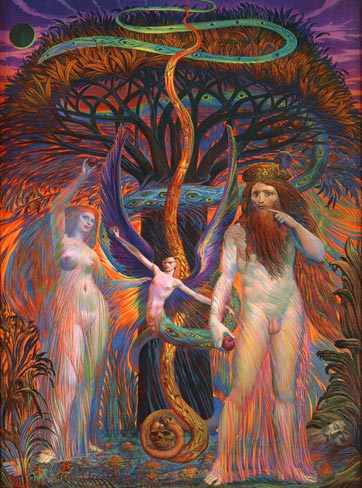
In Christian theology, the main source of human unhappiness is original sin. According to this way of thinking, the reason we can't be happy is because we are prone to sin; this means that we ultimately short-circuit all those things that might bring us happiness. Supposedly, this goes back to the original man, Adam, and his mate Eve. When they ate of the tree of knowledge of Good and Evil, which God said not to do, they sinned and were kicked out of Eden, or Paradise.
It is this original sin that some theologians say stains our personalities from birth. We are born in original sin. We are genetically engineered, so to speak, to sin, according to this view. There's some type of psycho-genetic disposition hardwired into us to do evil.
Kierkegaard disagrees with this theological understanding of sin. The origins of sin begin and end with each person. We are not hardwired to do evil. We are, though, born into a world of sin. This is the result of sins by people that have accumulated over time and in history.
For Kierkegaard, the springboard for individual sin occurs when people are afraid to face and oppose this world of sin. The world as we know it conditions who we are. While genetics plays a large part in who we are, so does the influence of society, culture, family and so on. But there is something built into the human spirit that can see the deception and hypocrisy, the evil in the world. This is what Kierkegaard calls the Nothing.
The Nothing is where we see our freedom to be who we are. It is the "possibility of possibility." We see an infinite world of possibility and we are dizzied by the things we see and could be. The world, ourselves, and those around us change and become either larger or smaller in comparison to this great world that could either be or not be. That it will be--for us at least--depends on our letting it be in one way or another.
In crises such as adolescence and other significant stages in personal growth, we realize that we have the freedom to either accept or refuse to accept society's rules and customs. We are not predetermined in the whole-sale way that some scientists might say we are. We are not simply biological cyborgs with "wet computers" as brains.
We have the natural capacity to form a distance from our environments and societies. We do not need to be what society or family or friends say we have to be. Indeed, we can to a very large extent shape and mold the very material conditions that life has thrown our way. Biology and genetics are materials to be used in fashioning a self that exhibits independence and joy.
But there is an inherent anxiety that accompanies this process. It's a risky endeavor fashioning a self from nothing. It takes courage and hard work. It takes standing up to people whom you love and respect and perhaps telling them that their way of looking at the world is either not your way or perhaps even wrong.
This creates anxiety, because people find support and safety in the rules and restrictions imposed by their societies. But by not thinking about whether these rules and customs are right or wrong, I simply join the crowd like everyone else. I do not form any relationship to the world except one that everyone else agrees with. They are not mine. Potentially I can wander aimlessly through life, never facing life's problems honestly and authentically. Life's problem is no problem as I let what others think provide the answers.
For Kierkegaard, this is an abuse of the freedom we have to choose responsibly. This type of choice is important, because if I don't do this then I am not acting ethically; I am not using the freedom to be who I am responsibly. In doing this, I also cannot be the type of human being who knows what it means to live as an individual. I only know how to live in a crowd. But crowds are notoriously amoral entities.
An ethical and moral environment is one wherein people associate with each other as individuals. For it is only as individuals who have understood themselves separately from the sinful world that they can come together to address the injustices created by that sinfulness.
The demonic arises when you reject the freedom to act in a free and responsible way, ethically, to the situations that life throws your way. The freedom to choose makes you anxious because there are no textbook answers to the way that you should respond to events. There's no recipe book on how to act ethically. If you have not cultivated the individual awareness that not only are you motivated at times by self-deceit and unconscious desires and motives, you will take the easy way out and run away from the problem.
This outlandish, if not absurd, claim comes in Kierkegaard's book on original sin, sinfulness, and the demonic. The work is a psychological look at how people gain an awareness of themselves as individuals. In doing so, they must face their freedom to be who and what they are.
As I have argued (following Kierkegaard) a main form of despair is the person who is aware they have an eternal side to them but who want to reject it and instead make something out of themselves that spites God. This person is in defiance against God because they are not happy with their place in life or with their
The reason that many who make the argument for the President's courage and going against public opinion sometimes invoke Kierkegaard's name is because he seems to assert something of the same kind. That is, the individual, one who really believes in what they are doing because they know it is right and true, will do everything in their power to accomplish that. Yet, as Kierkegaard noted, it is only within the confines of religious belief and the relationship that someone has with God that this view makes sense.
Following what either others tell you to do or giving in to self-deceit. The Christian way of life, according to Kierkegaard, is to recognize this sinful disposition and to inculcate a way of encountering the world that is ethical because responsible. Responsible because self-critical, self-critical because I have identified the freedom that comes from critical awareness of the socio-cultural norms that breed injustices and inequality.
Back to Index Read more!
0
comments
Labels:
bush,
demonic,
kierkegaard,
nihilist-politics,
religion
Friday, September 14, 2007
Texas George Rex Judas (4c)

I have argued that not only is this impossible but that it is dishonest and can lead in some instances to a form anti-ethical action that Kierkegaard describes as "demonic." The problem with most theories of individualism is that they isolate some essence that seems to be private and independent of others. Kierkegaard is sometimes interpreted this way, as I noted above. But what Kierkegaard discusses is not an isolated individual essence but rather a psychological state that critically assesses the values and customs of any socio-cultural matrix.
There is nothing like a soul or ineffable substance that does this. Instead, we as psycho-biological entities develop the capacity to critically understand our environments in a way that shows both inter-dependence and independence. As this shows, my own independence comes from interdependence just as my interdependence relies on my independence.
The soul is one aspect of the duality that we as bodied entities are. When I formulate who I am in terms of possibility and necessity, imagination and genetics, I take an attitude towards these two poles of my (past and future) history. This way of seeing or understanding the world is a third element whose nature is neither body nor soul. Its existence exists to evaluate how the two other elements interact and how one balances them. It does so by way of various actions and linguistic formulations that bring cognitive awareness as much as they do behavioral alignment. That is, through a process of formulating in words what it is I want to be and how I will accomplish that, I undertake to do what it is that I have formulated linguistically.
This way of putting the situation is obviously inadequate. It only gives a simplistic skeletal description of the way that we as humans act and think. Yet it points up several important dimensions for understanding what the nature of the Bush "revolution" is about. That is, these considerations show that like Genet and others, Bush et al. attempt to define their missions and actions in terms of isolated entities whose overall perspective is destructive of community.
This is so, because individuals are not isolated in this way, and when they act as though they are, they become ghosts and wraiths of real selves. Consequently, any society built around such actions and understandings will eat at the very foundations of any viable community.
Kierkegaard tries to outline a mode of facing life with courage and self-knowledge that short-circuits the this demonic way of seeing or understanding life means. As I noted in the previous section, one way of denying one's responsibility that Kierkegaard was keen on combating is to put the onus of responsible choice onto history.
This means that I say that I had no choice, that history and circumstances forced me to do such and such. This type of rationalization will go so far as to say that the choices I make are somehow substantiated by history to be; that history will somehow bear me out, that I will be vindicated by historical events.
In this context, Kierkegaard pointed to the politician who appeals to history to defend his or her decision. Kierkegaard writes:
When a headstrong person is battling with his contemporaries and endures it all but also shouts, "posterity, history will surely make manifest that Is poke the truth, then people believe that he is inspired. Alas, no, he just a bit smarter than the utterly obtuse people. he does not choose money and the prettiest girl or the like; he chooses world-historical importance--yes, he knows very well what he is choosing. But in relation to God and the ethical, he is a deceitful lover; he is also one of those for whom Judas became a guide (Acts 1:16)--he, too, is selling his relationship with God, though not for money. And although he perhaps reforms an entire age through his zeal and teaching, he confounds pro virili [to the very extent of his powers], because his own form of existence is not adequate to his teaching, because by excepting himself he establishes a teleology that renders existence meaningless. (Kierkegaard, Postscript, trns. Hong, pp 136-137)It is this notion that one is only responsible to some abstraction like "history" that displays Bush's ultimate Judas self-perception. The impending chaos and meaninglessness of human life implied in such statements and view have become apparent, I think, in the destruction and human suffering currently visited upon Iraq by this man's actions. But these considerations--in the light of Kierkegaard's comment call for further analysis, which I take up in the next section.
Back to Index Read more!
0
comments
Labels:
bush,
kierkegaard,
nihilist-politics,
religion
Tuesday, September 11, 2007
Texas George Rex Judas (Table of Contents)

Index of Postings on Texas George Rex Judas
- Texas George Rex Judas (1)
Texas George Rex Judas (2a)
Texas George Rex Judas (2b)
Texas George Rex Judas (3)
Texas George Rex Judas (4a)
Texas George Rex Judas (4b)
Texas George Rex Judas (4c)
Excursus: Original Sin and Politics
There's a lot of Kierkegaardian background to this analysis. I have tried to keep the jargon to a minimum. Yet, the background noise of so much of modern life requires a reworking and attunnement to things that one might otherwise miss. Kierkegaard is a good dissolvent for what I once heard someone call "cognitive dissonance."
Just as a side-note: It's interesting how a person can become a phenomenon. Bush as a person is probably a minuscule thing. As President, he becomes an amorphous thing that can be pulled and tugged into all kinds of silly-putty configurations (consider 1 and 2). For example, at Pat Lang's blog, I gave the following analysis:
One of my favorite scenes in Lawrence of Arabia is when the commanding field surgeon enters the Damascus "hospital" housing dead and dying Turks. The conditions are so horrendous he berates 'awrence, shouting at him "Outrageous! Outrageous." Then the nurses and others move in to clean up the crap and mess left by 'awrence's nostalgic trip to being Alexander.And who's the REAL Bush? That is indeed the question. Why it matters should really only be of importance to himself. That it concerns all of us at this time is unfortunate. As I say, the meat of these postings is not so much an attempt to get at the real George Bush as it is to identify a state of mind that afflicts many more than Bush himself. The scary thought, of course, is that might not be a REAL George Bush.
I just wish Petraeus and others (perhaps even a Senator or 2) would act in this way towards the crap-house Bush has created in Iraq. While I admire a guy like Petraeus who's willing to clean out the latrines as part of his duty, I am hoping that at the same time he's pointing out to Der Deciderer what a real f*-up he is.
Following on the attempt to psychoanalyze Bush in a previous post, I'd note that Narcissism from a Freudian analysis occurs at the same time as potty training. The Narcissist is pathologically fascinated by his/her own bodily functions and by-products. In a strange way, they see it as somehow themselves. (Need I mention the rumored predilection of Bush for flatulence jokes?)
One wonders how much Mama Bush changed baby Bush's nappies. As he went along in life Der Deciderer could certainly count on Mama and Papa Bush to clean up his messes. Then he met up with Rove, another person willing to clean up the mess--or at least smear it in ways that made Der Deciderer look like he was a prom queen and not Carrie.
Anyway, part of the message to Bush and others are things that Petraeus and Gates have left out of their quantitative analysis of Res-Iraq: over 2 million refugees; the lie that is falling body count; the ethnic cleansing.
And yes, the fact that nature indeed does hate a vacuum, and the vacuum of Iraq is sucking in all the ill-winds that the modern nation-state and colonialism tried to bottle up.
Update: I Cite points to an article at truthout that captures the tenor of the betrayal discussed in this series of posts. While the writer seems shaken by an impending sense of catastrophe, I think that he's on to something that must be stated much more clearly I suggest below that what has taken place is a betrayal of the very principles that make community possible. This can be seen as a form of soft fascism, as Richard Sennett sees it; but it is something more fundamental at work, something that ranges from seemingly innocuous things like more mistrust among people towards strangers to a cynical manipulation of public perception via distorted news stories about what's really happening.
William Rivers Pitt writes:
The joke: people say Bush and his people want to raze the core nature of the country itself by wrecking the Constitution, and they're correct. People say Bush and his people are enriching their friends beyond dreams of avarice at our actual expense, by way of war-inflated oil prices; war-captured Iraqi oil infrastructure; the orgiastic plunder of Treasury money through calamitously unsound tax cuts for Bush's pals; and through an Iraq war profiteering scam so unutterably corrupt that it bends the very light. That, and more besides, is what people say, and they're correct.JDean at I Cite adds her very academic and perhaps over-intellectualized take on what Pitt is talking about. I try to take a more pragmatic approach, using concepts and language that still hold meaning for people, though that meaning itself may be indefinable. By providing ana analysis using this mythology one can perhaps gain an insight into phenomea that are profpund just because they are so obvious. Obvious and yet insidious because they threaten unravel a social fabric and pit people against each other in fratricidal warfare.
But all that, along with everything else the Bush crew has done, just isn't enough for them. What Bush and his people really seek, at bottom, is to destroy the basic definition and literal existence of reality itself. They want to destroy reality, rebuild it according to their own blueprint, so the sum and substance of this new reality will accept as axiomatic the idea that lying, stealing and wholesale carnage are badges of integrity and moral clarity. In other words, our comprehensively understood reality today would be replaced by whatever madcap anti-reality currently exists within the walls of 1600 Pennsylvania Avenue.
Update: (via Born @ the Crest of the Empire) -- From AP
Just over half of the white evangelicals who attend church at least weekly said the war was the right decision and the extra troops were helping, while about four in 10 said the war is a success — well more than Catholics and Protestants measured in the survey.
Slight majorities of conservatives saw success in Iraq, a troop increase that is working and a war that was the right choice, a third of them or more answered each question negatively.
Related Links
- Hard-liners for Jesus By Harold Meyerson
0
comments
Labels:
atheism religion,
bush,
demonic,
nihilist-politics,
religion
Sunday, December 31, 2006
Kierkegaard Carnival II - December 31, 2006
 Welcome to the December 31, 2006 edition of Kierkegaard Carnival.
This New Year's edition of the Kierkegaard Carnival includes a congeries of blog postings that cover ethical, philosophical, religious, and biographical aspects of Kierkegaard's work. The pieces provided here are interesting for their diversity of viewpoint on the themes and ideas generated by that amazing writing machine we have come to love and admire.
What strikes any first-time reader of Kierkegaard, of course, is the number of pseudonyms that he writes under. The number of pseudonyms, along with the diverging and often conflicting viewpoints they divulge accounts, perhaps, for the many interpretations of Kierkegaard's work that we find in academia, as well as in the humble pages of this little carnival.
For many people, the idea of a pseudonym means that someone is trying to hide their real name behind a fake one. The reasons for why someone might want to do this can be multifarious--ranging from the con man's alias to the lover afraid to show their true name lest they be hurt by rejection. ...
Kierkegaard acknowledged and embraced the ambivalence of the pseudonym. It allowed him to explore the wide-ranging emotional and spiritual spectrum that exhibits human being. He was wily enough to see that people will hold to their beliefs and precious prejudices no matter what data or facts appear. They must be tricked out of their mind-set to embrace the open-ended reality that is the transcendent.
Using pseudonyms also allowed Kierkegaard to experiment with different views and ways of looking at life that he did not necessarily embrace, feel equal to, or had surpassed. For example, he says that the pseudonym anti-Climacus is a writer whose version of Christianity is much far higher than Kierkegaard himself could live in his own life.
What these comments point to is a cautionary tale about seeking the real Kierkegaard. That may not be possible--and it is perhaps best so, since he the individual would have found it abhorrent to believe that any words of system could capture the uniqueness that is each and every human being.
This is not to say that the works published under his own name--especially the religious discourses--do not represent his personal beliefs and views. Yet, even here there's a progression and evolution in his ideas that often defies categorization and that is often pigeon-holed into preconceived patterns and notions.
With this said, it seems only fair to expect to find in the work of those who are inspired by Kierkegaard's work the same types of diversity that his writings display. This edition of the Kierkegaard Carnival bears out some of these remarks.
(h/t to Without Authority for the link to the Kierkegaard finger puppet that appears above)
Philosophy
Richard presents Philosophy and Literature posted at Castrovalva.Richard explores the relationship between writing, reality, and self-transformation. Exploring the meaning of irony--a concept dear to Kierkegaard's heart--Richard links up Kierkegaard's views with those of American philosopher Richard Rorty. Especially important for Richard is the notion of self-transformation and how literature--rather than philosophy--enables that activity. In this regard, he sees Kierkegaard's Fear and Trembling as lacking in that value.
William presents Soren Kierkegaard - Existentialism, Nominalism, and the Three Spheres of Existence posted at Fidei Defensor.
William provides a historical introduction to Kierkegaard's role as an existentialist in European philosophy. After providing this background, William discusses how Kierkegaard's notion of the Three Spheres of Existence provide a useful heuristic and conceptual framework in understanding the stages in the spiritual and religious life.
Ethics
Thomas at Without Authority presents- Works of Love (Part 1): Do Not the Pagans do the Same?
- Works of Love (Part 1): Against a Natural Theology of Love
- Works of Love (Part 3): Proper Self-Love
- Works of Love (Part 4): The Paradox of Forgiveness
Thomas explores four aspects of one of Kierkegaard's greatest works. Works of Loveis the one writing that puts to rest the notion that Kierkegaard was an isolated, brooding man who cared naught for anything save his eternal soul. In this work he explores the meaning of human and divine love, opening up along the way the dimensions of sociality that put into practice that divine commandment to love the neighbor and the enemy as yourself.
Religion
Allan presents Soren Kierkegaard: Postmodern Prophet: #1, #2, #3, #4, and #5 at Allan R. Bevere.Allan gives the background and context for what has been called Kierkegaard's attack on Christendom. Observing the corruption of Christianity as he saw it, at the end of his life Kierkegaard took to the streets to disseminate his biting satire on the ways that the Danish Lutheran Church--the official state church--and its leaders had betrayed original Christianity. After exploring some of this history, Allan explains how this attack by Kierkegaard has meaning for today's faithful in a postmodern world.
Anna presents Does God take leaps of faith? posted at Grace Freewill.
If there's a single set of words that most people who have heard of Kierkegaard associate with him, it is the phrase, "leap of faith," which itself is often extended to include a "blind" leap of faith. Strangely enough, none of these words appear in Kierkegaard's writings. In Concluding Unscientific Postscript, where he does talk about a leap, the meaning is that one leaps to faith, not from it. Also, the leap is quite self-conscious and not blind. Its understanding of the realities of the situation--that faith can't be proven objectively, for example--are quite apparent to the leaper. Anna provides an excellent personal review of faith, as seen from her reading of Kierkegaard's Fear and Trembling. Who indeed can understand Abraham?
Hakim presents Reasonable Criticisms of the Unconditional posted at Wa Salaam.
Although not directly mentioning Kierkegaard, this short piece investigates in skeptical manner a subject that Kierkegaard wrestled with every day of his life: Is there an unconditional reality that provides the basis for discovering who and what we are?
Arts and Literature
Augustus Young presents A Gloss on Soren Kierkegaard posted at Augustus Young: Poetry and Prose a regular webzine.Augustus devotes an entire issue of his online webzine to Kierkegaard. Inside we find scenes from a movie about Kierkegaard, as well as a small fantasia examining the correspondences (in the sense Baudelaire meant it) between Kierkegaard and PT Barnum. Did Kierkegaard really see his age as a freak show? It is difficult to say, but it is certainly true that many saw him as a freak and laughed him off the streets he so much loved to roam after nights and days of writing what he later came to say was an enterprise undertaken in the name of the common people.
Popular Culture
Charles presents Confessing America: The TV as Confessional posted at the cynic librarian.Charles remarks on a side of detective shows like CSI, Law and Order, Monk, and The Closer that he thinks deserves mention: confession of guilt. Not of the characters in these shows but the guilt of the audience who watches the shows. He closes his remarks by citing Kierkegaard on sin and envy and speculates on how these intersect with the type of social confession he thinks this genre of TV show exploits.
That concludes this edition. Submit your blog article to Kierkegaard Carnival III using our carnival submission form.
Past posts and future hosts can be found on our blog carnival index page.
Technorati tags:
kierkegaard carnival, blog carnival.
1 comments
Labels:
kierkegaard,
kierkegaard-carnival,
religion,
xtianity
Wednesday, December 20, 2006
Religious Right Threat?
A fascinating discussion on whether there's a real threat from the religious right is taking place between a collective of left-wing scholars at Larval Subjects, The Weblog, and I Cite. I've added my own extensive comments there, for what they're worth. Read more!
0
comments
Labels:
religion,
xtianity
Wednesday, November 29, 2006
Fragments and Disruptive Reflections on Machiavelli, Kierkegaard, and Apocalyptic Confessions
There’s a darker side to my personality that I attempt to mostly keep at bay. This aspect of my personality looks at the world and news of events with a longing for chaos and anarchy. I want to see things apart. I don’t know whether others share this dark side to their personalities or not—I guess I shouldn’t really care.
In Doctor Zhivago, Pasternak describes a short discussion between Yuri Zhivago and an anarchist. For the anarchist, the new society that must be brought to birth can only be done so after complete and utter leveling of the old. Nothing of the old must stand for the new world to rise like a phoenix from its ashes.
I might interpret see these thoughts and emotions that I have as a sign of great boredom with the world. I once wrote that it is this deep-seated ennui that gives way to playing with variations on a theme. The nihilistic attempt to clear away the rubbish of the past and start anew is believe in what context, however? ...
I find a bit of solace when I remember that others whom I consider geniuses as sharing such views. Some of Wittgenstein’s remarks exhibit just such a desire to see western civilization leveled to the ground. He shared Oswald Spengler’s view that modern scientistic culture is a corrupt and ultimately debased civilization. This from a man who once served as a private in the Austrian army in WWI and a nurse during WWII.
Camus once noted that the Russian nihilists and Camus’ archetypal rebel respond to the overwhelming injustice that they see in the world by tracing its roots to basic human instincts and institutions that are corrupt at the core. To extirpate this corruption a complete renewal of human nature must take place. Since you could argue that human nature itself is an artificial construct and merely reflects the society that forms it, then that nature is ultimately as malleable as any animal’s.
The Marxists I read these days are a sad lot in this regard. They are waiting for a theory of community that will allow them to once again proselytize the world. There is something prudent about this waiting: it enables an assessment of where the political and related goals of the last attempt at revolutionary renewal. Beyond prudence, however, this waiting does seem somewhat comical and gives one license to view their standing on the street corner of history from the perspective of Beckett’s Waiting for Godot.
The strand within this school of thought that I can most easily identify with is the one put forward by Hardt and Negri. That thesis looks to a sort of riding the back of neoliberal empire as it lays waste the globe. In the wake of this desolation, possibilities will open up for revolutionary action that are opposed to reigning neoliberal regime and might finally give birth to a blueprint for future revolutionary communities. I am attracted to this game plan since it accords with some things I have found in my other readings, especially of Kierkegaard and Wittgenstein.
Then there’s Kierkegaard. I have written about his remarks on the plague. Pessimistically perhaps, Kierkegaard’s views are unstinting in their awareness that any rationalized regimen—while socially and ethically prudent—will not provide the type of radical undermining of lifeways that have given rise to a, for him, a Christendom that was eminently antithetical to everything Christian that Christ revealed. Any such renewal, again for him at least, required something so monumentally shattering to those lifeways that anything short of it would leave vestiges of the old in place that would ultimately engender the same types of corruption as the original that it had replaced.
The little that I have read of Slavoj Zizek’s work seems strangely Kierkegaardian in this regard. An avowed atheist, Zizek nonetheless demythologizes early Christian though to gain insight into its essentially revolutionary character. For Zizek, even an apparent accomodationist as Paul can be seen to be preaching a message that was radical in its undermining of naturalistic and imperial ideologies.
There are several ways to read Kierkegaard’s political thought. Many take the only outright political document he wrote, The Present Age, and go with its somewhat conservative message. They read this understanding of his thought forward into such documents as his later attacks on Christendom. Others, however, are beginning to see that The Present Age was just a way station on the road to a much more radical ethico-religious critique of modern society.
Be that as it may—since it’s the province of numerous egg-heads and specialists whose work I adore but whose application must be earned rather than assumed—there’s a somewhat strange affinity between Kierkegaard’s thought and that of the republican Machiavellians. Now this will seem strange to say—though it perhaps clarifies some posting that I’ve made on Machiavelli at this blog—since it goes against both received interpretations of Kierkegaard and Machiavelli.
Since I believe the scholarship has clearly shown that Kierkegaard was a thinker neither irrationalist nor apolitical, I’ll dispense with that misperception without further remark. The received understanding of Machiavelli’s thought is harder to dispense with, but I concur with Pocock and Quentin Skinner in seeing Machiavelli’s political philosophy as one that is eminently amenable to revolutionary agendas.
What makes me think that could be any relationship at all between Kierkegaard and Machiavelli? Consider the following description of Machiavelli’s thought as formulated by JGA Pocock at then of his Machiavellian Moment:Forms of property were seen to arise which conveyed the notion of inherent dependence: salaried office, reliance on private or political patronage, on public credit. For these the appropriate term in the republican lexicon was corruption—the substitution of private dependencies for public authority—and the threat to individual interests and self-knowledge which corruption has always implied was reinforced by the rise of forms of property seeming to rest in fantasy and false consciousness. Once property was seen to have a symbolic value, expressed in coin or in credit, the foundations of personality themselves appeared imaginary or at best consensual: the individual could exist, even in his own sight, only at the fluctuating value imposed upon him by his fellows, and these evaluations, though constant and public, were too irrationally performed to be seen as acts of political decision or virtue. The threat posed by corruption cut deep … [Pocock, The Machiavellian Moment, p. 464]
For anyone familiar with Kierkegaard’s Present Age, as well as numerous journal entries and Practice in Christianity, will discern, these themes of public, individual, false consciousness, money, and so on become paramount themes for the later Kierkegaard.
There’s an easy way to find roads between the thought of Kierkegaard and Machiavelli. Kierkegaard’s humanistic educational training in the classical authors is perhaps the best road. As Pocock maintains, Machiavelli was adapting an Aristotelian political model to his day in Italian politics. Kierkegaard’s reliance on several key Aristotelian notions is well-known. (Indeed, the Aristotelian framework that Kierkegaard sometimes borrows led the German philosopher Heidegger to call Kierkegaard’s philosophy medieval in spirit.)
There is another correlation between Kierkegaard and Machiavelli that I’d like to suggest. It applies as well to why I think that Hardt and Negri’s idea are amenable to Kierkegaard. This has to do with the view that history is cyclical and exhibits an evolutionary quality that runs from birth to growth to decline. The last phase of decline is simply prologue to rebirth.
It is this aspect that correlates with Kierkegaard’s notion that secularization and decline in western society should not be opposed. Instead the leveling processes should be allowed to proceed since they are preparatory to something new and revolutionary. In some ways—perhaps superficially—this idea of allowing a corrupt process to runs its course parallels what I understand of Hardt Negri’s analysis of neoliberal imperial designs.
If I am right, Kierkegaard modified this view of evolutionary change which he no doubt hoped to mimic Hegel in using. Instead, he becomes more radical in his awareness of how deeply the root of corruption runs. This is where he might ways with Machiavelli, wrestling with the problem of corruption never did seem to get resolved. Unable to accept theological concepts, he was perhaps blind to how closely his meditations on corruption mirror the Christian notion of original sin. (This no doubt is due to the misconceived formulation of that concept anyway, a reformulation of which we are in dent to Kierkegaard for BTW.)
If I am right, then, Kierkegaard still saw the process of corruption as inevitable, yet its healing would come in a far deeper crisis than anything socio-political could marshal to the table. Instead, the complete undermining of the ways and means of corruption would require something on the scale of plague and the consequent existential and socio-cultural disruptions that such an event creates.
Some politically conservative theologians and pundits seem to have glommed on to Kierkegaard’s critique of Christendom as a justification for their own contributions to the so-called culture war in America. This is understandable since a prevailing understanding of Kierkegaard’s life has come from fideistic-minded Lutheran translators and interpreters. Recent translations of his work, however, paint a much less fideist, not to mention quietist, portrait of Kierkegaard’s writings. Indeed, these recent translators and commentators put a decidedly leftist slant on these works.
That is, in plumbing the depths of western culture’s spiritual decline, Kierkegaard creates not only a critique of all ideology—as Merold Westphal calls it—but a more radical and comprehensive destruction of the very foundations upon which western society bases itself. The more astonishing aspect of his critique is that, contrary to the prevalent views, this spiritual plumbing work is just as much done in recognition of the economic aspects of that decline as it is in the psychological or simply religious aspects. In other words, Kierkegaard, in a work like The Sickness Unto Death for example, creates a spiritual typology of personality disorders that capitalist economies and their politico-theologico ideologies generate.
With these apocalyptic confessions off my chest, I can now go back to my job, living room, favorite TV shows, Chihuahua in my lap, uneasy concerns over children’s futures, and the unending desire to feel more worthwhile than the world seems willing to grant.
Read more!
0
comments
Labels:
kierkegaard,
religion,
xtianity
the cold winds of the interregnum
The northern winds churn their charmed ice palaces in the womb of winter. As the terrible news of civil war freezes the face into a hollow ghost like howl, I sit listening to industrial odes to my own wrestling with the angels of annihilation. ...
If there's any truth to contextual historical accounts, it's that those who control the language games do so not in the search for confessional truthfulness but out of a despairing clammer up the dung hill where they play king of the hill.
I hear many on all sides of this clash of civilizations triangulate the amount of suffering that is or is not meaningful in this war. Not only this, they also say that one death equals so many more of the other side's dead. They thereby implicitly condone an algebra of human suffering that crazily skews and cravenly sears the mind with despair.
For those who hope to inoculate themselves against the sickness unto death with reason, all is caught in the intransigent antinomies that honest Kant once descried. Though he later betrayed his own thought with paeans to Reason, he eventually came to his sense when he saw the heart of darkness called radical evil.
No politician would dare touch such a notion though some on the right try to marshal its theological cousin original sin to their propaganda. The Left of course is simply caught in visions various forms of u/dys-topic meanderings that any true revolutionary has too much salt int their bowels to believe.
[+/-] read/hide the rest of this post
Read more!
0
comments
Labels:
hamlet_machine,
religion,
xtianity
Monday, November 27, 2006
The Right and Marilyn Manson Hold Counsel
Certain phrases have switches that can be flipped one way or the other, contrary to the avowed intention of the writer. from the simple exercise of turning a bully's taunts into an emblem of pride to appropriating curses as inspiration for further rage, the switch in words meant to deride and turn you from self-idolized image to focus of ridicule exposes the raw nerve of much of our psychology.
It's said that the pull of the profane can be bent to one's own purpose since derision and social alienation appeal on levels that lie deep within the apparatus of social margins. Those on the outside suffer insult and terror and have little choice but to fight back or accept ignominy and shame. What better way to fling back into the face of such social stigma the nettles that sting than to imbibe the poison and draw strength from weakness? ...
The appeal of what some ethnographers have called the liminal is well-attested in history and ethnographic studies. It is perhaps best exemplified by the ancient European ritual of all fool’s day. In this ceremony the person most dispossessed and the object of public ridicule was placed in the seat of power for a day; the leader was demoted to the lowest status. In the reversal of values, what used to be profane and disallowed became suddenly allowable. It's said that these rituals are the basis of well-known modern festivities like carnival as it is played out in Brazil and what used to be New Orleans.
While these secularized festivals have perhaps lost their religious nuances, the religious impulse behind them has gone underground and been subsumed beneath more rationalized practices. Yet, the impulse and psychological mechanisms that make these practices meaningful may still be part of what's called human nature. They do appear in numerous cultures around the world and they appear to be able to maintain their meaningfulness even within the meaning-draining maelstrom that is modern secularization.
Indeed, you could say that such mechanisms have become the wellspring for people within the desert of the real. That is, to maintain distinctness from the conformity required by the modern rationalized state, people seem driven to find a way to mark themselves off from the confines erected by that conformity. From Marilyn Manson to glam rock to other niches in popular culture, the pull of the outsider and the forbidden and profane draw on these psychological mechanisms.
It'd be a mistake, however, to limit the play of this psychological phenomenon to the cultural. For they seem also to marshal their emotional cargo in politics, thereby lending various political movements with a powerful reservoir of anger and rage. The modern image-makers known as political consultants can massage these emotions into whatever direction they wish. Indeed, it seems to me that the secret of much of the Rove-laden propaganda emanating from the bowels of the White House has discovered a way to exploit these emotions. Karl Rove has discovered how to take what is intended as a negative characterization and to turn it on its head to become badges of honor.
Given the proliferation of political correctness, those who find themselves the butt of jokes and called uncool are drawn to messages that exploit that very outsiderness and help them to glory in it. In this way, you can explain the popularity of such culture mavens as Michael Savage, Glenn Beck, Anne Coulter, and Rush Limbaugh.
No doubt, there are social, political and economic sources for the anger of the so-called trailer riff-raff that liberals and Leftists love to despise. With the uncertainties promulgated by neoliberal economic models, the dissolution of traditional family structures and values, the attack by enlightenment values on religious institutions--all these promote a crisis environment in which those seeking stability grasp at any straw to maintain equilibrium.
In a world comprised of opposites, it's not so much that they attract each other (as the old cliché goes) as that one turns the image of the opposite into a positive source for motivation and meaning.
Related Link
Read more!
0
comments
Labels:
religion,
xtianity
Wednesday, November 22, 2006
Daily HotShots! 22*11*06
Just a day before the turkeys thaw and the table's set for our yearly family sit-down. I'll be working all night tonight so it's gonna be late tomorrow when we sit down. Football will take a back seat to sleep.
Bush: I would understand if Israel chose to attack Iran - Haaretz - Israel News Don't go to sleep with this guy at the wheel. To mix metaphors, does this guy's psych nurse get any sleep? Who knows how dangerous he is to himself and others around him.
Sacrifice Israel to Win Iraq Despite the (intentionally?) provocative title, this posting suggests a quite modest proposal. It will earn the ire of many rabid Zionists but it suggests like a sacrifice of Israel, only the return of illegally occupied Palestinian territories.
civil war in lebanon If you've read my postings here for some time, you will remember that civil war in Lebanon is one of the potential causes that Israel will use to justify attacking Iran. I know, I'm paranoid--and anti-semitic to boot. .....
Israel ups the stakes in the propaganda war And you thought that war was about killing people. Wake up and smell the coffee, look at your newspaper and see the naked breakfast served up by the propaganda machines. Ho Chi Minh said this years ago--the Israelis and the Americans understand this quite well. Heard about the Pentagon's own internet propaganda effort? Look it up.
Grim prognostications from the dismal science Okay, I am what you'd call socially critical humanist/existentialist cynic. Economic arguments for change take a back seat to ethical and self-actualization issues in the bizarre book I read. Still, if you think you're sitting on a nest egg worth maybe $200K plus--ie, your house--this article is going to be a real bummer to read. Since I am semi-nomadic, this means little to me, although those dear to me will think I am being paranoid when I bring up facts like these.
US Special Forces Manual Ever wonder what those black ops guys do for a living? Want to see the reality behind fictional accounts like The Unit (CBS)? Well, even with most of the manual unavailable for public perusal (otherwise I'd have to shoot you), this description gives some insight. What I find a bot unsettling is that I think this guy is saying that special ops teams operate in the continental US. I thought that was illegal.
CBS on the "Group of Weirdos" Who Ran the GOP House So what's wrong with the press coverage of the carnage and disastrous undertaking in Iraq? How come the press doesn't cover the neocon putsch? This article suggests it's a matter of the press' sense of civility. They just don't want to talk brass tacks. I like this article because it calls the liberal mumbling points to task while taking the gloves off ... Have I used enough cliches yet?
Has a fresh look at 118-year-old evidence revealed the true face of Jack the Ripper? The century old fascination with this serial murderer deserves more comment. But seriously, if the main suspect is supposed to be a Polish immigrant, how come this guy looks... Arab! Talk about historical irony. I'm having flashbacks here evoking Orwell's 1984 and his description of the uber-enemy Goldmann.
The myth of the selfish gene Gritty gut check about our most basic nature or a way to salve guilty consciences and pin responsibility onto deterministic processes? That was a mouthful but you know what I mean, right?
The Weaponized Phallus (and five easy-to-remember steps) Okay, language is just one of those things that reflects the faults and unseen designs of deception--not to mention unheralded anger, violence, and baser instincts.
Thousands Of Evangelicals Rally To Reclaim Wal-Mart's "Biblical" Heritage Thank God for Walton beer, soda, and smiley faced-welfare. Do I hear an amen? Give me a shout-out!
Roskies on Neuroscientific Challenges to Free Will Those pesky academics have nothing better to do than doubt their own existence? Maybe they're right. Seriously, I am less free than I think; I am more free than I think--put that through your biological computer once called the mind.
Book Review: Overblown! Saying that the so-called war on terror is hyperbole might get some stony stares. Saying that the threat from terrorists is all hype and empty propagandizing could get you an ass-whipping. This guy's thesis that that is indeed the case is not exactly new, but it does have facts and facts and many more facts to back it up. The American Prospect blog beat me to it.
More Book Talk: Zen and the Art of Mo-Cycle Maint. The cult classic that tore up the book charts in the early 80s is still drawing readers. My son just read it and I had some time eliciting any meaning for him from my hazy memories. My memories of the work included more of a story of why I read the book in the first place: a fellow student dying from cancer recommended it; he eventually left school but his motorcycle sat unused near the back door to the kitchen all year. At night I'd hear a motorcyclist pass the Santa Fe foothills where the college sat like some ghostly reminder of the spirit that had passed. (The interview with Pirsig is here.)
Movie Review: Pan's Labyrinth I love the use of fantasy to present serious subjects. What better way to explore fascism than through the unwinding nightmares that plague the individual and communal unconscious? How long do I have to wait for it to get on Sundance or IFC? Not long I hope.
On-line Vote Against Torture There are so many reasons not to sign this petition aren't there? It won't do anything; it's not real political action; it's by a religious group. But then there's so much wrong about torture. Besides what you done about it that could really stop it?
In Memoriam: Robert Altman The man was a genius--and had a wicked wit, something I find amenable. MASH is still the funniest movie that quickly comes to mind when I think of such things. Needless to say, I hated the TV show based on what's a masterpiece movie. McCabe and Mrs. Miller set the next stage in how people did westerns, right Clint? As it is, for those who think that art has no impact on the "real world," I can tell you that MASH added much to the growing anti-war movement against VietNam. This goes to show that irony and satire can still play a part in how people develop their moral and political views. Did you ever doubt it?
Read more!
Friday, November 10, 2006
HotShots! 10*11*06
How many votes? So how does the vote--as a gross number--look in comparison to other elections?
A Mass Delusion? This is what I love about Pat Lang. Put it on the line, no-holds barred. You think Bush is going to give up his Oedipal traipse through history? Get it in writing before you take it to the bank, Lang reminds us.
BLACKFIVE: Bush is an idiot This is from a pro-Bush soldier, obviously expressing his frustration with the great decider after the devastating defeat in the midterm elections and the sacrifice of Rumsfeld. Take a look at the comments section too.
Larval Subjects: Post-Election Grogginess Yes, this guy's an egg-head, but he's very clear in this piece and presents some unique angles on the election results.
U.S. Election Post-Mortem Thoughts (Leiter) Decent observations about what's ahead on the political scene.
Where is Ike? I'm not one for tears in the eye, heart-jerk patriotism, and I think that Robert Lowell was unfair when he decried the moribund nature of Einsenhower's presidency, but remembering people who stand up for principle--as Eisenhower did in opposing the Israeli invasion of Egypt--is worth remembering.
What happened when Democrats in Congress cut off funding for the Vietnam War? They say it won't get to this point in Congress in the confrontation over Iraq; if it does, here's how they did it last time.
EM Woods: "Democracy as the Ideology of Empire" Yes, you knew I'd sneak something in here by the commies at Lenin's Tomb. It's not necessarily that I agree with everything he says--nor that I disagree--it's just that his selection of topics is so great and his ability to write heady stuff for a general public is so well done.
Number of Jewish parliamentarians worldwide reaches record high Yes, there are people keeping track of these things--and they're jewish. I was thinking about this the other day. Of course, many of the jews in Congress run the gamut in their religious identity--most perhaps are so-called secular jews.
Another Apostasy Hadith Revealed First part of an exegesis of a Hadith that many see as the heart of the extremism of Islam. Eteraz argues against that interpretation.
More On The Apostasy Hadith Continues the exegesis of the apostasy Hadith.
Austrolabe: Are We Victims of Our Own Abstinence? Interesting stories about what it means to be an observant Muslim in secular society.
Can it be that it was all so simple then? Exploring the nostalgia for better days, the land that childhood once knew, the times and spaces never to be again.
A Review of John's Yoo's WAR BY OTHER MEANS: AN INSIDER'S ACCOUNT OF THE WAR ON TERRORIt's hard not to spit at the same time as I say Yoo's name, but Geoffrey Stone is right: these men are only human though they preach inhumanity. Learn to unravel the evil they do.
Read more!
0
comments
Labels:
religion,
xtianity

 Posts
Posts