I share little in common with my father except nightmares and genes. Echoing through the silence of the years during which we have not spoken there winds the terror and horror of an insanity that was his and which I have guarded against. As with most shadows, though, the danger in fighting them brings the danger that you will mistake what's real for shadow and shadow for what's real.
There's no doubt that I have often taken a no-prisoners strategy in defending those I love and myself from often paranoiac fears that my father was on the highways, headed my way with a trunk full of automatic weapons and bent on a rampage that started with the death of my mother and would end with the slaughter of my children and me.
These personal comments relate to the paranoia that strikes deep in the heart of fantasy and illusion that comprise the American dream. When attacked, the US public responded with a hysteria that can only astound the rest of the world for its over-reaction. ...
While we sit and watch the fantasy war unfold, US citizens sit bemused and impotent at the sight of their representatives who are apparently incapable of doing anything to stop the madness that their own hysteria set in motion. Asserting the type of sovereignty and authority that a head of state is supposed to exhibit, the mannequin that voices testosterone-filled apothegms that beggar grammar strides the world stage like an idiot savant known for bringing death and destruction to innocents.
It's said that during the first days of the Afghan invasion Pres. George Bush once told the CIA to send him the head of Osama bin-Laden after the terrorist was caught and killed. The CIA agent on the ground took the order seriously enough that he gathered the materials required to pack the head in dry ice and ship it to Washington.
What this story says to me is that the facade created by the civilized US invasion is nothing but a charade created by a sophisticated media effort. The real, on-the-ground actions that buttress the invasions of Iraq and Afghanistan have never made it into the US public sphere. Instead of the decapitation fantasies of our leader, we see the US portrayed as the army of light versus the forces of darkness.
I have drawn attention to the appearance in the public fantasy show of a genre called War Porn. This genre gains in popularity, it seems, throughout the US and perhaps the world, as suggested by hits at my blog with "war porn" as the search terms.
Yet, the indecency of this genre is many-sided. What differentiates the prurient interests of adolescents and young soldiers looking for, trading, and selling this type of porn and the types of videos put on the web by the oh-so-virtuous jihadists? Consider the beheading of famous Iraqi female journalist Atwar Bahjat.
As the following description shows, the thin line separating the video of this crime and that in porn is a diminishing, if not non-existent, value:We now know that it was not that swift for Bahjat. First she was stripped to the waist, a humiliation for any woman but particularly so for a pious Muslim who concealed her hair, arms and legs from men other than her father and brother.
The scene could come from a snuff film. Yet, tragically and inhumanly, it comes from a group of brutish men who think they perform this defilement in the name of Allah.
Then her arms were bound behind her back. A golden locket in the shape of Iraq that became her glittering trademark in front of the television cameras must have been removed at some point — it is nowhere to be seen in the grainy film, which was made by someone who pointed a mobile phone at her as she lay on a patch of earth in mortal terror.
In a book called Toxic Religion, it's stated that the religious fanatics are often plagued by sexual thoughts that are perverse and violent. I suggest that the jihadists fit this description to a tee. That these demons in the form of men believe that they are virtuous because they can carry out this brutality only shows how empty and filled with a despairing sin their version of religion is. They manifest their own sickness and wretched feelings about sexuality in crimes that reveal nothing but corrupt hearts and spirits.
I have included this description along with my personal reminiscences for a reason: in his despair over his divorce and what he considered his betrayal by my mother, my father once described for me the very type of scene that was played out in Bahjat's death. That vision--of my mother's head in my father's hands and plunked on the hood of a car--haunted my late adolescent years and still does. I cannot watch the movie Seven because the ending plays back too realistically that vision for me.
Does the personal nature of my father's insane fury obviate in any way the crime he nurtured in his heart? Does it make what these so-called men did to this woman, who simply wanted to be a woman, more or less heinous once we see it from the perspective of the crimes and despair that fill not a personal life but the vengeance-filled fantasy of our leader?
Do these thoughts provide a spectrum of ghoulish sensuality that festers in the heart of men who despair of their own humanity so much that they cannot stomach a woman leading her own life and who must therefore degrade her sexually and monstrously?
Simone Weil once wrote that we must recognize that given the right circumstances we are all capable of the most despicable acts. I believe that she was right in this, and I therefore recognize that the acts of these men and the crime fantasized by my father are also potentially acts that I myself could and would enact.
Some will say that what separates us from them is the barbarity of their acts. Yet, barbarism is a reality that seems to change once we begin to plumb the depths of our own sins.
Read more!
Wednesday, November 12, 2008
War Porn II: Invitation to a Beheading
0
comments
Labels:
demonic,
xxxxxxx

Sunday, September 07, 2008
American Neoliberalism: Intro to Demonology 101
Talk about demons appeals to the popular consciousness. Numerous works of fiction and film exploit the idea that we humans can be inhabited and made to do things that we otherwise would not do. Evil things--evil things so horrendously heinous and terrible that we'd despair of some presupposed innocence that we're born with.
Of course, the most spectacular of these films was Peter Blatty's potboiler, The Exorcist. The film based on the book made huge bundles of cash for Hollywood and spawned two sequels. The most recent, The Exorcist: The Beginning just played last year and is now on HBO.
I watched this most recent installment the other night. Beyond the obvious absurdities, and the still quaint notion that evil inhabits another woman, what struck me most was the indefatigable tenaciousness of the priest who doesn't believe in God anymore. His spiritual journey back to faith is played out against the backdrop of his loss of faith occasioned by the massacre of innocents by Nazis. While the special effects are decent, and the story is often compelling, the movie is not very convincing in showing the true meaning of the demonic.
Two recent articles show the Catholic Church's unwavering war against demons, however. Working on empirical data that demon possession is on the rise, the Church has revamped its book of exorcism, enlisted a cadre of new exorcists, and made public pronouncements of its unerring belief in the reality of the Devil. ...
In an interview with Sign and Sight one exorcist, Rev. Pedro Barrajon, claims:Cases of possession seem to me to be the evil flip-side of miracles, which are equally inexplicable, but which we can also observe. The devil is present everywhere that evil things happen within the normal laws of nature. In anyone who says: I don't accept love, the love of my brothers and sisters, the love of God. And in many places, in all massacres, in every murder, in physical catastrophes, in every concentration camp, in all evil. Sometimes he shows himself, strangely, but also in cases of possession. But he's much more dangerous where he doesn't let himself be seen, where he can't be done away with through exorcism. No question.
Such expressions, of course, meet with a skeptical guffaw from the intelligentsia. A scientific age cannot and will not believe in anything that cannot be subsumed under the aegis of empirical study. But the empirical is exactly what the demonologists work with. As innumerable ethnographic reports will tell you, demon possession is real--for those possessed and for those who witness it.
The point, of course, is that these cases are simply manifestations of psychological problems that proper psychiatric care can dispel and cure. Or so it is said. For anyone familiar with the incapacity of modern psychiatry to truly effect cures in the mentally disturbed, such claims as cure and returns to normal are irenic at best, self-delusionary at worst. If you think that prescribing powerful anti-hallucinogens and mood-altering drugs is a cure, then perhaps we need to redefine the concept of cure.
I am not saying that cases of possession aren't symptoms of deep and profound psychological problems. Indeed, I believe that modern psychiatry and psychology are correct in identifying the mundane causes of these symptoms and taking them out of the realm of the supernatural. No doubt, more people have been helped--however relatively--by the psychological treatments than by medieval treatments for possession. Again, however, this statement must be put into context. Traditional and indigenous methodologies show an amazing ability to cast out demons and integrate individuals back to social normality.
I've intentionally conveyed the impression here that I am skeptical of both the religionists who use demon posession to cover up their own connivance with power structures as well as the brainiacs who think that the demonic is simply the distorted manifestations of superstitious minds.
---------------------------------
In a recent post, I quoted Martin Matustik's characterization of Kierkegaard's understanding of the "diabolical." Contrary to every received opinion of Kierkegaard as a thinker, he was intimately concerned about the political and social events of his time. For Kierkegaard, from his post-Xtian perspective, the demonic manifests itself in ways that traditional religionists would reject and rationalists would find offensive.
In the context of US foreign policy in Iraq, Matustik identifies the the desire of Americans to appear innocent to themselves and to their friends and enemies. Matustik writes:Known to [Frederick] Douglass but lost on most contemporary Americans is the danger of an even greater evil: what Kierkegaard called the human capacity for acting “diabolically.” The “diabolical” is anyone who wills oneself to be good without having confronted one’s capacity for evil. Such a person must cling fast to false innocence because this person despairs over the question whether he or she truly is innocent. The politically “diabolical” is any regime that in despair wills its false innocence. The desire to be the innocent source of one’s power - a phenomenon we can call the despair of America - can be confronted, says Kierkegaard, by the breakdown of the false ego and its attachment to power.
Matustik calls to attention the innate tendency of Americans to impute to itself an inherent innocence when it comes to dealing with others. In a country where difference means everything yet is itself to be erased in the great melting pot, the erasure is supposed to return us to a commonly shared humanity that short-circuits the influences of tradition and cultural conditioning. But this supposed dimensionless region of individuality is a con job since it abrogates the obvious effects that environment and socio-cultural institutions and life-forms have on humans. You can’t, at the risk of becoming wraithful non-beings, abrogate personal history or the general history of your society.
The pernicious notion that society or culture does not affect an innate innocence produces individuals who are tragically unconscious of their own responsibility for evil. We go through life believing that we are simply atoms borne about by chaotic and ultimately unknowable forces. In the popular imagination, this state produces an anxiousness about the unknown that continually beckons from fictional accounts of evil forces inhabiting otherwise decent human beings. The mass production of horror and slasher films and TV programs indicates the uneasiness that many feel about their place in the universe.
On the obverse side of this coin, the scientist attempts to reduce the anxiety to physiological processes that only a scientist or expert can understand. From the notion that we are hardwired to do what we do to the idea that environment determines all our actions, the scientific lack of imagination believes that it can explain human life and thereby serve as the keystone is an edifice of a yet-to-be-determined socially engineered utopia. That the theory changes every few months based on new studies and new data; that the final explanation of the data is always put off until more data or new instrumentation is available; all this does not deter the rationalist mind from pronouncing that the end of the search for who we are is at an end.
The ethico-religious implications of this confusion are obvious. In the face of the general uncertainty about what humans really are reinforce the demand to follow rigidly defined dogmas and a nihilistic appeal to a mealy-mouthed fideism. This fideism is not the leap into the absurd of a Kierkegaard or Camus but is instead an act of despair that ultimately bolsters the prevailing machinery of power and self-interest.
For the social engineers, the uncertainty is equally unsettling yet blinded by the starry night of scientific promise they simply point to a future age when the anxiety will end. Hoping to usurp the role of oracle and prophetic office that religion served in the past, the engineers can at least point to concrete and hardcore results that supposedly prove their truth. Yet it is a truth that benefits the demonic eye in the sky that ensures social conformity and comity. It steels the mechanics of control, feeding in to the spiritual and socio-cultural fears that no psychology will ever erase but only repress.
And in their repression they combobulate and fester and breed the swirling crimes of personalistic nightmares: the serial killer, nice guy who lives next door, the consumerist queen who will kill to stay on top of the mass production fashion hill, the angst-filled adolescents stalking the halls of revenge.
For Kierkegaard and Douglass, according to Matustik, the demonic is a massive con job, perpetrated by individuals in their denial of a self beyond self-interest, as well as selves that desire to hide from themselves their own potential for perpetrating evil acts while seeming innocent.
Kierkegaard's take on evil and the demonic is situated in the individual and his/her journey to true selfhood. Given the propensity for lying to oneself and covering over one's true motives, this search often involves outright rejection of the Good simply because it is the good. Yet, the more insidious forms of the demonic, according to Kierkegaard come in the form of those who espouse religion while secretly using it to bolster their own cherished rejection of the true demands of what the Good demands.
In its wraithful obsession with denying the other, in being like the others better than them, in fearing that someone else more rights or more things or more beauty, Americans have become the walking dead crack ho of the world. Possessed by all that it denies in others and its dreams of pie-in-the-sky happiness, we stalk the stage of history like those brain-dead zombies in George Romero’s films. For as much as Americans want to be different they are just as much envious of anyone who might find a source of life-filled meaning that does not measure up to the criteria by which we gauge real success and real equality.
Read more!
0
comments
Labels:
demonic,
kierkegaard
Sunday, January 13, 2008
"Now Is the Winter of Our Discontent" III: The Architecture of Despair
The idea of invisibility seems to be something primitive enough to the human psyche as to ask what it is that seeks to hide, from whom, and why. In the preceding sections, I noted that Shakespeare's Richard III exploits the chasm between what others see someone do and say and the underlying reasons or motives that might be impelling to do so. The notion of an interior space or thing existing apart from an external world has come under philosophical attack.
Without going into the details of this important debate, I will simply assume in the following that the chasm exists, in whatever way it does. In doing so, I will continue focusing on Gloucester, but this time from Kierkegaard's reflective psychology. This psychology breaks from the traditional notion of a separate entity that somehow exists apart from social, biological, and political forces active in human life.[I]t is inconceivable that it has not already happened that by a generatio aequivoca [self-procreation] our generation has itself given birth to its hero, the demon, who ruthlessly puts on the dreadful theatrical piece that makes the whole generation laugh and forget that it is laughing at itself. Indeed, what other value does existence have than to be laughed at--when one has already attained the highest by the age of twenty. -- Kierkegaard, Fear and Trembling, trns. Hongs, p. 101
Gloucester is a man eaten to the core by resentment and hatred of those whose image of him makes into a less-than-human stump of a man. Cursed by life itself with a deformity that moves others to laugh in secret, Gloucester marshals his formidable self-awareness and profound understanding of psychology to turn that comic effect he produces in others onto the laughers themselves. He attacks human hypocrisy and social convention, turning it on its head, gutting the seamy underbelly of self-deception and lies that people tell themselves.
Within the microcosm of the play, it is difficult to apply the ferocity of Gloucester's actions in their social, political, and individual dimensions. What is especially difficult is seeing how the individual act embodies these dimensions in such a way that we are for the most unconscious of their influence. Gloucester's self-consciousness can be frightening in this respect. Perhaps gaining insight from his position at the margins of society, as well as his being the brunt of jokes and ridicule, he
In some ways, Gloucester is the prototypical Shakespearean fool, a person who sees the hypocrisies and vanities of life and turns his insight into jokes and irony. While it is true that Gloucester laughs at existence, his immense Machiavellian skills and thirst for power turn his actions into a horrible and terrifying joke that would threaten to turn creation itself into a farce. He wants to harness that laughter and derision thrown at him throughout his life and turn it back onto others not simply as bon mots or fool's wit but siege engines undermining the foundations that support the very beliefs we tell use to organize and channel reality into easily understood concepts and values.
Something of the farce that Gloucester tries to make of life and the continuing joke he sees life as comes, I think, in the following scene depicting his death.
Gloucester has seen into the nothing, that abyss at the core of existence where all is allowed and nothing is real except the stand a human takes. It is Kierkegaard who has schematized these psychological processes. Contrary to much of western philosophy, Kierkegaard's analysis of self-formation in relationship to social, religious, and ideological constructs undermines the notion that these are somehow eternal. The self, or whatever it is that human consciousness of itself is to be called, is a task that finds no certainty in anything other than its own desire for or flight from the freedom to exist.
Gloucester demolishes the crutches and sophistry we depend on to keep ourselves from seeing that abyss or appropriating the responsibility to make ourselves who we are. For Kierkegaard, the tendency of most humans is to react in terror at the thought that the social conventions that support us are only provisional constructs. While we are attracted to this freedom, we also fear it and run as far away as we can in the opposite direction, grasping at every banister or jetsam and flotsam that might float our way to keep us from having to face this freedom. We then lose ourselves in innumerable ways in mindless and senseless behavior.
These remarks about Gloucester lead in a direction that some might find unexpected, at least from within the psychology of capitalism (more about this later) that Kierkegaard undertakes. That is, Kierkegaard takes this notion of absolute freedom as a preliminary stage in living an authentic life. Anything less is simply one or another form of self-deceit, according to Kierkegaard.
Kierkegaard recognizes the genius that is Gloucester. Yet, as he is more than willing to admit, this genius is demonic. It is so not because it's a dumb or ignorant person who has no self-awareness. Instead, it is a demonic genius that is self-aware not only of its foibles but of the very freedom and power that gives it this self-awareness.
For Kierkegaard, humans are bio-psychic assemblages which can be constructed in varying degrees of adaptation to the social and physical environments. What brings these pieces together, so to speak, is a sense or awareness that the freedom to put them together resides in the person whose various components--the biological, historical, and physical processes--form not just the world outside but our own attitude to that world.
For Kierkegaard, this self-awareness of the various sides to what is to be human is called the self. It is a recognition and understanding of the relationship between the physical and psychological sides of human being. A key aspect of this awareness is the need to maintain a balance between these elements. They represent not only the very biological processes known from empirical study but also the values and beliefs that one builds up based on experiences of limitation and freedom, dream and reality, possibility and necessity. This self attempts to balance the various needs, desires and memories into a viable being in pursuit of happiness.
But the self is not simply a combination of the physical and psychological. There is also the very background against which this self acts and finds itself. For the various elements described above will lead only to a fragmented being without a guiding pattern, without the love and friendship that complete the whole. This pattern or guiding pattern is the other in whose face I find myself being seen and recognized for who I want to be and believe I am. Much like the android in the movie Blade Runner, the creature wishes to know its creator. For humans, these are family. When they are left, those we look to to acknowledge us and to whom we look to gain status and patterns of molding our behavior are friends and heroes.
The disrelationship of any of these elements causes despair. This notion is often associated with situations where we have no recourse to attaining something, whether that be safety, health, or goods. For Kierkegaard, however, the spiritual dimension of despair relates to the entire relationship humans form with their world, others, and themselves. Since the self is a relationship of various elements, internal and external, despair can occur at any level. People exhibit more and more despair and therefore suffer more the higher one attains consciousness of the factors comprising the self and the responsibility you have in coordinating them.
I will discuss the notion of an image and the role in plays in forming the self in the following section. This is significant especially in the context of political and historical factors that contribute to who we are. In the process, I hope to show how Gloucester exhibits that type of despair that is prototypical in a capitalist society.
Read more!
0
comments
Labels:
anxiety,
demonic,
despair,
kierkegaard,
richardIII
Sunday, September 16, 2007
Excursus: Original Sin and Politics
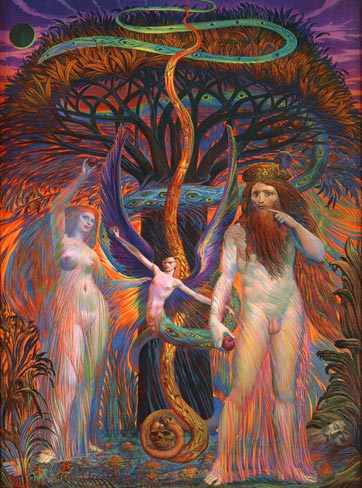
All of this, of course, is a variant of the theory of original sin. There are certainly secular and theological variants of such a position. Social conservatives will often remind us that man fell as a result of pesky woman (personally I like it when women try to get me to do things I’m not supposed to do, but that’s me), and that for this reason it is sheer arrogance or pride (sin of sins!) to imagine that we could improve this world. Tend your garden, be devout, and wait for the next. Secular variants might make some appeal to human nature or innate biology as that which renders us intrinsically inimical to such arrangements. Nevermind what ethnography might show about alternative economies and social arrangements. “Nonsense!” screams the self-assured biosociologist. Of course, those bio- psychologists and sociologists never bother much with ethnography or anthropology– After all, humans are biologically identical regardless of when and where they live, demonstrating that human nature is the same in all possible universes.I wrote: As to your comments on original sin, drive, and the political: a Kierkegaardian religious understanding of this would suggest that you can’t have a free and just society until there’s equality. Given sinfulness, though, and human finitude, that is impossible. Only God has the ability to see each in an equal way, without socio-cultural accretions occluding one’s view.
The rhetorical dimension of these arguments are clear enough. By appealing to a fundamentally flawed nature, we bar any attempt to transform society a priori. All social transformation is necessarily doomed to failure and horror because humans are necessarily flawed and horrible. Often I’m inclined to agree. Between what I’ve heard from my patients– you do learn a thing or two about people in analysis –and what I’ve observed, we’re a pretty vile lot. Nonetheless, I am not convinced by claims that such social transformations are doomed to horror. I do, however, find myself wondering whether psychoanalytic political theory does not end up unwittingly repeating this narrative of human nature. Is not the psychoanalyst saying precisely the same thing when he claims that there’s an irreducible real, that there’s always the swerve of drive, that we’re always duped by the unconscious? As a result, is not psychoanalysis an inherently conservative ideology? The question isn’t rhetorical.
On the other hand, through an awareness and continuing awareness of sinfulness and the attempt to stay on guard vis a vis that sinfulness, one can begin to follow the commandment to love neighbor and enemy. This only occurs, of course, when one realizes that given other circumstances and contingencies I would or could indeed be in the same situation as that other. Yet, it’s only with an awareness of something that provides a transcendent horizon, where nothing is ever final and ultimate in this life except death that I can find the motivation to realize the ethical and moral imperatives of that awareness.
Death is the horizon within which all things in some way gain a proper perspective. Kierkegaard doesn’t so much see death as a drive, as he does as a shirking of responsibility in one regard, an easy way out in another. This lines up with one aspect of despair, but only the passive despair that despairs of ever being oneself. Because we can’t be who we are, especially who we think we should be, then we want to die.
Westphal in his book on God, Guilt and Death, marshals Freud and Kierkegaard, throwing in Heidegger to boot, to examine the relationship between the transcendent desire to be who I am–eg, a good person, a fulfilled person–and the facing of death. In face of that, there’s a form of resentment that forms and humans begin to take out their resentment on themselves and others. Using this framework, Westphal analyzes Freud’s atheism in terms of his father’s sheepish responses to antisemitism.
Westphal has noted in another work that Kierkegaard’s political attitude begins from within the notion that all is questionable and nothing is absolute. He calls it Religiousness C, which is a form of ideology critique that takes to task any ideology that might set itself up as absolute and beyond question. At the same time, the motivation behind such critique is the awareness of sinfulness and that this brings with it an identification with the persecuted other.
Others have taken the Kierkegaardian insights in secular directions: early Marcuse, Heidegger, Sartre, Habermas, and Matustik. Most demythologize sinfulness and replace it with supposed secularized cognates. Matustik is the most consistent and most Kierkegaardian.
In her analysis of how Heidegger (mis)appropriated Kierkegaard, Patricia Huntington notes that Heidegger de-ethicizes Kierkegaard’s category of authenticity. He turns it into an ontological category, eschewing the ontic, and by doing so identifies the authentic self with an ethical substrate borne by culture and social institutions, as well as wayward ontologies. In doing this, Huntington, argues, Heidegger abstracts authentic being and thereby identifies coming to know myself as who i truly am with fate. In this regard, only some are born to be great and true selves, while others are minions of the great They.
Kierkegaard does not ontologize authenticity in this way, aware as he is that sinfulness is an individual event of personal history. The task of regaining a true self is never identified with that realm of historical sin which he recognizes as original sin and which, it seems, Heidegger inappropriately identified as a form of necessary historical unfolding.
I would suggest that the Xtian Right makes the same category mistake that Heidegger did. That is, they ontologize original sin, thereby making the problem of modernity a problem of ethos. Therefore, you want to change what’s wrong with America or the world, you must change the ethos. They do not follow, obviously, Heidegger’s route of destruktion, but instead do so via various strands of natural theology, whether Thomistic or Calvinist/Lutheran.
--------------------------------------------------
Unlike thinkers before or after him, Kierkegaard understood the compelling nature of thinking through problems about what it means to be a human being. He also understood the passion that is faith and how it can bring peace and understanding in a world where all values and traditions have become empty.
For Kierkegaard, sinfulness is a state in which we are prone or motivated to sin. This state psychological in the sense that sinfulness occurs when we relate ourselves to others and the world through thoughts, desires, and behavior. The way we desire something determines how we think about others and what we do in the world to accomplish those things that will bring us happiness.
In Christian theology, the main source of human unhappiness is original sin. According to this way of thinking, the reason we can't be happy is because we are prone to sin; this means that we ultimately short-circuit all those things that might bring us happiness. Supposedly, this goes back to the original man, Adam, and his mate Eve. When they ate of the tree of knowledge of Good and Evil, which God said not to do, they sinned and were kicked out of Eden, or Paradise.
It is this original sin that some theologians say stains our personalities from birth. We are born in original sin. We are genetically engineered, so to speak, to sin, according to this view. There's some type of psycho-genetic disposition hardwired into us to do evil.
Kierkegaard disagrees with this theological understanding of sin. The origins of sin begin and end with each person. We are not hardwired to do evil. We are, though, born into a world of sin. This is the result of sins by people that have accumulated over time and in history.
For Kierkegaard, the springboard for individual sin occurs when people are afraid to face and oppose this world of sin. The world as we know it conditions who we are. While genetics plays a large part in who we are, so does the influence of society, culture, family and so on. But there is something built into the human spirit that can see the deception and hypocrisy, the evil in the world. This is what Kierkegaard calls the Nothing.
The Nothing is where we see our freedom to be who we are. It is the "possibility of possibility." We see an infinite world of possibility and we are dizzied by the things we see and could be. The world, ourselves, and those around us change and become either larger or smaller in comparison to this great world that could either be or not be. That it will be--for us at least--depends on our letting it be in one way or another.
In crises such as adolescence and other significant stages in personal growth, we realize that we have the freedom to either accept or refuse to accept society's rules and customs. We are not predetermined in the whole-sale way that some scientists might say we are. We are not simply biological cyborgs with "wet computers" as brains.
We have the natural capacity to form a distance from our environments and societies. We do not need to be what society or family or friends say we have to be. Indeed, we can to a very large extent shape and mold the very material conditions that life has thrown our way. Biology and genetics are materials to be used in fashioning a self that exhibits independence and joy.
But there is an inherent anxiety that accompanies this process. It's a risky endeavor fashioning a self from nothing. It takes courage and hard work. It takes standing up to people whom you love and respect and perhaps telling them that their way of looking at the world is either not your way or perhaps even wrong.
This creates anxiety, because people find support and safety in the rules and restrictions imposed by their societies. But by not thinking about whether these rules and customs are right or wrong, I simply join the crowd like everyone else. I do not form any relationship to the world except one that everyone else agrees with. They are not mine. Potentially I can wander aimlessly through life, never facing life's problems honestly and authentically. Life's problem is no problem as I let what others think provide the answers.
For Kierkegaard, this is an abuse of the freedom we have to choose responsibly. This type of choice is important, because if I don't do this then I am not acting ethically; I am not using the freedom to be who I am responsibly. In doing this, I also cannot be the type of human being who knows what it means to live as an individual. I only know how to live in a crowd. But crowds are notoriously amoral entities.
An ethical and moral environment is one wherein people associate with each other as individuals. For it is only as individuals who have understood themselves separately from the sinful world that they can come together to address the injustices created by that sinfulness.
The demonic arises when you reject the freedom to act in a free and responsible way, ethically, to the situations that life throws your way. The freedom to choose makes you anxious because there are no textbook answers to the way that you should respond to events. There's no recipe book on how to act ethically. If you have not cultivated the individual awareness that not only are you motivated at times by self-deceit and unconscious desires and motives, you will take the easy way out and run away from the problem.
This outlandish, if not absurd, claim comes in Kierkegaard's book on original sin, sinfulness, and the demonic. The work is a psychological look at how people gain an awareness of themselves as individuals. In doing so, they must face their freedom to be who and what they are.
As I have argued (following Kierkegaard) a main form of despair is the person who is aware they have an eternal side to them but who want to reject it and instead make something out of themselves that spites God. This person is in defiance against God because they are not happy with their place in life or with their
The reason that many who make the argument for the President's courage and going against public opinion sometimes invoke Kierkegaard's name is because he seems to assert something of the same kind. That is, the individual, one who really believes in what they are doing because they know it is right and true, will do everything in their power to accomplish that. Yet, as Kierkegaard noted, it is only within the confines of religious belief and the relationship that someone has with God that this view makes sense.
Following what either others tell you to do or giving in to self-deceit. The Christian way of life, according to Kierkegaard, is to recognize this sinful disposition and to inculcate a way of encountering the world that is ethical because responsible. Responsible because self-critical, self-critical because I have identified the freedom that comes from critical awareness of the socio-cultural norms that breed injustices and inequality.
Back to Index Read more!
0
comments
Labels:
bush,
demonic,
kierkegaard,
nihilist-politics,
religion
Tuesday, September 11, 2007
Texas George Rex Judas (Table of Contents)

Index of Postings on Texas George Rex Judas
- Texas George Rex Judas (1)
Texas George Rex Judas (2a)
Texas George Rex Judas (2b)
Texas George Rex Judas (3)
Texas George Rex Judas (4a)
Texas George Rex Judas (4b)
Texas George Rex Judas (4c)
Excursus: Original Sin and Politics
There's a lot of Kierkegaardian background to this analysis. I have tried to keep the jargon to a minimum. Yet, the background noise of so much of modern life requires a reworking and attunnement to things that one might otherwise miss. Kierkegaard is a good dissolvent for what I once heard someone call "cognitive dissonance."
Just as a side-note: It's interesting how a person can become a phenomenon. Bush as a person is probably a minuscule thing. As President, he becomes an amorphous thing that can be pulled and tugged into all kinds of silly-putty configurations (consider 1 and 2). For example, at Pat Lang's blog, I gave the following analysis:
One of my favorite scenes in Lawrence of Arabia is when the commanding field surgeon enters the Damascus "hospital" housing dead and dying Turks. The conditions are so horrendous he berates 'awrence, shouting at him "Outrageous! Outrageous." Then the nurses and others move in to clean up the crap and mess left by 'awrence's nostalgic trip to being Alexander.And who's the REAL Bush? That is indeed the question. Why it matters should really only be of importance to himself. That it concerns all of us at this time is unfortunate. As I say, the meat of these postings is not so much an attempt to get at the real George Bush as it is to identify a state of mind that afflicts many more than Bush himself. The scary thought, of course, is that might not be a REAL George Bush.
I just wish Petraeus and others (perhaps even a Senator or 2) would act in this way towards the crap-house Bush has created in Iraq. While I admire a guy like Petraeus who's willing to clean out the latrines as part of his duty, I am hoping that at the same time he's pointing out to Der Deciderer what a real f*-up he is.
Following on the attempt to psychoanalyze Bush in a previous post, I'd note that Narcissism from a Freudian analysis occurs at the same time as potty training. The Narcissist is pathologically fascinated by his/her own bodily functions and by-products. In a strange way, they see it as somehow themselves. (Need I mention the rumored predilection of Bush for flatulence jokes?)
One wonders how much Mama Bush changed baby Bush's nappies. As he went along in life Der Deciderer could certainly count on Mama and Papa Bush to clean up his messes. Then he met up with Rove, another person willing to clean up the mess--or at least smear it in ways that made Der Deciderer look like he was a prom queen and not Carrie.
Anyway, part of the message to Bush and others are things that Petraeus and Gates have left out of their quantitative analysis of Res-Iraq: over 2 million refugees; the lie that is falling body count; the ethnic cleansing.
And yes, the fact that nature indeed does hate a vacuum, and the vacuum of Iraq is sucking in all the ill-winds that the modern nation-state and colonialism tried to bottle up.
Update: I Cite points to an article at truthout that captures the tenor of the betrayal discussed in this series of posts. While the writer seems shaken by an impending sense of catastrophe, I think that he's on to something that must be stated much more clearly I suggest below that what has taken place is a betrayal of the very principles that make community possible. This can be seen as a form of soft fascism, as Richard Sennett sees it; but it is something more fundamental at work, something that ranges from seemingly innocuous things like more mistrust among people towards strangers to a cynical manipulation of public perception via distorted news stories about what's really happening.
William Rivers Pitt writes:
The joke: people say Bush and his people want to raze the core nature of the country itself by wrecking the Constitution, and they're correct. People say Bush and his people are enriching their friends beyond dreams of avarice at our actual expense, by way of war-inflated oil prices; war-captured Iraqi oil infrastructure; the orgiastic plunder of Treasury money through calamitously unsound tax cuts for Bush's pals; and through an Iraq war profiteering scam so unutterably corrupt that it bends the very light. That, and more besides, is what people say, and they're correct.JDean at I Cite adds her very academic and perhaps over-intellectualized take on what Pitt is talking about. I try to take a more pragmatic approach, using concepts and language that still hold meaning for people, though that meaning itself may be indefinable. By providing ana analysis using this mythology one can perhaps gain an insight into phenomea that are profpund just because they are so obvious. Obvious and yet insidious because they threaten unravel a social fabric and pit people against each other in fratricidal warfare.
But all that, along with everything else the Bush crew has done, just isn't enough for them. What Bush and his people really seek, at bottom, is to destroy the basic definition and literal existence of reality itself. They want to destroy reality, rebuild it according to their own blueprint, so the sum and substance of this new reality will accept as axiomatic the idea that lying, stealing and wholesale carnage are badges of integrity and moral clarity. In other words, our comprehensively understood reality today would be replaced by whatever madcap anti-reality currently exists within the walls of 1600 Pennsylvania Avenue.
Update: (via Born @ the Crest of the Empire) -- From AP
Just over half of the white evangelicals who attend church at least weekly said the war was the right decision and the extra troops were helping, while about four in 10 said the war is a success — well more than Catholics and Protestants measured in the survey.
Slight majorities of conservatives saw success in Iraq, a troop increase that is working and a war that was the right choice, a third of them or more answered each question negatively.
Related Links
- Hard-liners for Jesus By Harold Meyerson
0
comments
Labels:
atheism religion,
bush,
demonic,
nihilist-politics,
religion

 Posts
Posts