Is there anything that provides a grimmer testament to human frailty than the Abu Ghraib pictures now available on the web? When you see these pictures, many react with disgust, anger, horror, or perhaps pity. Maybe you even react dumbly and uncomprehendingly. After all, they are pictures of men stripped naked and put into positions that make no sense. You have to think the brute reality of their physical discomfort into the pictures. The pictures themselves don't breathe the sighs or the smell of bodies contorted into shapes and positions meant to humiliate and demean. Pictures don't bleed.
But there's more to a picture than what's seen. That we fill that unseen void with our own nightmares or lack of feeling or overblown sense of pity--is it there where the gulf between human and human eventually erupts and discharges its foul poisons? For no picture can grasp that image that eludes every camera, that sense of who we are and that no word will ever inscribe on paper or sand but whose carcass can taunt with nagging ignorance.
These pictures tell a mute story of desolation and desecration; the profane shock of nude men that have become nothing but masses of flesh and hooded mannequins. They elicit more of that final and ultimate irony: our safe securities are nothing but lies and self-deception. ...
One thing that the photos from Abu Ghraib do not document and perhaps cannot show is the fragile hold that custom and ritual have on our lives. You have to delve deeply into the literature to see the concerted regime undertaken by the torturers to reduce these men to mere zeroes. The awful truth revealed by this psychological desecration is that what binds us to each other is quite tenuous and that it breaks quite easily in times of crisis and stress.
Humans are indeed a product of their culture and environment. This is a sad truth that the torturers and their medical gurus know well how to exploit and destroy. To break someone down, attack, mock, and crush their most sacred customs and ideals. Isolate, intimidate, deafen with noise to disconstruct a human being into its most elemental parts. And when the human grovels at your feet begging for mercy, start to retrain it and make it compliant and scarred for life. In this condition they might even learn how to kill for you.
Humans can and will mistreat each other much like a bad dog trainer treats an untrained dog. Given the right circumstances and the right conditions, to paraphrase Simone Weil, humans are capable of the most despicable crimes. The problem is, she said, that most of us will not admit that truth to ourselves. Instead, we work under the illusion that we wouldn't do it, we couldn't do it. ...
Our leaders want us to believe that what will save us is something called civilization. The Pope, for example, has joined the choir of those singing the hosannas of western culture and civilization. (Also see 700 Club reporter's comments.) Along with Pres. Bush, the Pope tells us that Christianity itself is threatened by the terrorists. This choir makes common cause on the Scylla and Charydbis of secular relativism and Islamic fundamentalism.
Were we to sacrifice a billion lives on the altar of western culture, would it produce a society where these crimes would never again arise? Given the assumption of original sin shared by the Pope and Bush, they cannot guarantee any such thing. And given the inability of social and cultural constructs to ensure this, why should I care whether western civilization survives or not?
The Pope’s and Bush’s view makes the basis for individual salvation count on belonging to a group of believers; belonging to this group somehow works magically to obviate the consequences of individual evil--that is, just as long as I belong to the group I am saved. Like those terrorists that say their group is the one to belong to, civilization has now come to a war between what group guarantees salvation or not.
Nothing in culture or civilization will save me from having to face the evil over and over that might face me as a possibility. Never, until time itself ends. The trumpet blare to fight for and save civilization as though it means the salvation of myself is just as much a manifestation of nihilism as the nihilism that these politico-religious leaders say they are out to destroy.
Religiously minded nihilism destroys values and guts self meaning as surely and widely as does the nihilism of secularity. Both purvey a type of self-consciousness that means joining the herd. Like any other consumer movements, religious institutions cannot but mirror this process since they have bought into the presuppositions of nihilism itself. And they themselves are part of the problem.
There are millions of ways that religious nihilism accommodates with purely temporal productions a universal human desire for happiness. Not only does the loss of cultural and social roots create the types of nihilism and violence exhibited by various religious fundamentalisms--Islamic, Jewish, Xtian, and Hindu--civilization and the need to ensure its survival also produces various forms of fascistic political regimes that fill the ennui and despair with repressive and nihilistic gestures.
As Kierkegaard noted long ago, modern individuals face a stark choice: join the fundamentalist charge back to the "origins," the culture of mass mind (mirror image of secularism itself) and thereby lose your real self in mindless despair. Or one can choose to realize the temporality of existence and in radical self-choice disengage oneself from the surrounding world; self-consciously aware of one's eternal destiny.
The way of the solitary individual is a narrow gate that few will enter. The modern age is a time when the spiritual is gutted and enervated to the point that even understanding that one has an eternal self is a joke and a scandal. Unless you can regain primitivity your only health will be envy, resentment, and the anger of the mutant lashing out an alien world.
False religion and its call to group identity destroy the true desire for love and community. Merge into the faceless herd of civilizattional religion or respond to the task of becoming a self, an individual of true faith striving to attain a perfection that you know in dreams but that existence itself tells you is impossible.
Related Links
Read more!
Wednesday, November 12, 2008
Civilization@Risk
0
comments
Labels:
disgust,
kierkegaard,
religion,
torture,
xtianity

Kierkegaard Carnival III
Welcome to the December 23, 2007 edition of The Kierkegaard Carnival. After a long hiatus, I am proud to present the most recent issue of the Kierkegaard Carnival.
This edition continues in the tradition of the past two installments. The blog postings are diverse in their range of topics and include academic postings to those from non-academic bloggers, from pastoral to the everyday. The subjects chosen reflect not only those that some might consider relevant to a 19th century Dane but those that speak to the face of every day.
While there's much to thank for the ingenuity of these authors' intelligent remarks, it is the melancholy Dane's vibrant spirit that happily haunts this Christmas edition of the Carnival staged in his name. In the names of Christmases past, present, and future, it is perhaps a note of sobriety that Kierkegaard brings to the riot of Xmas greed and consumerism. I can only hope that this sobriety works as meant: not to strangle the child in its crib but to liberate the hosannas in the heavens and on earth and bring freedom and peace.
The continuing diversity exhibited by admirers of Kierkegaard's thought relates tangentially to the accusation of Levinas that Kierkegaard, like Nietzsche, practiced a "philosophy of the hammer." While it's debatable whether Kierkegaard was even a philosopher in the academic sense, it is a charge that many agree with.
From his "ambush from behind" of the Hegelian blitzkrieg through history, to his so-called attack on Christendom, Kierkegaard brought into play a formidable array of rhetorical and logical weapons against his adversaries. Yet, as Mark Dooley argues in The Politics of Statehood vs. A Politics of Exodus: A Critique of Levinas’s Reading of Kierkegaard, Kierkegaard did not only marshal an acidic wit against those who exercised power irresponsibly in the name of a bastardized religious sentiment. For those without the trappings and arsenals of real politique at their beck and call, the weak and despised at the margins, Kierkegaard had words of consolation and upbuilding. At the same time that he undermined the ideological systems of Hegel and much of western metaphysics and theology, he wrote in his discourses words that brought comfort and love.
There are some who take Kierkegaard's attack on Christendom as a major plank in a program of defense for what is commonly called western civilization. In the name of a neo-orthodox theology, this program sets itself against what it perceives as an attack from anti-civilizational forces whose malevolence is identified with the forces of Satan himself.
The theologian Richard Neuhaus, for example, has written kindly of a recent translation of Kierkegaard's Training in Christianity (a work perhaps more accurately titled Practice in Christianity, as Howard and Edna Hong translate it). Neuhaus is a member of that contemporary contingent of Christian apologists for the political ideology of the neocons. This movement has earned the title of Theocons.
Neuhaus' reading of Kierkegaard is perhaps best explained by the translation of Practice in Christianity on which he bases his foreword. By the estimable Lutheran cleric, Walter Lowrie, the translation often does read like a defense of neo-Orthodox theo-political thought. Yet, as commentators have shown, Lowrie's translations are more conservative socially and theologically than the Danish text allows. Perhaps Lowrie was only partially to blame, however, for this conservative slant. Historian Bruce Kirmmse has argued (persuasively I believe) that the effort to paint Kierkegaard as a defender of the conservative status quo was begun by literary executors while the thinker's body was still warm in the grave.
Neuhaus would argue that such work as Kirmmse's is at best academic nitpicking and at worst historical revisionism, most likely in the name of a Liberal, if not Leftist, ideological agenda. I cannot go into details here, but one can find in commentators such as Hannay, Dooley, Pattison, and Westphal an awareness that Kierkegaard's thought evolved over time. Going from a fairly aristocratic conservatism to a more and more radically social Gospel, Kierkegaard's work shows a growing awareness that to defeat the Kingdom of Satan one must attack the gatekeepers and their clerical minions. His final words against the ruling church hierarchy was therefore an attempt to bring down the edifice of institutional Christianity--Christendom--by undermining one of those pressure points of solidified power that Foucault investigates.
Neuhaus' reading--and those who would join his ranks--of Kierkegaard is not only ideologically based but based in such a way as to violate the text and the spirit of Kierkegaard's thought. While the patriots of monology despise any notion that every human act is tainted with ideology, I would suggest that this idea works its way throughout the Dane's work. I'd even be so bold as to assert that Kierkegaard would ask whether anything is ever non-ideologically based. In various guises as angst, purity of heart, despair--social conditioning and human sinfulness corrupt the heart and leave none innocent.
We all indeed stand sinful in God's eyes.Blog Postings
Kierkegaard and Aesthetics
The Christian martyr Dietrich Bonhoeffer once criticized Kierkegaard for underplaying the role that aesthetics plays in a religious life. This piece explores the struggles of an artist with some of the Dane's writings, struggles I think many of us can identify with.Kierkegaard and Bible
Anyone reading Kierkegaard's upbuilding discourses knows how much emphasis he places on living by biblical teachings. This piece introduces the reader to some of the difficulties contemporary readers of Kierkegaard might find in his reading of biblical writings.Kierkegaard and Heidegger on Dread (Angst)
A comprehensive review of Kierkegaard's concept of anxiety and how the German philosopher Martin Heidegger used it in his book, Being and Time. This is a subject that has been investigated by other commentators who note Heidegger's unacknowledged debt to Kierkegaard. Like Sartre, Heidegger relied heavily on Kierkegaard's "Concept of Anxiety," though Dreyfus thinks that Kierkegaard's Christian Discourses was more influential. Be sure to follow the rest of Michael's series on this fascinating topic at the Kierkegaard Label page.
An introspective, anti-realist dialog with Kierkegaard and other non-presences, living and dead. An imaginative and evocative dialog that calls up a side of Kierkegaard's spirit, perhaps not least his concern of love for the dead, the most perfect work of love.Kierkegaard on Love and Ethics
Investigates the still neglected aspect of Kierkegaard's ethics and looks at self-love and its role in the possibility of loving not only oneself but others. Be sure to read Barry's other postings on Kierkegaard.Kierkegaard and Theism
"A little essay I wrote against the traditional Theistic interpretation of God, and indeed, any metaphysical (mis)comprehension of the attributes of God."
Fear and Trembling
- Stephen presents Kierkegaard posted at Stephen Law
A short "Introduction to Kierkegaard on the Knight of Faith." Provides critical remarks on Kierkegaard, with a few questions that any Kierkegaardian should be ready to confront and try to answer. - Rick presents Soren Kierkegaard and Ethics posted at Ikant; A Refutation of Moral Relativism.
Explores the dilemmas posed by Kierkegaard's ethico-religious sphere. Fear and Loathing has always threatened to erupt into the personal lives of its reader's. It probably cuts as close as any writing can to real flesh and bone. The author of this piece leaves some open questions that any reader of Kierkegaard should work to answer. - Geoffrey presents thoughts on Kierkegaard and faith... posted at Shadows Veil Our Eyes....
Personal reflections on how Kierkegaard's Abraham intersects everyday life.
Kierkegaard for Living
- Allan presents Consolation of Kierkegaard posted at JHEK-JHEK WAS HERE.
The pastoral care of the Self comes in many guises. Kierkegaard says much to salve the savage heart.
Book Review
- Chris presents Fear and Trembling(Penguin Books, Great Ideas Series, ISBN 0-14-303757-9) posted at Only a Game.
Reviews the book that breaks the back of Hegelian pretensions to Xtian religious hegemony.
Kierkegaard and Politics
- Charles presents Texas George Rex Judas at the cynic librarian.
A diatribe that calls it as the writer sees it. Contains a Kierkegaardian reading of present-day events, perhaps relying too heavily on the background work of Matustik and Huntington. The background on Kierkegaard starts after the Introduction.
Online Resource
For numerous online articles about Kierkegaard, don't forget to visit Online Kierkegaard LinksThat concludes this edition. Submit your blog article to the next edition of kierkegaard carnival using our carnival submission form.
Past posts and future hosts can be found on our blog carnival index page.
If you want to host a future editions of this Carnival, use the email address at Carnival Blog to contact me.
Technorati tags:
kierkegaard carnival, blog carnival.
0
comments
Labels:
kierkegaard,
kierkegaard-carnival
Thursday, October 30, 2008
All That Oil and No Bush in Sight?
I repost the following in light of arch-conservative Milton Friedman's pronouncement that "of course" the war in Iraq is about oil:
The point I was making was that if there were no oil under the sands of Iraq, Saddam Hussein would have never been able to accumulate the resources which enabled him to threaten his neighbors, Iran, Kuwait, Saudi Arabia. And having watched him for thirty years, I was very fearful that he, if he ever achieved — and I thought he might very well be able to buy one — an atomic device, he would have essentially endeavored and perhaps succeeded in controlling the flow of oil through the Straits of Hormuz, which is the channel through which eighteen or nineteen million barrels a day of the world eighty-five million barrel crude oil production flows. Had he decided to shut down, say, seven million barrels a day, which he could have done if he controlled, he could have essentially also shut down a significant part of economic activity throughout the world.
The size of the threat that he posed, as I saw it emerging, I thought was scary. And so, getting him out of office or getting him out of the control position he was in, I thought, was essential. And whether that be done by one means or another was not as important, but it’s clear to me that were there not the oil resources in Iraq, the whole picture of how that part of the Middle East developed would have been different.
Reading over a recent Guardian Unlimited piece on Christopher Hitchens, I recalled Slavoj Zizek's comments that Hitchens has presented one of the best arguments for the so-called war in Iraq
:The one good argument for war against Iraq is evoked by Christopher Hitchens: The majority of Iraqis are Saddam's victims, and they would be really glad to be rid of him. He is such a catastrophe for his country that an American occupation in whatever form is a much brighter prospect for Iraqi citizens. We are not talking here of "bringing Western democracy to Iraq," but of just getting rid of the nightmare called Saddam. To this majority, the caution expressed by Western liberals cannot but appear deeply hypocritical. Do they really care about how the Iraqi people feel?
Of course, what Zizek gives with one hand, he takes away with another. While conceding that most western liberals are mealy-mouthed placaters when it comes to opposing real evil and tyranny, he also notes that the war with Iraq is not that kind of war--no matter what Hitchens avers. Indeed, for Zizek the Iraq debacle is symptomatic of western neoliberals and the social and economic imperialism imposed by this way of thinking.
It's an oversimplification of Zizek's argument, but it seems that he has always said that any war--no matter how noble or apparently altruistic in intent any war carried out by neoliberal countries, they will always be underpinned by less noble, more mercenary motives.
The war in Iraq is a case in point. The Bush admin has crashed and tumbled over numerous "reasons" for going to war like a drunk trying to maneuver an obstacle course.
First, we had weapons of mass destruction and the impending shadow of nuclear mushroom clouds. When that didn't pan out and no weapons were found and the nuclear threat was shown to have been based on a forgery whose origin is still unknown, the Bush admin reverted to some soporific talk of democratizing the Mideast.
Now Iraq that is slowly circling the drain into sectarian civil war, the Bush admin has supposedly dropped its mantra about staying the course in Iraq. But what has appeared unique in the new rhetoric and the old one's demise is something of a peek at the real reasons for this war and for the US presence in the Mideast.
Thomas Nadelhoffer at Truth to Power (echoing others) points to Bush's own recent statements about the reason to see the nasty deed done to the bloodiest nail and tooth:
You see, 'reasonable' citizens of the world look at these kinds of facts and conclude that we invaded Iraq in order to liberate the Iraqi people from an oppressive dictator. The delusional, paranoid, and conspiratorial, on the other hand, are crazy enough to conclude that the Bushie oiligarchy might have invaded Iraq for profit and oil.A day or so after I read Nadelhoffer's comments, I heard Pres. Bush voice the same argument again; that is, that if we allow the terrorists to take Iraq that they will gain access to Iraqi oil fields and thereby threaten US security. During his Oct 25 news conference, Bush said:
The fact that the fighting is tough does not mean our efforts in Iraq are not worth it. To the contrary, the consequences in Iraq will have a decisive impact on the security of our country, because defeating the terrorists in Iraq is essential to turning back the cause of extremism in the Middle East.Of course, few in the MSM picked up on this comment or the one quoted by Nadelhoffer (though I believe that CNN's Wolf Blitzer made passing reference to it but without pursuing its implication; CNN's own report of the news conference doesn't quote it).
If we do not defeat the terrorists or extremists in Iraq, they will gain access to vast oil reserves and use Iraq as a base to overthrow moderate governments across the broader Middle East.
And--of course--the idea is not a new one, that is, that the US' main objective in Iraq is to secure the vast oil field and reserves there. Noam Chomsky has been saying this since the beginning of the so-called war, as I have in speaking to various groups of people. Indeed, the idea that the US or another imperial power would go to war over oil was first voiced by Simone Weil in the late 1930s. I have linked several times to articles that deal with this issue, most notably the comments by former Republican strategist and insider Kevin Phillips.
While all of this may be true, I want to look at one phenomenon I have recently encountered when trying to discuss this notion about the US going to war over oil. From the beginning of the invasion I always heard people say that it cannot be about oil. That if it was about oil, it'd be ... something.
The reason I put an ellipsis there is because when people say that it can't be about oil and then are asked why it can't be, they are often speechlessly left saying< "It just can't be...". One of the more articulate responses about why it can't be is because if it is then it's wrong. That if soldiers are dying for oil it's ... just wrong.
On the face of it, there's nothing unreasonable about a country that depends on oil to run its industrial infrastructure on oil trying to secure its sources for this valuable resource. In a world where Machiavellian maneuvering displace banalities about morality, the idea seems perfectly rational, indeed overwhelmingly rational. Many people, however, simply do not want to face several factors: 1) the immense role that oil plays in our lives, 2) the effects that having no oil would have on their lives, and 3) the desire to simply deny reality when it becomes apparent when the reality is staring them in the face.
Certainly, leftists have not made enough of the oil-over-war meme. In the rather over-used phraseology of an over-worked corporate hack, leftists have not "educated" the public in this aspect of 1) the war and 2) the role that oil plays in everyday life. Yet, beyond this practical, procedural observation, there's the existential fact that even should the idea gain some discussion in the public sphere whether people would believe it, want to believe it, or simply tune it out because it is unbelievable, conspiratorial sounding, or too brutally honest that they'd rather believe anything else except that.
I have a penchant for naivety. I respect the desire to see good in all things and to trust those who tell me something. I take seriously Kierkegaard's admonition that when faced with uncertainty involving hate or love, it always incumbent to choose love:
"[E]xistence must be so arranged that you do not with the aid of certainty in knowledge slink out of revealing yourself in judging or in the way you judge. When deception and truth are presented as two equal possibilities in contrast to each other, the decision is whether there is love or mistrust in you." -- Kierkegaard, _Works of Love_Yet, this type of stance towards life does not rule out a common sense, critical eye on the machinations of the power mongers. Indeed, as Kierkegaard would have been the first to point out, those who attempt to deceive and falsely pass off truths that exploit our deepest anxieties must indeed be exposed for the liars and corrupters they are.
That argument has the distinction of giving the leaders of this country a benefit of the doubt. Imagine, on the other hand, that the scenario depicted in the movie Syriana of oil running out is not paranoid delusions. Then the leaders of this country could be seen as acting ethically, if by that you mean for the benefit of the whole. Yet, by hiding the truth of the danger and by lining the pockets of the wealthy oil barons, that ethical dimension begins to diminish as the level of corruption grows.
Ethically, the empire's leaders should level with the American public. Not in the saccharine and sanguine terms that GW tried to do several months ago with his talk about energy dependence. This talk should be as hard-bitten and to the bone as possible. It should be as black and white as possible with all the finer shades of grey included but not for the sake of cushioning the blow of the truth but to make the true light of that truth stand in its proper background.
My guess is that the truth here will be immensely bitter. Facing the facts would entail a complete redirection of the life of the community--away from excessive consumerism and take-it-all while you can life styles. It would mean a massive sacrifice of immediate pleasures and gratifications on such a large, painful scale that the US might actually look like a Spartan nation rather the ostentatious Athens that it now does.
Such an undertaking would guarantee future generations of our children at least a future. And if it is done right, that future would not have to look so spartan nor so bleak as a world in crisis because it can't feed its thirst for oil and blood might otherwise look.
My guess, though, is that there are few politicians who have the grit to bring these truths to reality for an American public more willing to delude itself because of its inability or its refusal to face the bare-knuckled ethical problems. The reasons for this are many and include the way that the republic is organized to leave a preening mass in the dark while the so-called insider elite finds its entitled glimpse of hardcore realities reason enough to govern.
The problem is that this position in the past has allowed them to moderately profit from their insider knowledge. Now, however, the lid has come off and the profit-taking and massive plunder of the public treasure has given them a taste for more and ever more. The restraint that a Protestant ethic once inculcated in the leadership has worn away and the profiteers of the republic have nothing to stabilize or stem their greed.
Related Links Read more!
0
comments
Labels:
kierkegaard,
torture
Sunday, September 07, 2008
American Neoliberalism: Intro to Demonology 101
Talk about demons appeals to the popular consciousness. Numerous works of fiction and film exploit the idea that we humans can be inhabited and made to do things that we otherwise would not do. Evil things--evil things so horrendously heinous and terrible that we'd despair of some presupposed innocence that we're born with.
Of course, the most spectacular of these films was Peter Blatty's potboiler, The Exorcist. The film based on the book made huge bundles of cash for Hollywood and spawned two sequels. The most recent, The Exorcist: The Beginning just played last year and is now on HBO.
I watched this most recent installment the other night. Beyond the obvious absurdities, and the still quaint notion that evil inhabits another woman, what struck me most was the indefatigable tenaciousness of the priest who doesn't believe in God anymore. His spiritual journey back to faith is played out against the backdrop of his loss of faith occasioned by the massacre of innocents by Nazis. While the special effects are decent, and the story is often compelling, the movie is not very convincing in showing the true meaning of the demonic.
Two recent articles show the Catholic Church's unwavering war against demons, however. Working on empirical data that demon possession is on the rise, the Church has revamped its book of exorcism, enlisted a cadre of new exorcists, and made public pronouncements of its unerring belief in the reality of the Devil. ...
In an interview with Sign and Sight one exorcist, Rev. Pedro Barrajon, claims:Cases of possession seem to me to be the evil flip-side of miracles, which are equally inexplicable, but which we can also observe. The devil is present everywhere that evil things happen within the normal laws of nature. In anyone who says: I don't accept love, the love of my brothers and sisters, the love of God. And in many places, in all massacres, in every murder, in physical catastrophes, in every concentration camp, in all evil. Sometimes he shows himself, strangely, but also in cases of possession. But he's much more dangerous where he doesn't let himself be seen, where he can't be done away with through exorcism. No question.
Such expressions, of course, meet with a skeptical guffaw from the intelligentsia. A scientific age cannot and will not believe in anything that cannot be subsumed under the aegis of empirical study. But the empirical is exactly what the demonologists work with. As innumerable ethnographic reports will tell you, demon possession is real--for those possessed and for those who witness it.
The point, of course, is that these cases are simply manifestations of psychological problems that proper psychiatric care can dispel and cure. Or so it is said. For anyone familiar with the incapacity of modern psychiatry to truly effect cures in the mentally disturbed, such claims as cure and returns to normal are irenic at best, self-delusionary at worst. If you think that prescribing powerful anti-hallucinogens and mood-altering drugs is a cure, then perhaps we need to redefine the concept of cure.
I am not saying that cases of possession aren't symptoms of deep and profound psychological problems. Indeed, I believe that modern psychiatry and psychology are correct in identifying the mundane causes of these symptoms and taking them out of the realm of the supernatural. No doubt, more people have been helped--however relatively--by the psychological treatments than by medieval treatments for possession. Again, however, this statement must be put into context. Traditional and indigenous methodologies show an amazing ability to cast out demons and integrate individuals back to social normality.
I've intentionally conveyed the impression here that I am skeptical of both the religionists who use demon posession to cover up their own connivance with power structures as well as the brainiacs who think that the demonic is simply the distorted manifestations of superstitious minds.
---------------------------------
In a recent post, I quoted Martin Matustik's characterization of Kierkegaard's understanding of the "diabolical." Contrary to every received opinion of Kierkegaard as a thinker, he was intimately concerned about the political and social events of his time. For Kierkegaard, from his post-Xtian perspective, the demonic manifests itself in ways that traditional religionists would reject and rationalists would find offensive.
In the context of US foreign policy in Iraq, Matustik identifies the the desire of Americans to appear innocent to themselves and to their friends and enemies. Matustik writes:Known to [Frederick] Douglass but lost on most contemporary Americans is the danger of an even greater evil: what Kierkegaard called the human capacity for acting “diabolically.” The “diabolical” is anyone who wills oneself to be good without having confronted one’s capacity for evil. Such a person must cling fast to false innocence because this person despairs over the question whether he or she truly is innocent. The politically “diabolical” is any regime that in despair wills its false innocence. The desire to be the innocent source of one’s power - a phenomenon we can call the despair of America - can be confronted, says Kierkegaard, by the breakdown of the false ego and its attachment to power.
Matustik calls to attention the innate tendency of Americans to impute to itself an inherent innocence when it comes to dealing with others. In a country where difference means everything yet is itself to be erased in the great melting pot, the erasure is supposed to return us to a commonly shared humanity that short-circuits the influences of tradition and cultural conditioning. But this supposed dimensionless region of individuality is a con job since it abrogates the obvious effects that environment and socio-cultural institutions and life-forms have on humans. You can’t, at the risk of becoming wraithful non-beings, abrogate personal history or the general history of your society.
The pernicious notion that society or culture does not affect an innate innocence produces individuals who are tragically unconscious of their own responsibility for evil. We go through life believing that we are simply atoms borne about by chaotic and ultimately unknowable forces. In the popular imagination, this state produces an anxiousness about the unknown that continually beckons from fictional accounts of evil forces inhabiting otherwise decent human beings. The mass production of horror and slasher films and TV programs indicates the uneasiness that many feel about their place in the universe.
On the obverse side of this coin, the scientist attempts to reduce the anxiety to physiological processes that only a scientist or expert can understand. From the notion that we are hardwired to do what we do to the idea that environment determines all our actions, the scientific lack of imagination believes that it can explain human life and thereby serve as the keystone is an edifice of a yet-to-be-determined socially engineered utopia. That the theory changes every few months based on new studies and new data; that the final explanation of the data is always put off until more data or new instrumentation is available; all this does not deter the rationalist mind from pronouncing that the end of the search for who we are is at an end.
The ethico-religious implications of this confusion are obvious. In the face of the general uncertainty about what humans really are reinforce the demand to follow rigidly defined dogmas and a nihilistic appeal to a mealy-mouthed fideism. This fideism is not the leap into the absurd of a Kierkegaard or Camus but is instead an act of despair that ultimately bolsters the prevailing machinery of power and self-interest.
For the social engineers, the uncertainty is equally unsettling yet blinded by the starry night of scientific promise they simply point to a future age when the anxiety will end. Hoping to usurp the role of oracle and prophetic office that religion served in the past, the engineers can at least point to concrete and hardcore results that supposedly prove their truth. Yet it is a truth that benefits the demonic eye in the sky that ensures social conformity and comity. It steels the mechanics of control, feeding in to the spiritual and socio-cultural fears that no psychology will ever erase but only repress.
And in their repression they combobulate and fester and breed the swirling crimes of personalistic nightmares: the serial killer, nice guy who lives next door, the consumerist queen who will kill to stay on top of the mass production fashion hill, the angst-filled adolescents stalking the halls of revenge.
For Kierkegaard and Douglass, according to Matustik, the demonic is a massive con job, perpetrated by individuals in their denial of a self beyond self-interest, as well as selves that desire to hide from themselves their own potential for perpetrating evil acts while seeming innocent.
Kierkegaard's take on evil and the demonic is situated in the individual and his/her journey to true selfhood. Given the propensity for lying to oneself and covering over one's true motives, this search often involves outright rejection of the Good simply because it is the good. Yet, the more insidious forms of the demonic, according to Kierkegaard come in the form of those who espouse religion while secretly using it to bolster their own cherished rejection of the true demands of what the Good demands.
In its wraithful obsession with denying the other, in being like the others better than them, in fearing that someone else more rights or more things or more beauty, Americans have become the walking dead crack ho of the world. Possessed by all that it denies in others and its dreams of pie-in-the-sky happiness, we stalk the stage of history like those brain-dead zombies in George Romero’s films. For as much as Americans want to be different they are just as much envious of anyone who might find a source of life-filled meaning that does not measure up to the criteria by which we gauge real success and real equality.
Read more!
0
comments
Labels:
demonic,
kierkegaard
Tuesday, January 15, 2008
"Now Is the Winter of Our Discontent" I
There are few characters in world literature as evil as Shakespeare's Richard III. Yet, to see his evil unfold we run the risk of assuming that the evil will manifest itself in words and gestures that are too easily discovered. Richard's personality and actions belie this easy perception. And that is, perhaps, the genius of Shakespeare's artistic rendering of this evil. In many ways, Richard is the paradigmatic evil modern man. His power machinations, while wholly Machiavellian, exhibit spiritual qualities that Shakespeare's study points to.Gloucester: Now is the winter of our discontent
One can ask whether Richard is not simply a study of Machiavellian cynicism and vertu. Based mostly on the common understanding of Machiavelli's book, The Prince, this understanding sees the politician as a rapacious individual willing to go to any extreme to satiate his or her thirst for power. (I will not go into historigraphical studies that add a more nuanced reading of Machiavelli, especially his republican writings, as expatiated by Skinner and Pocock.)
Made glorious summer by this sun of York;
And all the clouds that lour'd upon our house
In the deep bosom of the ocean buried.
Now are our brows bound with victorious wreaths;
Our bruised arms hung up for monuments;
Our stern alarums changed to merry meetings,
Our dreadful marches to delightful measures.
Grim-visaged war hath smooth'd his wrinkled front;
And now, instead of mounting barded steeds
To fright the souls of fearful adversaries,
He capers nimbly in a lady's chamber
To the lascivious pleasing of a lute.
But I, that am not shaped for sportive tricks,
Nor made to court an amorous looking-glass;
I, that am rudely stamp'd, and want love's majesty
To strut before a wanton ambling nymph;
I, that am curtail'd of this fair proportion,
Cheated of feature by dissembling nature,
Deformed, unfinish'd, sent before my time
Into this breathing world, scarce half made up,
And that so lamely and unfashionable
That dogs bark at me as I halt by them;
Why, I, in this weak piping time of peace,
Have no delight to pass away the time,
Unless to spy my shadow in the sun
And descant on mine own deformity:
And therefore, since I cannot prove a lover,
To entertain these fair well-spoken days,
I am determined to prove a villain
And hate the idle pleasures of these days.
Plots have I laid, inductions dangerous,
By drunken prophecies, libels and dreams,
To set my brother Clarence and the king
In deadly hate the one against the other:
And if King Edward be as true and just
As I am subtle, false and treacherous,
This day should Clarence closely be mew'd up,
About a prophecy, which says that 'G'
Of Edward's heirs the murderer shall be.
Dive, thoughts, down to my soul: here
Clarence comes. -- Act I, Sc. 1
I think there's much to the common-sense perception of Richard's evil. Its portrayal in art can be very powerful and chilling to see unfold. Yet, like much art, the freezing of evil in a moment or series of moments often exaggerates features of evil that make it grotesque and ultimately deceptive. As much fiction does, art can even sexify evil. This statement does not apply to fiction alone, though. Even news accounts can present evil in such a way that it takes on this attractive quality.
Simone Weil and Kierkegaard discuss this often overlooked tendency of literature. Without going into an analysis, I think Kierkegaard's statement about the "sympathetic antipathy" to the strange and weird makes sense. Writers can exploit this feature of the human psyche to varying degrees, depending on talent and ethical concerns. Kierkegaard himself uses the full panoply of fear and horror to create a spiritual space where the reader finds possibilities open up for different ethical and religious stances toward life.
Something of the horror that great artists can evoke is shown in the following speech of Richard III in Henry VI.
The entire production here is geared to heighten the terrifying aspects of the speech. While highly effective and aesthetically pleasing, the performance and production is so grotesque that it pulls one out of the ordinary in such a way that it is otherworldly. Obviously, this can be the purpose of art: to open up realms of possibility that give insight into our own and others' psyches.
Yet, the obverse of this type of production is that it makes evil or life in general so unreal that we cannot see evil in its mundane everydayness. This can go so far that, as Weil points out, evil becomes alluring and "sexy." From the Marquis de Sade to Anne Rice, the attraction of such artistic renditions obscures the ethical questions posed by the actions portrayed. Commenting on de Sade, for example, the Polish poet Czeslaw Milosz noted that his de Sade's work is effectively a manual on criminality.
For his part, Georg Lukacs theorized that the reason for much of this failure in ethics is the result of artistic presentation that disregards sociological, historical, and philosophical questions. For Lukacs, the realistic novel addresses these deficiencies. Basing him or herself on an understanding of historical awareness, the novelist can bring in elements that undermine the tendency of art to spectacle and moral indifference.
I will not go into the theoretical aspects of these questions in the following sections. Instead, I will look at the opening scene from Shakespeare's Richard III, specifically his opening speech. I will first do so from within the context of these comments. I will then end with comments by Kierkegaard that places the psychological type of Richard as indicative of an aspect of modern capitalist false consciousness.
Read more!
0
comments
Labels:
capitalism,
drama,
kierkegaard,
literature,
richardIII,
shakespeare
Monday, January 14, 2008
"Now Is the Winter of Our Discontent" II: Invisibility
The question about illusion and reality, the inside versus the outside of why a person acts morally or not goes back to Plato. In Republic, Glaucon--one of Socrates' questioners--asks the Greek wise man how we could ever know whether someone is really good. We can't really look into someone's soul--or whatever--after all, so how can we ever know that someone "means it" when they act justly? They might do something good, or apparently so, but that act could be part of a series of acts that end in something bad. After all, Hitler did bring Germany out of economic and social catastrophe, right?
Plato's question about the "really" good is further elaborated in the dialog when Glaucon asks about the nature of justice and suggests that if we could follow people "in imagination," we'd see that their motives were far from pure or sincere. Glaucon tells Socrates:But as for the second point, that those who practise it do so unwillingly and from want of power to commit injustice--we shall be most likely to apprehend that if we entertain some such supposition as this in thought: [359c] if we grant to each, the just and the unjust, licence and power to do whatever he pleases, and then accompany them in imagination and see whither his desire will conduct each. We should then catch the just man in the very act of resorting to the same conduct as the unjust man because of the self-advantage which every creature by its nature pursues as a good, while by the convention of law1 it is forcibly diverted to paying honor to 'equality.' The license that I mean would be most nearly such as would result from supposing them to have the power [359d] which men say once came to the ancestor of Gyges the Lydian. -- Plato, Republic
The allusion to Gyges refers to a man who discovers a ring that makes him invisible. Glaucon notes that people--everyone, it is assumed--, once released from social conventions and laws, would exploit this situation and commit forbidden and immoral acts.
The myth about the ring of Gyges is a variant of the proverbial fly-on-the wall. Were we to become flies and observe others, what hypocrisy and dissimulation would we find? Wouldn't we want to visit Ms. Goody-two-shoe's apartment and see whether she's as good as she puts out in public? In a world with stories of church leaders and good husbands who turn out to be serial killers, the shadowland that most people inhabit when it comes to dealing with their passions, faults, fantasies, and frailties belies the idea that people can act purely and without self-interest.
The relationship with how art depicts reality is pertinent here. The artist can plumb the imagination and bring to light those secret passions that others might not wish to see exposed. Great artists like Shakespeare portray the dialectic between act and motive, and the disjunction between the two becomes great art in their hands. While the question is a favorite theme of aesthetic theoreticians and even of artists like Borges, the relationship that the question has to morality is often elided if not disregarded altogether. Borges, for example, often takes his Schopenhauerian aesthetics for granted and simply sees the metaphysical conundrum posed by reality and fiction as subsuming ethical questions in the aesthetic experience of terror and paradox.
Shakespeare's Richard III (Earl of Gloucester) seems to be a complete study in this disjunction between reality and illusion. Richard is the Magus of reality--the sleight-of-mind artist who can divert attention from his true intent and put a dagger in the ribs as your attention is diverted. He is a master psychologist and knows how to play the heart strings of gullibility and vanity, disgust and shame, pride and cowardice. Yet it is too simplistic to characterize Gloucester's actions in only utilitarian terms. I will argue later that a Kierkegaardian analysis provides more insight into this character's actions. In this regard, I hope to elicit a broader perspective on Gloucester's brand of evil than the utilitarian or even the Machiavellian vs. Christian framework allows.
There is a chilling scene in Ian McKellen's portrayal of Richard that brings the "looking into the mind" of evil to birth in the viewer in a powerful way. The beginning words of the play are staged in such a way that--unlike in Olivier's version for example--we are moved from an objective, public speech listening to Richard speak to himself in the public restroom. The final words of the speech are spoken by McKellen in front of the public bathroom mirror.
The idea that this should occur in a bathroom is a stroke of genius on the director's part, I suggest. It displaces the viewer from the grand and mighty festivities of the jet set, omni-powerful and beautiful in the prior scenes and relegates it to the most plebeian space that everyone recognizes. The place where many of our bodily functions are in full display in all their disgust and privacy, where our full humanity exposes itself to us in its mundane shame and animality, where we can't hide from ourselves, is a powerful image.
This links to many subthemes that Richard's own rage at his humanity play on. In an extraordinarily powerful way, we see Richard, a man who has seen human disgust and shame at work in his very existence, reveal himself in his true milieu. In the place where we dread to tread, where we have to face ourselves in all our nudity and animality, Richard sharpens his plan and his blade of bitterness gleams brightly.
I have written before about the theme of disgust, especially in relationship to Martha Nussbaum's book on that subject. One of her theses is that disgust originates in a primitive reaction to our own humanity or animal nature. While it might seem that Richard has in some way transcended this disgust at his own deformity, I will argue later that it his rage at his own physical defects that drives him to destroy not only others but himself. This analysis will eventuate in a reference to Kierkegaard's work, The Sickness Unto Death, especially his schematic on despair.
The scene in the bathroom displays another feature. It comes while Richard speaks to his own image. Then in a truly harrowing gesture, he looks behind his shoulder, finally recognizing the presence of the observer--us. For me, at least, this scene is harrowing because I was sucked into the film convention that gives us the illusion that we, the audience, see them but they do not see us. The short moment of recognition that we have been seen by the observed object is disconcerting to say the least.
This gesture of recognition on Gloucester's part: does it make us confidants or co-conspirators? Are we to witness evil take place to learn its secret machinations or to live out in fantasy those secret desires for vengeance we might all harbor? On a deeper level, are we Gloucester's confreres because we ourselves not only find shame in our secret deformities--whether physical, psychological, or social--but also seek to avenge them on a world and a power, nature, that has made us so?
Gloucester is the epitome of illusion--of performing evil while doing apparent good. The scene depicted here clues us into the secret of Gloucester's intent. Like the fly-on-the wall we will witness evil as it unfolds, confidant to its inner workings, geared in to its windings and turns as it maneuvers through the world. The question becomes, however, whether we simply watch Richard's bloody deeds as though they are just another instance of a monster or whether we find in ourselves those same desires and deception that motivate his vast power project of illusion.
As witnesses to this project, we must decide how much the illusion redoubles itself in our own imaginations. Do we let the acid of the picture as it is etched in our souls reveal those secret reservoirs of resentment and revenge that we nurture so secretly and often unconsciously?
The idea of a nation of voyeurs and spectators goes back to Plato. In his famous allegory of the Cave, Plato describes the uninitiated and ignorant masses as living lives of passive spectatorship in a world populated by shadows. Philosophy breaks the chains of this slavery and ultimately leads the seeker to see the Real. Simone Weil update the allegory in political terms, likening the slaves to modern day film goers undergoing indoctrination via propaganda.
It is debatable that Shakespeare had such intentions in mind in his use of the soliloquy. It is not simply a literary technique in his hands, however, and in Richard III we find it used to powerful psychological effect. The fact that we watch Richard's evil plans unfold, as though looking over his misshapen shoulder, makes us complicit in a way that expands Aristotle's notion of catharsis in a profoundly disturbing way.
Kierkegaard analyzed the spectator society in depth. Basing his analysis on sociological concepts, he sees the spectator as a phenomenon endemic to modern capitalist false consciousness. Kierkegaard sees the psychological foundations for this in the human propensity to identify with others and thereby form self-identity. In modern society, the result of this is envy and much of modern psychological resentment and other ethical and moral behavior originates in this envious viewing.
The idea that we can be invisible to others, thereby losing ourselves in a world where moral culpability is lost has many sources. For Kierkegaard, Richard III epitomizes the modern self-conscious ego in its violent ferocity rebelling against the facts of environmental and genetic givenness. The existential situation we all face, in all our fragility, drives us to seek anonymity and invisibility from the stare of others. We seek to cloak ourselves in a secret world of envious self-deceit.
Richard's self-consciousness of his faults and his rebellion against the facts of his physical and social condition is simply the condition of the modern human writ large. For Kierkegaard, this complex of psychological, social, moral, and political concerns is schematized as despair. In the following, I will expand on this concept and describe further how Richard's actions render despair in a prototypical manner.
Read more!
0
comments
Labels:
deception,
drama,
evil,
kierkegaard,
richardIII,
shakespeare
Sunday, January 13, 2008
"Now Is the Winter of Our Discontent" III: The Architecture of Despair
The idea of invisibility seems to be something primitive enough to the human psyche as to ask what it is that seeks to hide, from whom, and why. In the preceding sections, I noted that Shakespeare's Richard III exploits the chasm between what others see someone do and say and the underlying reasons or motives that might be impelling to do so. The notion of an interior space or thing existing apart from an external world has come under philosophical attack.
Without going into the details of this important debate, I will simply assume in the following that the chasm exists, in whatever way it does. In doing so, I will continue focusing on Gloucester, but this time from Kierkegaard's reflective psychology. This psychology breaks from the traditional notion of a separate entity that somehow exists apart from social, biological, and political forces active in human life.[I]t is inconceivable that it has not already happened that by a generatio aequivoca [self-procreation] our generation has itself given birth to its hero, the demon, who ruthlessly puts on the dreadful theatrical piece that makes the whole generation laugh and forget that it is laughing at itself. Indeed, what other value does existence have than to be laughed at--when one has already attained the highest by the age of twenty. -- Kierkegaard, Fear and Trembling, trns. Hongs, p. 101
Gloucester is a man eaten to the core by resentment and hatred of those whose image of him makes into a less-than-human stump of a man. Cursed by life itself with a deformity that moves others to laugh in secret, Gloucester marshals his formidable self-awareness and profound understanding of psychology to turn that comic effect he produces in others onto the laughers themselves. He attacks human hypocrisy and social convention, turning it on its head, gutting the seamy underbelly of self-deception and lies that people tell themselves.
Within the microcosm of the play, it is difficult to apply the ferocity of Gloucester's actions in their social, political, and individual dimensions. What is especially difficult is seeing how the individual act embodies these dimensions in such a way that we are for the most unconscious of their influence. Gloucester's self-consciousness can be frightening in this respect. Perhaps gaining insight from his position at the margins of society, as well as his being the brunt of jokes and ridicule, he
In some ways, Gloucester is the prototypical Shakespearean fool, a person who sees the hypocrisies and vanities of life and turns his insight into jokes and irony. While it is true that Gloucester laughs at existence, his immense Machiavellian skills and thirst for power turn his actions into a horrible and terrifying joke that would threaten to turn creation itself into a farce. He wants to harness that laughter and derision thrown at him throughout his life and turn it back onto others not simply as bon mots or fool's wit but siege engines undermining the foundations that support the very beliefs we tell use to organize and channel reality into easily understood concepts and values.
Something of the farce that Gloucester tries to make of life and the continuing joke he sees life as comes, I think, in the following scene depicting his death.
Gloucester has seen into the nothing, that abyss at the core of existence where all is allowed and nothing is real except the stand a human takes. It is Kierkegaard who has schematized these psychological processes. Contrary to much of western philosophy, Kierkegaard's analysis of self-formation in relationship to social, religious, and ideological constructs undermines the notion that these are somehow eternal. The self, or whatever it is that human consciousness of itself is to be called, is a task that finds no certainty in anything other than its own desire for or flight from the freedom to exist.
Gloucester demolishes the crutches and sophistry we depend on to keep ourselves from seeing that abyss or appropriating the responsibility to make ourselves who we are. For Kierkegaard, the tendency of most humans is to react in terror at the thought that the social conventions that support us are only provisional constructs. While we are attracted to this freedom, we also fear it and run as far away as we can in the opposite direction, grasping at every banister or jetsam and flotsam that might float our way to keep us from having to face this freedom. We then lose ourselves in innumerable ways in mindless and senseless behavior.
These remarks about Gloucester lead in a direction that some might find unexpected, at least from within the psychology of capitalism (more about this later) that Kierkegaard undertakes. That is, Kierkegaard takes this notion of absolute freedom as a preliminary stage in living an authentic life. Anything less is simply one or another form of self-deceit, according to Kierkegaard.
Kierkegaard recognizes the genius that is Gloucester. Yet, as he is more than willing to admit, this genius is demonic. It is so not because it's a dumb or ignorant person who has no self-awareness. Instead, it is a demonic genius that is self-aware not only of its foibles but of the very freedom and power that gives it this self-awareness.
For Kierkegaard, humans are bio-psychic assemblages which can be constructed in varying degrees of adaptation to the social and physical environments. What brings these pieces together, so to speak, is a sense or awareness that the freedom to put them together resides in the person whose various components--the biological, historical, and physical processes--form not just the world outside but our own attitude to that world.
For Kierkegaard, this self-awareness of the various sides to what is to be human is called the self. It is a recognition and understanding of the relationship between the physical and psychological sides of human being. A key aspect of this awareness is the need to maintain a balance between these elements. They represent not only the very biological processes known from empirical study but also the values and beliefs that one builds up based on experiences of limitation and freedom, dream and reality, possibility and necessity. This self attempts to balance the various needs, desires and memories into a viable being in pursuit of happiness.
But the self is not simply a combination of the physical and psychological. There is also the very background against which this self acts and finds itself. For the various elements described above will lead only to a fragmented being without a guiding pattern, without the love and friendship that complete the whole. This pattern or guiding pattern is the other in whose face I find myself being seen and recognized for who I want to be and believe I am. Much like the android in the movie Blade Runner, the creature wishes to know its creator. For humans, these are family. When they are left, those we look to to acknowledge us and to whom we look to gain status and patterns of molding our behavior are friends and heroes.
The disrelationship of any of these elements causes despair. This notion is often associated with situations where we have no recourse to attaining something, whether that be safety, health, or goods. For Kierkegaard, however, the spiritual dimension of despair relates to the entire relationship humans form with their world, others, and themselves. Since the self is a relationship of various elements, internal and external, despair can occur at any level. People exhibit more and more despair and therefore suffer more the higher one attains consciousness of the factors comprising the self and the responsibility you have in coordinating them.
I will discuss the notion of an image and the role in plays in forming the self in the following section. This is significant especially in the context of political and historical factors that contribute to who we are. In the process, I hope to show how Gloucester exhibits that type of despair that is prototypical in a capitalist society.
Read more!
0
comments
Labels:
anxiety,
demonic,
despair,
kierkegaard,
richardIII
Sunday, September 16, 2007
Excursus: Original Sin and Politics
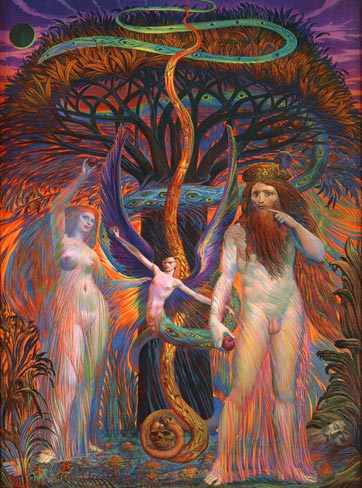
All of this, of course, is a variant of the theory of original sin. There are certainly secular and theological variants of such a position. Social conservatives will often remind us that man fell as a result of pesky woman (personally I like it when women try to get me to do things I’m not supposed to do, but that’s me), and that for this reason it is sheer arrogance or pride (sin of sins!) to imagine that we could improve this world. Tend your garden, be devout, and wait for the next. Secular variants might make some appeal to human nature or innate biology as that which renders us intrinsically inimical to such arrangements. Nevermind what ethnography might show about alternative economies and social arrangements. “Nonsense!” screams the self-assured biosociologist. Of course, those bio- psychologists and sociologists never bother much with ethnography or anthropology– After all, humans are biologically identical regardless of when and where they live, demonstrating that human nature is the same in all possible universes.I wrote: As to your comments on original sin, drive, and the political: a Kierkegaardian religious understanding of this would suggest that you can’t have a free and just society until there’s equality. Given sinfulness, though, and human finitude, that is impossible. Only God has the ability to see each in an equal way, without socio-cultural accretions occluding one’s view.
The rhetorical dimension of these arguments are clear enough. By appealing to a fundamentally flawed nature, we bar any attempt to transform society a priori. All social transformation is necessarily doomed to failure and horror because humans are necessarily flawed and horrible. Often I’m inclined to agree. Between what I’ve heard from my patients– you do learn a thing or two about people in analysis –and what I’ve observed, we’re a pretty vile lot. Nonetheless, I am not convinced by claims that such social transformations are doomed to horror. I do, however, find myself wondering whether psychoanalytic political theory does not end up unwittingly repeating this narrative of human nature. Is not the psychoanalyst saying precisely the same thing when he claims that there’s an irreducible real, that there’s always the swerve of drive, that we’re always duped by the unconscious? As a result, is not psychoanalysis an inherently conservative ideology? The question isn’t rhetorical.
On the other hand, through an awareness and continuing awareness of sinfulness and the attempt to stay on guard vis a vis that sinfulness, one can begin to follow the commandment to love neighbor and enemy. This only occurs, of course, when one realizes that given other circumstances and contingencies I would or could indeed be in the same situation as that other. Yet, it’s only with an awareness of something that provides a transcendent horizon, where nothing is ever final and ultimate in this life except death that I can find the motivation to realize the ethical and moral imperatives of that awareness.
Death is the horizon within which all things in some way gain a proper perspective. Kierkegaard doesn’t so much see death as a drive, as he does as a shirking of responsibility in one regard, an easy way out in another. This lines up with one aspect of despair, but only the passive despair that despairs of ever being oneself. Because we can’t be who we are, especially who we think we should be, then we want to die.
Westphal in his book on God, Guilt and Death, marshals Freud and Kierkegaard, throwing in Heidegger to boot, to examine the relationship between the transcendent desire to be who I am–eg, a good person, a fulfilled person–and the facing of death. In face of that, there’s a form of resentment that forms and humans begin to take out their resentment on themselves and others. Using this framework, Westphal analyzes Freud’s atheism in terms of his father’s sheepish responses to antisemitism.
Westphal has noted in another work that Kierkegaard’s political attitude begins from within the notion that all is questionable and nothing is absolute. He calls it Religiousness C, which is a form of ideology critique that takes to task any ideology that might set itself up as absolute and beyond question. At the same time, the motivation behind such critique is the awareness of sinfulness and that this brings with it an identification with the persecuted other.
Others have taken the Kierkegaardian insights in secular directions: early Marcuse, Heidegger, Sartre, Habermas, and Matustik. Most demythologize sinfulness and replace it with supposed secularized cognates. Matustik is the most consistent and most Kierkegaardian.
In her analysis of how Heidegger (mis)appropriated Kierkegaard, Patricia Huntington notes that Heidegger de-ethicizes Kierkegaard’s category of authenticity. He turns it into an ontological category, eschewing the ontic, and by doing so identifies the authentic self with an ethical substrate borne by culture and social institutions, as well as wayward ontologies. In doing this, Huntington, argues, Heidegger abstracts authentic being and thereby identifies coming to know myself as who i truly am with fate. In this regard, only some are born to be great and true selves, while others are minions of the great They.
Kierkegaard does not ontologize authenticity in this way, aware as he is that sinfulness is an individual event of personal history. The task of regaining a true self is never identified with that realm of historical sin which he recognizes as original sin and which, it seems, Heidegger inappropriately identified as a form of necessary historical unfolding.
I would suggest that the Xtian Right makes the same category mistake that Heidegger did. That is, they ontologize original sin, thereby making the problem of modernity a problem of ethos. Therefore, you want to change what’s wrong with America or the world, you must change the ethos. They do not follow, obviously, Heidegger’s route of destruktion, but instead do so via various strands of natural theology, whether Thomistic or Calvinist/Lutheran.
--------------------------------------------------
Unlike thinkers before or after him, Kierkegaard understood the compelling nature of thinking through problems about what it means to be a human being. He also understood the passion that is faith and how it can bring peace and understanding in a world where all values and traditions have become empty.
For Kierkegaard, sinfulness is a state in which we are prone or motivated to sin. This state psychological in the sense that sinfulness occurs when we relate ourselves to others and the world through thoughts, desires, and behavior. The way we desire something determines how we think about others and what we do in the world to accomplish those things that will bring us happiness.
In Christian theology, the main source of human unhappiness is original sin. According to this way of thinking, the reason we can't be happy is because we are prone to sin; this means that we ultimately short-circuit all those things that might bring us happiness. Supposedly, this goes back to the original man, Adam, and his mate Eve. When they ate of the tree of knowledge of Good and Evil, which God said not to do, they sinned and were kicked out of Eden, or Paradise.
It is this original sin that some theologians say stains our personalities from birth. We are born in original sin. We are genetically engineered, so to speak, to sin, according to this view. There's some type of psycho-genetic disposition hardwired into us to do evil.
Kierkegaard disagrees with this theological understanding of sin. The origins of sin begin and end with each person. We are not hardwired to do evil. We are, though, born into a world of sin. This is the result of sins by people that have accumulated over time and in history.
For Kierkegaard, the springboard for individual sin occurs when people are afraid to face and oppose this world of sin. The world as we know it conditions who we are. While genetics plays a large part in who we are, so does the influence of society, culture, family and so on. But there is something built into the human spirit that can see the deception and hypocrisy, the evil in the world. This is what Kierkegaard calls the Nothing.
The Nothing is where we see our freedom to be who we are. It is the "possibility of possibility." We see an infinite world of possibility and we are dizzied by the things we see and could be. The world, ourselves, and those around us change and become either larger or smaller in comparison to this great world that could either be or not be. That it will be--for us at least--depends on our letting it be in one way or another.
In crises such as adolescence and other significant stages in personal growth, we realize that we have the freedom to either accept or refuse to accept society's rules and customs. We are not predetermined in the whole-sale way that some scientists might say we are. We are not simply biological cyborgs with "wet computers" as brains.
We have the natural capacity to form a distance from our environments and societies. We do not need to be what society or family or friends say we have to be. Indeed, we can to a very large extent shape and mold the very material conditions that life has thrown our way. Biology and genetics are materials to be used in fashioning a self that exhibits independence and joy.
But there is an inherent anxiety that accompanies this process. It's a risky endeavor fashioning a self from nothing. It takes courage and hard work. It takes standing up to people whom you love and respect and perhaps telling them that their way of looking at the world is either not your way or perhaps even wrong.
This creates anxiety, because people find support and safety in the rules and restrictions imposed by their societies. But by not thinking about whether these rules and customs are right or wrong, I simply join the crowd like everyone else. I do not form any relationship to the world except one that everyone else agrees with. They are not mine. Potentially I can wander aimlessly through life, never facing life's problems honestly and authentically. Life's problem is no problem as I let what others think provide the answers.
For Kierkegaard, this is an abuse of the freedom we have to choose responsibly. This type of choice is important, because if I don't do this then I am not acting ethically; I am not using the freedom to be who I am responsibly. In doing this, I also cannot be the type of human being who knows what it means to live as an individual. I only know how to live in a crowd. But crowds are notoriously amoral entities.
An ethical and moral environment is one wherein people associate with each other as individuals. For it is only as individuals who have understood themselves separately from the sinful world that they can come together to address the injustices created by that sinfulness.
The demonic arises when you reject the freedom to act in a free and responsible way, ethically, to the situations that life throws your way. The freedom to choose makes you anxious because there are no textbook answers to the way that you should respond to events. There's no recipe book on how to act ethically. If you have not cultivated the individual awareness that not only are you motivated at times by self-deceit and unconscious desires and motives, you will take the easy way out and run away from the problem.
This outlandish, if not absurd, claim comes in Kierkegaard's book on original sin, sinfulness, and the demonic. The work is a psychological look at how people gain an awareness of themselves as individuals. In doing so, they must face their freedom to be who and what they are.
As I have argued (following Kierkegaard) a main form of despair is the person who is aware they have an eternal side to them but who want to reject it and instead make something out of themselves that spites God. This person is in defiance against God because they are not happy with their place in life or with their
The reason that many who make the argument for the President's courage and going against public opinion sometimes invoke Kierkegaard's name is because he seems to assert something of the same kind. That is, the individual, one who really believes in what they are doing because they know it is right and true, will do everything in their power to accomplish that. Yet, as Kierkegaard noted, it is only within the confines of religious belief and the relationship that someone has with God that this view makes sense.
Following what either others tell you to do or giving in to self-deceit. The Christian way of life, according to Kierkegaard, is to recognize this sinful disposition and to inculcate a way of encountering the world that is ethical because responsible. Responsible because self-critical, self-critical because I have identified the freedom that comes from critical awareness of the socio-cultural norms that breed injustices and inequality.
Back to Index Read more!
0
comments
Labels:
bush,
demonic,
kierkegaard,
nihilist-politics,
religion
Friday, September 14, 2007
Texas George Rex Judas (4c)

I have argued that not only is this impossible but that it is dishonest and can lead in some instances to a form anti-ethical action that Kierkegaard describes as "demonic." The problem with most theories of individualism is that they isolate some essence that seems to be private and independent of others. Kierkegaard is sometimes interpreted this way, as I noted above. But what Kierkegaard discusses is not an isolated individual essence but rather a psychological state that critically assesses the values and customs of any socio-cultural matrix.
There is nothing like a soul or ineffable substance that does this. Instead, we as psycho-biological entities develop the capacity to critically understand our environments in a way that shows both inter-dependence and independence. As this shows, my own independence comes from interdependence just as my interdependence relies on my independence.
The soul is one aspect of the duality that we as bodied entities are. When I formulate who I am in terms of possibility and necessity, imagination and genetics, I take an attitude towards these two poles of my (past and future) history. This way of seeing or understanding the world is a third element whose nature is neither body nor soul. Its existence exists to evaluate how the two other elements interact and how one balances them. It does so by way of various actions and linguistic formulations that bring cognitive awareness as much as they do behavioral alignment. That is, through a process of formulating in words what it is I want to be and how I will accomplish that, I undertake to do what it is that I have formulated linguistically.
This way of putting the situation is obviously inadequate. It only gives a simplistic skeletal description of the way that we as humans act and think. Yet it points up several important dimensions for understanding what the nature of the Bush "revolution" is about. That is, these considerations show that like Genet and others, Bush et al. attempt to define their missions and actions in terms of isolated entities whose overall perspective is destructive of community.
This is so, because individuals are not isolated in this way, and when they act as though they are, they become ghosts and wraiths of real selves. Consequently, any society built around such actions and understandings will eat at the very foundations of any viable community.
Kierkegaard tries to outline a mode of facing life with courage and self-knowledge that short-circuits the this demonic way of seeing or understanding life means. As I noted in the previous section, one way of denying one's responsibility that Kierkegaard was keen on combating is to put the onus of responsible choice onto history.
This means that I say that I had no choice, that history and circumstances forced me to do such and such. This type of rationalization will go so far as to say that the choices I make are somehow substantiated by history to be; that history will somehow bear me out, that I will be vindicated by historical events.
In this context, Kierkegaard pointed to the politician who appeals to history to defend his or her decision. Kierkegaard writes:
When a headstrong person is battling with his contemporaries and endures it all but also shouts, "posterity, history will surely make manifest that Is poke the truth, then people believe that he is inspired. Alas, no, he just a bit smarter than the utterly obtuse people. he does not choose money and the prettiest girl or the like; he chooses world-historical importance--yes, he knows very well what he is choosing. But in relation to God and the ethical, he is a deceitful lover; he is also one of those for whom Judas became a guide (Acts 1:16)--he, too, is selling his relationship with God, though not for money. And although he perhaps reforms an entire age through his zeal and teaching, he confounds pro virili [to the very extent of his powers], because his own form of existence is not adequate to his teaching, because by excepting himself he establishes a teleology that renders existence meaningless. (Kierkegaard, Postscript, trns. Hong, pp 136-137)It is this notion that one is only responsible to some abstraction like "history" that displays Bush's ultimate Judas self-perception. The impending chaos and meaninglessness of human life implied in such statements and view have become apparent, I think, in the destruction and human suffering currently visited upon Iraq by this man's actions. But these considerations--in the light of Kierkegaard's comment call for further analysis, which I take up in the next section.
Back to Index Read more!
0
comments
Labels:
bush,
kierkegaard,
nihilist-politics,
religion
Wednesday, May 30, 2007
What Is It That Will Solve Everything? Nothing
As Kierkegaard noted, it's not what in the past you appropriate but how you appropriate it. The history of philosophy and theology has been a quest for origins, seeking the source of the current problem, the pure self once established and somehow lost. The past must be chosen not as past but as preparation for a future.
Kierkegaard was concerned that Hegel continued the metaphysical tradition begun with Plato in seeking the source of identity and being in the pure past. Does modernity go in the opposite direction and pose a future without a past (Lockeanism)? We must find liberation in the nothingness of the present that acknowledges both the death of the past and its resurrection in a just future.
The notion of the blogosphere and the promise of infinite (impossible) identities is that nothingness that informs the basis of who we are. The play of potential selves is important but only as a tensioned antithesis to what must be. Without engaging the real world in its temporality, its finiteness, we end up being inauthentic selves.
---------
Anyway, with my very limited understanding of these issues, I was looking for a common framework (I love that word--used it in my thesis several times) for Leftist religionists to use in voicing how they see a truly (what's that?) religious response to modern issues taking shape.
I came up with several tentative tracks ( I borrow the notion from a book I recently read on Kierkegaard and Repetition):
1) there's the Nietzsche track--here, positive and negative Nihilism duke it out, with the eventual victory of der Ubermensch, a religious type that spurns all religions and lives for eternal recurrence.
a) Under this track, I place Heidegger, probably unfairly, and his notion of the time of the god(s) and its relationship to the Problem of Technology, especially Dreyfus' contention that Heidegger is actually advocating a positive vision of technology in that essay.
2) Kierkegaard and Leveling--though K did not use the term Nihilism, it does seem there are parallels between what he calls leveling and Nihilism.
Again, K like N, sees a positive and negative aspect to this historical process. The negative for K is traditional Xtendom. The positive is a process whereby leveling leads to the gutting and evisceration of all traditional values, a state of nothingness which will actually form the starting point for a new form of religiousness.
The form of this new religiousness would follow the lines of a more radical Christianity verging on martyrdom.
a) Under this track, I'd mention George Pattison's work on agnosis. Pattison has worked on a non-Christological understanding of religion that emphasizes the nothingness of everyday life as the starting point for a revitalized religious life.
Okay, that's really generalized and poorly organized. I realize its deficiencies, most notably in alluding to specialized areas of thought that might not be generally known.
It's a start, or is it? Maybe it's just drivel and all this crap is just ivory tower wannabes doing the solitary nasty in a corner, as the future proletariat will no doubt judge.
---------------
There are two aspects to the problem, I think. The first is sociological. Since that fits the temper of the age, I'll go with that first. And since I'm so much a Kierkegaardian, I'll steal shamelessly from his critique, though I take full responsibility for my interpretation of K.
The early "church" witnessed some form of struggle between those who wished to maintain an itinerant existence and those who thought that the church should organize and institutionalize. Gerd Theissen has called the former, the prophetic movement. It seems to have been in some disagreement about the understanding of Jesus' message, specifically related to the saying about having no place to lay his head.
This movement was at loggerheads with the Pauline strain which believed that forming into churches and maintaining fellowship in this way was the right interpretation. The struggle continues for some time into the later centuries, and may be part fo the reason why some of the gnostic groups had difficulties with the established hierarchy. Though not a gnostic, Tertullian's association with the Montanists may also have been part of this. Various reform movements within Christianity, especially milinialist groups also represent this undercurrent within Christianity.
Anyway, as I say, Kierkegaard recognized much of this and criticizes the early church's cozying up to the status quo and political regimes. That forms the basis of his own so-called attack on Xtendom. In psychological terms, Kierkegaard's explanation for why Xtians buy into the status quo involves a form of false consciousness called despair. The two concepts can't be collapsed into each other, though, since despair also includes the Christian notion of sinfulness.
Despair is the desire to be God on one level--Sartre borrowed heavily from K's Concept of Anxiety--and the non-desire to be who one is on another level. With consciousness comes awareness of the absolute freedom that humans have to be who they are. In much the same way that Heidegger was later--he too borrowed heavily from K's work--to analyze the THEY, K says that in reaction to this freedom we tend to fall back into reliance on various socio-cultural apparatuses that shield me from the imperative to be who I am in freedom, ie, making authentic and conscious choices.
In this framework (there's that word I love so much), Xtians who buy into the capitalist ideology and thereby provide cover for its oppressive and exploitive undertaking do so because they are in despair and cannot live with the infinite demand to be who they are, which ultimately involves doing God's will, which itself involves living an ethico-religious life that opposes all forms of oppression and injustice.
There's some correspondence, I think, between the Lacanian understanding of the Nothing and interpretations of K that start from his analysis of freedom--which itself is awareness of the nothing.
Read more!
0
comments
Labels:
kierkegaard
Sunday, December 31, 2006
Kierkegaard Carnival II - December 31, 2006
 Welcome to the December 31, 2006 edition of Kierkegaard Carnival.
This New Year's edition of the Kierkegaard Carnival includes a congeries of blog postings that cover ethical, philosophical, religious, and biographical aspects of Kierkegaard's work. The pieces provided here are interesting for their diversity of viewpoint on the themes and ideas generated by that amazing writing machine we have come to love and admire.
What strikes any first-time reader of Kierkegaard, of course, is the number of pseudonyms that he writes under. The number of pseudonyms, along with the diverging and often conflicting viewpoints they divulge accounts, perhaps, for the many interpretations of Kierkegaard's work that we find in academia, as well as in the humble pages of this little carnival.
For many people, the idea of a pseudonym means that someone is trying to hide their real name behind a fake one. The reasons for why someone might want to do this can be multifarious--ranging from the con man's alias to the lover afraid to show their true name lest they be hurt by rejection. ...
Kierkegaard acknowledged and embraced the ambivalence of the pseudonym. It allowed him to explore the wide-ranging emotional and spiritual spectrum that exhibits human being. He was wily enough to see that people will hold to their beliefs and precious prejudices no matter what data or facts appear. They must be tricked out of their mind-set to embrace the open-ended reality that is the transcendent.
Using pseudonyms also allowed Kierkegaard to experiment with different views and ways of looking at life that he did not necessarily embrace, feel equal to, or had surpassed. For example, he says that the pseudonym anti-Climacus is a writer whose version of Christianity is much far higher than Kierkegaard himself could live in his own life.
What these comments point to is a cautionary tale about seeking the real Kierkegaard. That may not be possible--and it is perhaps best so, since he the individual would have found it abhorrent to believe that any words of system could capture the uniqueness that is each and every human being.
This is not to say that the works published under his own name--especially the religious discourses--do not represent his personal beliefs and views. Yet, even here there's a progression and evolution in his ideas that often defies categorization and that is often pigeon-holed into preconceived patterns and notions.
With this said, it seems only fair to expect to find in the work of those who are inspired by Kierkegaard's work the same types of diversity that his writings display. This edition of the Kierkegaard Carnival bears out some of these remarks.
(h/t to Without Authority for the link to the Kierkegaard finger puppet that appears above)
Philosophy
Richard presents Philosophy and Literature posted at Castrovalva.Richard explores the relationship between writing, reality, and self-transformation. Exploring the meaning of irony--a concept dear to Kierkegaard's heart--Richard links up Kierkegaard's views with those of American philosopher Richard Rorty. Especially important for Richard is the notion of self-transformation and how literature--rather than philosophy--enables that activity. In this regard, he sees Kierkegaard's Fear and Trembling as lacking in that value.
William presents Soren Kierkegaard - Existentialism, Nominalism, and the Three Spheres of Existence posted at Fidei Defensor.
William provides a historical introduction to Kierkegaard's role as an existentialist in European philosophy. After providing this background, William discusses how Kierkegaard's notion of the Three Spheres of Existence provide a useful heuristic and conceptual framework in understanding the stages in the spiritual and religious life.
Ethics
Thomas at Without Authority presents- Works of Love (Part 1): Do Not the Pagans do the Same?
- Works of Love (Part 1): Against a Natural Theology of Love
- Works of Love (Part 3): Proper Self-Love
- Works of Love (Part 4): The Paradox of Forgiveness
Thomas explores four aspects of one of Kierkegaard's greatest works. Works of Loveis the one writing that puts to rest the notion that Kierkegaard was an isolated, brooding man who cared naught for anything save his eternal soul. In this work he explores the meaning of human and divine love, opening up along the way the dimensions of sociality that put into practice that divine commandment to love the neighbor and the enemy as yourself.
Religion
Allan presents Soren Kierkegaard: Postmodern Prophet: #1, #2, #3, #4, and #5 at Allan R. Bevere.Allan gives the background and context for what has been called Kierkegaard's attack on Christendom. Observing the corruption of Christianity as he saw it, at the end of his life Kierkegaard took to the streets to disseminate his biting satire on the ways that the Danish Lutheran Church--the official state church--and its leaders had betrayed original Christianity. After exploring some of this history, Allan explains how this attack by Kierkegaard has meaning for today's faithful in a postmodern world.
Anna presents Does God take leaps of faith? posted at Grace Freewill.
If there's a single set of words that most people who have heard of Kierkegaard associate with him, it is the phrase, "leap of faith," which itself is often extended to include a "blind" leap of faith. Strangely enough, none of these words appear in Kierkegaard's writings. In Concluding Unscientific Postscript, where he does talk about a leap, the meaning is that one leaps to faith, not from it. Also, the leap is quite self-conscious and not blind. Its understanding of the realities of the situation--that faith can't be proven objectively, for example--are quite apparent to the leaper. Anna provides an excellent personal review of faith, as seen from her reading of Kierkegaard's Fear and Trembling. Who indeed can understand Abraham?
Hakim presents Reasonable Criticisms of the Unconditional posted at Wa Salaam.
Although not directly mentioning Kierkegaard, this short piece investigates in skeptical manner a subject that Kierkegaard wrestled with every day of his life: Is there an unconditional reality that provides the basis for discovering who and what we are?
Arts and Literature
Augustus Young presents A Gloss on Soren Kierkegaard posted at Augustus Young: Poetry and Prose a regular webzine.Augustus devotes an entire issue of his online webzine to Kierkegaard. Inside we find scenes from a movie about Kierkegaard, as well as a small fantasia examining the correspondences (in the sense Baudelaire meant it) between Kierkegaard and PT Barnum. Did Kierkegaard really see his age as a freak show? It is difficult to say, but it is certainly true that many saw him as a freak and laughed him off the streets he so much loved to roam after nights and days of writing what he later came to say was an enterprise undertaken in the name of the common people.
Popular Culture
Charles presents Confessing America: The TV as Confessional posted at the cynic librarian.Charles remarks on a side of detective shows like CSI, Law and Order, Monk, and The Closer that he thinks deserves mention: confession of guilt. Not of the characters in these shows but the guilt of the audience who watches the shows. He closes his remarks by citing Kierkegaard on sin and envy and speculates on how these intersect with the type of social confession he thinks this genre of TV show exploits.
That concludes this edition. Submit your blog article to Kierkegaard Carnival III using our carnival submission form.
Past posts and future hosts can be found on our blog carnival index page.
Technorati tags:
kierkegaard carnival, blog carnival.
1 comments
Labels:
kierkegaard,
kierkegaard-carnival,
religion,
xtianity

 Posts
Posts