I quoted Helena Cobban in the original post. Her understanding of Mideast politics is quite extensive. In consultation with other Mideastern political experts like Juan Cole and Pat Lang, she produces some of the most in-depth analysis of Mideastern politics than anything you can find in innumerable think tanks and talking heads on the MSM.
Beamed over the MSM all day today was Pres. Bush's meeting with Shiite parliamentarian Hakim. Amid all the emprty talk and spin, I was left scratching my head in confusion about why the heck Bush was meeting this man at this time. The so-called analysis on the MSM just didn't make sense. Imagine my surprise, then, to read Cobban's understanding of what's afoot in Iraq. ...
That is, while Bush is flailing about like a drowning man but with that shit-eating grin that's really starting to get under my skin, while US troops seem engaged in an insurgency of attrition, Bush's brain trust seems to have had some type of "thinking outside the box" and brought in far left field perhaps a misstep that will not only worsen the political situation but exacerbate the carnage.
Cobban writes quite convincingly that Bush's A-Team has misjudged, misunderstood, and stepped into the cow paddy up to his hip this time.
According to Cobban, the story that the MSM's missing is that the movement that Bush should be concerned about and perhaps backing is the one being ndertaken by the very man that Bush's fascist minions are presently saying he should assassinate--or "take out" as Wolf Blitzer and Lou Dobbs so nonchalantly suggest.
Cobban writes:I mean, what is happening is that apparently Moqtada al-Sadr-- who was crudely caricatured on the Newsweek cover this week, and portrayed as some kind of near devil-incarnate-- is entering a coalition with Mutlak (a "Sooni") and Allawi (pretty much of a secularist and a fairly strongly Baath-style enforcer)-- and between them the three of them are also hoping to split Maliki's party and lure a sizeable chunk of its members over to their new Front....
You have my vote Helena for Secretary of State. Or how about a position as editor at WaPo?
Important stuff, don't you think?
The politics of the new Front haven't been described in any great detail that I've seen. But I'm fairly confident that this group of people would be fairly strongly Iraqi-nationalist and anti-occupation. (Though Iyad Allawi looms like a bit of an outlier in this regard.) They are also determinedly cross-sectarian.
So my question remains: Why don't we hear anything about this in the MSM?
I mean, I know journalists can tend to get lazy and use handy labels like "Shiite" or "Sooni" in a fairly sloppy way... But doing so at a time like the present seems to run at least two serious risks: (1) Inasmuch as western media people have any effect on attitudes in Iraq, the too-sloppy use of such labels would seem to essentialize and harden the inter-sectarian differences in question; and (2) This sloppiness leaves the average US consumer of media-- and the average US policymaker-- completely in the dark about what is really going on, while strengthening these people's beliefs that all Iraqis are simply primitive, unidimensional beings who are "consumed by ancient tribal hatreds", etc etc (and thus, that they more or less "deserve" whatever horrendous things befall them.)
PS This is an amazing little interview with al-Sadr's spokesman, Baha al-Araji. Listen to this guy; he's intelligent, articulate, knowledgeable about American politics. Imagine seeing this guy on TV--wouldn't that dispel something of the MSM's portrait of the insurgents, al-Sadr etc. as stupid, parochial blood-feeding zombies?
al-Araji says:The emergence of militias in Iraq is a natural response to the situation here. There is a principle which says that for every action, there is a reaction. So, when there are occupation forces on the ground, there should naturally be a resistance to that occupation. We choose peaceful and diplomatic resistance, so the government and the coalition forces should not exaggerate our activities. Because those of us who are affiliated with the Sadr movement are sensitive, we don’t like to provoke this contentious question.
Or maybe it's this guy that the Bush brain trust is listening to:
Do you know that 60 percent of the Mahdi Army already serves in government programs and installations? One of our biggest challenges with this issue is getting the Americans to understand it. The problem is that the U.S. leaders in Iraq, even though they are here, still think in an American way. But Iraq totally differs in its nature, its economy, and its culture from the United States.Washington is abuzz with theories offering a potential way out of Iraq, one risk expert poses a new option: split Iraq in two. "We need radical thinking. The military situation (in Iraq) cries out for political experimentation," David Apgar, a risk and development strategist and author of the book "Risk Intelligence."
Read more!
Monday, December 04, 2006
The Rabid Dog -- Exihibit A
0
comments
Labels:
fascism,
fascist,
media

Tuesday, November 07, 2006
HotShots!

The Elections, National Security Policy, and Wars If the Dems win the midterm elections, will they work with Bush? Or will there be a constitutional meltdown that could equal a bloodless purge not seen since the heydays of the fascist demise in Germany?
'Allah is my Lord and yours': Talking with Ahmadinejad The President of Iran's challenge to George Bush to live by his faith was treated as a joke by much of the press, if they even mentioned it. But really George, what would Jesus do?
"Christian" politics Evangelicals love to quote CS Lewis. But would good old CS turn over in his grave thinking about the devil's pact the Religious Right has made with the Beast, Ubu-Bush?
A Brief History of Wedge Politics An excellent review of the way politics is machined in the US--all to guarantee that certain ruling class interests are not challenged."What is called politics is comparatively something so superficial and inhuman, that practically I have never fairly recognized that it concerns me at all.....I have not got to answer for having read a single President's Message. A strange age of the word this, when empires, kingdoms, and republics come a-beggin to a private man's door and utter their complaints at his elbow! I cannot take up a newspaper but I find that some wretched goverment or other, hard pushed, and on its last legs, is interceding with me, the reader, to vote for it, - more inportunate than an Italian beggar." -- Henry David Thoreau, "Life Without Principle."
The lessons of Iraq 'state-building' Another decent posting by the commie atheists at Lenin's Tomb.
THE COMING CONSTITUTIONAL SHOWDOWN Okay, let's assume that the Reps don't intimidate, steal, deceive their way out of a Democratic win today. What might the Dems do to bring some real accountability to the political landscape, especially in getting the White House to account for its unconstitutional actions during the last six years?
Religion and Politics Analyzes recent Newsweek and Time cover stories on religion and politics--notes the odd fetish many Xtians for things sexual rather than social justice. Thank God Jesus wasn't that uni-dimensional, huh?
Religion and the Profane Investigates the intersection between the notions and how they play into the political.
Science & faith work together, Pope says The guy's got nute. While I don't believe it for a minute, it's good to hear the old dude say it and put some of the more odious neo-creationists in their place.
Dawkins Interviews Haggard Seriously. Hear the two go at it...
The Top 50 Books That Have Shaped Evangelicals In case you had some spare reading time... These are what you might call "light"reading, written for popular consumption, which might explain their ability to "shape" evangelicals.
The New Testament and the 'State' Some will say that this piece by the good Bishop of Durham is dated, perhaps hearkening to days of a liberation theology that had already been brutally oppressed by secular and religious authorities. On the other hand, you could say that the hope it conveys in staid, pedantic terms cannot never be suppressed because it always lives in people's hearts.
Read more!
Monday, September 11, 2006
Assessing the Successes of the Neocon Putsch
We'll all remember Orwell's 1984 descriptions of Winston Smith's manipulating the news, ostensibly history. The current 911 movie that ABC is showing only extends the effort by the neocons to neutralize the massive organs of cultural reproduction that are the MSM and Hollywood. Perhaps more ominously, it is the shadow of things to come as the Pentagon's efforts to "influence" the news stream becomes more integrated with the Internet. ...
It's not news that those who control the telling of history hold the reins of power. That crudely conceived cliché has been a commonplace among deconstructionists for some time. As much as the neocons and other Rightist culture warriors have castigated the Left's attachment to this deconstructionist insight, they put its truth into practice every day. I imagine the neocons and rightists believe that because they practice a historiography that espouses absolute values--versus the relativist ones of the left--their version of history is the most correct one.
It’s been said by some that the modus operandi of the neocon propaganda machine is to take the strengths of the Left and turn them against them. I think the brilliance of this propaganda machine is to take Leftist clichés and turn them on their head by filling them with neocon content. This no doubt reflects the Trotskyist background of many of these same neocons. Concepts such as fascism and international democracy take on a seemingly new and vibrant life when they find a new enemy and a new threat. Such concepts account, no doubt, for how formerly ultra-leftists like Christopher Hitchens joined the neocon cause after 911.
Americans have never liked intellectuals. The "smart-allecky" eggheads make a nuisance of asking too many questions when there's always a healthy need to see things closer to the bone. But the intelligentsia has always played a key role in asking the hard questions, keeping the corporate memory free of errors, and formulating the big issues which then get disseminated to the masses by lesser minds.
The neocons have been very effective, I think, at decapitating the US intelligentsia. This effort began directly after 911 when teachers and professors were scared into silence by threats of losing tenure if they taught a different line or interpretation from the one espoused by the neocon white house. In effect, what the neocons have accomplished is a bloodless version of what the Soviets did in 1940at Katyn to the Polish intelligentsia after it invaded Poland.
Of course, the ivory tower types often only have themselves to blame for this, since their abstruse interests rarely intersect with the reality of the masses. Still, that they would rather engage in their vicious internecine department wars than deal with the freedoms that underpin the republic will only make them less and less relevant.
The neocons have filled the ensuing vacuum left by the decapitation of the intelligentsia with their think tank luminaries like Kristol, Brooks, Perle, et al. Backed by infusions of millions of dollars from conservative backers, they’ve taken over the cultural apparatus that has solidified the basics of the republic’s intellectual heritage for 200 years. Now we face the prospect not of free and open dialog and discussion about the republic’s fate, but an ideologically based regime with effective means of disseminating that ideology.
In a speech before the Nazi Party at Nuremberg, Hitler defined what it meant to be a Nazi. What distinguished the Nazi party from every other political party, he said, was that it was a party of ideology. It would be ruled by ideology and assessed by how well and comprehensively that ideology was put into practice. Obviously, anything or anyone that questioned, opposed, or undermined this ideology was to be exterminated.
While the atmosphere of ideological intimidation that came after 911 has seemingly dissipated, there are warning signs indicating that there’s more ideologically based efforts afoot by the neocon Bush white house. Infusing the reified term fascist with the blood and skin of Islamic jihadists is one such effort. The new 911 film is another. Just as an iceberg is unseen, it seems well to determine how much the ideologically based programme of the neocons has adapted to twist the facts of history to their advantage.
In a little noticed article on the web, sociologist Richard Sennett noted that there are two types of fascism—hard and soft. The hard type is the jack boot in the face and the iron fist. The soft type is an environment of intimidation and fear that squashes all dissent, internal or external. Orwell called it thoughtcrime. We haven’t reached that nadir in ideological austerity. As the disinformation of the Pentagon-based propaganda machine ratchets up its efforts, we will face further confusion and further displays historigraphical fascism.
Read more!
0
comments
Labels:
fascism,
fascist
Thursday, August 31, 2006
Do You Have the Will (balls) to Defeat the Fascists? Or Are you Helping Them?
US Secretary of Defense Donald Rumsfeld told a crowd of American Legionnaires that not only is there a new form of fascism afoot in the world, but that there are appeasers of these fascists among us. Without exactly defining who or what these fascists are, Sec. Rumsfeld appeared to say that those who oppose his and the President's so-called "war on terror" (WoT) are appeasing these fascists.
As some commentators have already noted, a majority of Americans are against the war in Iraq. Since that war forms the cornerstone of the WoT, then it would seem that Rumsfeld is accusing many Americans of either consciously or unconsciously appeasing incipient mini-Hitlers. ...
As I have written at this blog several times, what constitutes fascism is difficult to assess because the term is used by so many on Right and Left that it can mean almost anything or nothing. In a posting on Islamic jihadism and fascism Ibn Warraq tries to correlate the teachings of Islam with a definition of fascism proposed by Umberto Eco, the Italian philosopher/novelist.
I think that Eco's definition, while accurate, is too abstract. It certainly captures the main features of the structural elements of fascism, but I wonder how useful this abstract framework is when it comes to identifying the subjective aspects of the fascist mentality. In a previous posting, I have tried to present a more "street level" exploration of fascism, which I know does not capture the more superstructure of the political aspects of the ideology but does provide a way for people to see fascism "from the inside."
In his analysis of fascism and Islam, Ibn Warraq's rhetorical strategy is to take Eco's main points and then identify incidents and Koranic verses and Hadith to show how Islam exhibits those features that Eco says are essential to fascism. Warraq starts out his essay saying the following:Islam is the quintessentially tradition-bound religion. First, the Koran is the eternal and infallible Word of God, and contains the whole of God’s final revelation to man, and must be obeyed in all its details. "This day I have perfected your religion for you and completed My favour to you. I have chosen Islam to be your faith." The Koran is immutable, "Say: ‘It is not for me to change [the Koran]. I only follow what is revealed to me. I cannot disobey my Lord, for I fear the punishment of a fateful day." "Proclaim what is revealed to you in the Book of your Lord. None can change His Words. You shall find no refuge besides Him." The Koran is a faithful and unalterable reproduction of the original scriptures which are preserved in heaven.
Now, I don't know about you, but it seems to me that you could replace Islam and Koran here with Christianity, Judaism, or Hinduism and not fall far south of verisimilitude. Indeed, in many of the points that Eco makes, one could apply those to many religious traditions, not to mention political systems and thereby "prove" that they are fascist.
I believe that a more useful understanding of fascism has come from Richard Sennett, whose article on soft fascism I have quoted several times in these pages. After differentiating what he calls hard and soft fascism, Sennett goes on to argue that Post-911 America exhibits many of the features that characterize this latter term. Sennett writes:We could think of fascism itself as either hard or soft. Hard fascism rams home to the citizen that he or she is held in that iron grip, as in Mussolini's theatre of force or George Orwell's nightmare Nineteen Eighty-four. Soft fascism is not so much a velvet glove as an invisible hand, the operations of control hidden from scrutiny as Patriot Act II, and more, internal repression presented to the public as merely preventive action against threats that have yet to materialise. The Bush administration acted in this preventive way, for instance, by shutting three of the larger Muslim charities in America, not for anything they had done, but for what might happen, some time, somewhere. In hard fascism the state exploits concrete fear, in soft fascism the state exploits diffuse anxiety.
Without going into the question of whether Mr. Rumsfeld is serving up several fallacious arguments here, most notably begging the question on what constitutes fascism, here is some of what he wrote:Someone recently recalled one U.S. senator's reaction in September of 1939. Upon hearing that Hitler had invaded Poland to start World War II he exclaimed, "Lord, if only I had talked to Hitler, all of this might have been avoided." I recount that history, because once again, we face similar challenges in efforts to confront the rising threat of a new type of fascism, with the growing lethality and the increasing availability of weapons, can we truly afford to believe that somehow, some way, vicious extremists can be appeased?
Numerous Left and Right pundits replied to Rumsfeld's accusations.Keith Olbermann wrote a response that has earned widespread recognition. Turning the tables on Mr. Rumsfeld, Olbermann accuses the Bush administration itself as being the Neville Chamberlain in the current face-off with terrorism:Mr. Rumsfeld is also personally confused, morally or intellectually, about his own standing in this matter. From Iraq to Katrina, to the entire “Fog of Fear” which continues to envelop this nation, he, Mr. Bush, Mr. Cheney, and their cronies have — inadvertently or intentionally — profited and benefited, both personally, and politically.
Other, less prominent, commentators also chimed in. Summerisle, for example, notes the following:
And yet he can stand up, in public, and question the morality and the intellect of those of us who dare ask just for the receipt for the Emporer’s New Clothes?
In what country was Mr. Rumsfeld raised? As a child, of whose heroism did he read? On what side of the battle for freedom did he dream one day to fight? With what country has he confused the United States of America?
The confusion we -- as its citizens— must now address, is stark and forbidding.
But variations of it have faced our forefathers, when men like Nixon and McCarthy and Curtis LeMay have darkened our skies and obscured our flag. Note -- with hope in your heart — that those earlier Americans always found their way to the light, and we can, too.
The confusion is about whether this Secretary of Defense, and this administration, are in fact now accomplishing what they claim the terrorists seek: The destruction of our freedoms, the very ones for which the same veterans Mr. Rumsfeld addressed yesterday in Salt Lake City, so valiantly fought."They are actively manipulating the media in this country" by, for example, falsely blaming U.S. troops for civilian deaths in Iraq and Afghanistan, he said.
"The enemy lies constantly _ almost totally without penalty," he told the veterans group, which presented him with the Dwight D. Eisenhower Distinguished Service Award. "They portray our cause as a war on Islam when in fact the overwhelming majority of victims of their terrorism have been the thousands and thousands of innocent Muslims _ men, women and children _ that they have killed."
He added, "While some at home argue for tossing in the towel, the enemy is waiting and hoping that we will do just that." "
You either have to be a master bullshitter or totally insane to make a statement like that about Iraq and Afghanistan. This level of projection against an apparant enemy, who doesn't have the weapons to wage conventional war much less have a media bureau, is so extreme that to believe in it is to believe in conspiracy theory.
[Xposted in part at Spengler Forum
Read more!
0
comments
Labels:
fascism,
fascist,
religion,
xtianity
Wednesday, August 09, 2006
Guilt, Israel, Radical Evil, and Beyond
Pat Lang is known for his realpolitik. A former military man, he sees war through a pretty clear lens and multiplies his perception with intelligence, experience, and learning. His views on the Israeli invasion of Lebanon are unique in this regard, as well as in their ability to raise questions and present perspectives that you just don't find in the mainstream media.
Given this background, you'd expect a less sentimental view of the Mideast conflict than from many others. ...
In one of his postings on the Israeli-Lebanese conflict, Lang takes on Charles Krauthammer's view that Israel is an investment by the US. Lang's analysis here is somewhat ironic, since he's taking on the neocon view that Israel is fighting in US interests and that Israel's interests are US interests.
At the beginning of his analysis of Krauthammer's article, Lang summarizes the sentiments behind much US popular support for Israel. Lang writes:The Holocaust is something nearly all Americans feel strongly about. A nagging feeling of guilt still exists over the issue of whether or not antisemitism played a role in decisions about welcoming Jewish refugees to the United States in the World War 2 period. Did we Americans act quickly enough against Hitler? Are we really not prejudiced against Jews? In spite of the evidence presented by the prominence of Jews in our society, these feelings of guilt linger on.
Lang clearly states the way that many in the US feel toward Israel. The atrocities experienced by Israel throughout history call for a deep and profound sense of reflection on how a single people can undergo so much pain and yet maintain their heritage and their sense of self throughout.
What's important to note in Lang's remarks is its expression of guilt. It's not obvious that I or anyone should feel guilt for what happened to Israel. In most respects, I would probably not know anything about Israel if I had not grown up in the culture I have. Lang points to particular instances where the US did not do enough to help Jews who fled Nazi Germany.
This inaction or even indifference toward their plight is sufficient reason to feel guilt. Given this guilt, we are compelled, it’s often asserted, that we should help and support Israel’s interests in the Mideast since one of the reasons for the founding of that nation is that Jews will never once again face the possibility of persecution by other countries. Indeed, any military action taken by Israel after its founding has been portrayed in these very terms; that is, the fight of Jews against another Holocaust.
Guilt is one of those strange phenomena that can be tied to both real and imagined offenses. This offense can be against anything a person feels is worthy of respect, an authority to whom I owe something that often rises above simple monetary payment. That is, while I expect to get a thing or something similar in return for paying a price, with guilt the return is a seemingly subjective event that others might or might not understand.
In ancient religious practices, guilt is often pictured as a stain or impurity that attaches itself to a person. In more literal explanations this can even be seen as skin diseases or physical infirmities. Perhaps there's no greater testament to this view than that illustrated in the Hebrew book of Job. Job, innocent and "righteous" as he is, is struck down with not only the death of his children and loss of his property but is touched with a horrible skin disease whose boils he scrapes off with potsherds.
Job's friends allude numerous times to the fact that these events and the disease is the consequence of some sin committed by Job. To return to health, Job must confess his guilt. But, as Job asserts over and over again, his innocence is complete. His mind is clear of any fault that could cause guilt.
Few are as innocent as Job believes himself to be. Yet many suffer tremendously and have visited upon themselves many evils that Job would understand deeply, from the inside. Given the fact that few are guiltless or who feel that they have committed nothing to cause guilt, it's not hard to see how many consider the present circumstances in the world to reflect their own guilt.
When one faces horrendously evil crimes such as the Holocaust, the feelings of guilt become even more profound. We all seem implicated in these terrible events. The atrocities committed, the demonic means used to entice people to their deaths, the factory system developed to systematically and coldly kill innocent men, women, and children--all impinge in some way on conscience and call for not simply an expression of horror but a complaint against creation itself.
How could we have let that happen? In a world filled with such evil, the notion expressed by French philosopher Jacques Derrida that we are all guilty yet not guilty becomes understandable, if still disturbingly paradoxical. Its disturbing aspects are the recognition that living in a world with others brings to bear interdependencies and associations that carry with them historical actualities that we may not even be aware of bit that may have a blood-soaked hand attached.
This knotted world of contingency, where innocence is an illusion that the snake-oil preachers wish to sell, involves too much pain and suffering--too much history for anyone to ever be guiltless. The desire to be so or to believe that you are either self-delusive or demonic.
But once you suffer, once you have been reduced to nothingness, there is the desire to say that the suffering was for something, that it earned you something. One thing it could earn you, of course, is the right to exact vengeance on the world. Suffering teaches me justice and my suffering itself becomes the measure of justice. Who will measure up to the nothingness that fills my memories, seeps into my bones and makes them ache for an echo of retribution?
How else explain comments like the following quote from an Israeli politician. Lenin's Tomb quotes:To those who are disturbed by the images of Lebanese refugees, Itzik said: "There is no nation who can teach us what it means to a refugee and uprooted. They invented the term 'refugee' for us. Enough of the self-flagellation and the self-righteous moral preaching. Anyway we are conducting this war with one hand tied behind our back because of our interest in protecting humanitarian and moral principles against a murderous enemy who makes no distinction and value of human life. I am still waiting for the first Hizbullah members, the first Lebanese, who will express regret or apologize for the suffering of innocent people on the Israeli side."
It is not uncommon for victims of great atrocity to feel guilt. As irrational as that may seem. The victim feels perhaps that they invited the pain or suffering, something in their behavior of lives brought about the conditions in which attack seems justified. What makes this picture even more warped and contorted is the notion that perpetrators themselves can use these feelings to bend the victim to his or her purposes.
As Freud and others who have tried to understand the labyrinth of guilt have shown, along with guilt goes the need for punishment. The punishment is expected and when it does not come, a person will often do something to bring about punishment. Yet, that feeling for punishment can just as easily become the desire to punish others. Whether innocent or guilty, all are seen as complicit in the web of deceit and illusion that brought about the pain and suffering visited upon me.
The guilt-punishment dialectic often turns into a vicious circle of vengeance and retribution. While Freud and others attempted to neutralize the cycle through understanding the guilt. This process involves identifying the source of guilt, talking about it, and understanding its emotional effects. By shining the light of reason on the source–seeing the guilt as perhaps a misunderstanding of what happened (still thinking as a child, for example) or even an attempt to hold on to the guilt for the emotional effect itself–the guilt and its associated need for punishment will disappear.
Perhaps it is right to search through one’s conscience to identify the sources of our guilt feelings. Yet, as once guilt feelings come to the surface and we begin exploring their sources it also often comes to light that there is something in the human psyche that wishes to do evil–above and beyond all reason, simply for the sake of doing evil. Carrying out his radical critique of the limits of reason, the philosopher Kant came late in life to realize this fact about human nature. He called it “radical evil.”
Commenting on Kant’s notion of radical evil, the Japanese philosopher Tanabe Hajime notes:Radical evil is impossible to comprehend from the standpoint of hermeneutics because as radical it is something from which the self cannot be released by the self’s own power. It is a transcendent moment of negativity for which the self will always be guilty as long as it exists. It is the dark abyss that cannot be annihilated by the immanent transcendence of self-consciousness. – Hajime, Philosophy as Metanoetics, p. 148
In less philosophical terms and more personal understanding, Hajime describes the appropriate understanding of one’s own impulse of radical evil is the following:I feel especially obliged to share in the corporate responsibility for irrationalities like the injustice and prejudice evident in our country [fascist Japan]. I feel responsible for all of the evils and errors committed by others, and in so doing find that the actual inability of my philosophy to cope with them compels me to a confession of despair over my philosophical incompetence. More than that, I find that this predicament obliges me–the ordinary person, ignorant and sinful, that I am–to admit that such a confession applies not only to me but to all persons everywhere who are similarly ignorant and sinful.
Related Links
Read more!
2
comments
Labels:
fascism,
fascist,
religion,
xtianity
Tuesday, August 01, 2006
Pale Horse Rider
... has an excellent review of the current Mideast crisis' players and their scripts at his blog, Ride a Pale Horse. While I don't agree with everything this blogger says, the recent posting on Israel is exceptional in several aspects. ...
First, its perspicuity is clear and it provides a wide-open lens on how the players and their different agendas calesce. He points out, for example, the relationship of Benjamin Netanyahu to Jablotinsky, an alleged fascist. EHud Olmert's assoication with Jablotinsky's heritage is also noted by this author.
Second, his selction of material is not only pinpoint and precise, but he unearths some documents not currently under discussion in the public sphere. I am particularly intrigued by the French letter of ben-Gurion.
Third, the reconstruction of events is inspired. Tying tog ether the ragged ends of everyday life, especially while we are in the midst of their occurring, is an art. The reconstruction has enough detail to support the connections that are made, although time will tell how well the picture stands up.
My favorite passage is the following:That viewpoint concurs with that of the United States administration. The control of areas rich in hydrocarbons defined by Zginiew Brzezinski and Bernard Lewis as the “arc of crisis”, ie. the arc reaching from the Gulf of Guinea to the Caspian sea going through the Persian Gulf, demands a redefinition of borders, States and political regimes: a “remodeling of the Greater Middle East,” to use the expression of George W. Bush.
Read more!
That is the new Middle East which Miss Rice claims to be the mid-wife of, and whose painful birth she is watching.
The idea is simple: substitute to the States inherited by the collapse of the Ottoman empire, smaller entities of mono-ethnic character, and neutralize those mini-states by setting up them permanently against each other. In other terms, the idea is to reconsider the secret agreements concluded in 1916 by the French and British empires, the Sykes-Picot agreements [6] and to establish rather a total domination of the Anglo-Saxons over the region. But in order to define new states, the existing ones must first be destroyed. That is what the Bush Administration and its allies have been doing since 5 years with the enthusiasm of a sorcerers apprentices.
0
comments
Labels:
fascism,
fascist
Tuesday, July 18, 2006
The Birth of Terrorism
Interesting discussion of the birth of terrorist methods in Ireland and its migration to Palestine via Zionist revisionists. One thing I found out here is that Ehud Olmert is a Zionist revisionist in the tradition of Manehm Begin. ...
According tot hese guys:The irregular warfare concept was imported to the Middle East by the Revisionist Zionists who wanted to use terrorist methods to get the British out of Palestine. There is an interesting book on the fascist Zionist movement, Revisionism, about a discussion in Warsaw during the 1930s between the movement’s founder Vladimir Jabotinsky, an admirer of Mussolini’s Fascist Italy and his disciple, future mass-murderer and Israeli Prime Minister, Menachem Begin, by Lenni Brenner, The Iron Wall: Zionist Revisionism from Jabotinsky to Shamir, about using the Irish example in Palestine to drive the British out and set up a state for the Jews. As we note that the current Israeli Prime Minister, Mr. Olmert, comes from this Revisionist Zionist tradition can we, just to be fair, refer to Israelofascists as often as we refer to Islamofascists?
Read more!
0
comments
Labels:
fascism,
fascist
Leo Strauss Waxes Poetic About Fascism
Here's an interesting discussion of Leo Strauss (via Leiter via Balkin), the father of neoconism. The posting features a letter from Strauss wherein he waxes poetic about what's right with fascism and how much he despises the democratic notion of the rule of law. Sound familiar?
The influence of thinkers on everyday life is often thought to be ridiculous. What do thinkers have to say that affects what Joe or Jill in the street think and feel and carry out their lives?
Tell that to those who suffered from Nazism or Communism--both of which were cobbled together from the books and ideas of thinkers.
Of course, for a philosopher the very thought that their ideas can have an impact on everyday life is somehow conformation of their life's work. Too many scholars and thinkers live in that proverbial ivory tower, often hermetically sealed off from the rough and tumble of "real things."
Yet, given the track record for recent philsophers--from Marx to Nietzsche--and their ideas translated into the real world is not so sanguine. The barbarities and atrocities committed in the name of their ideas should certainly make us leery of following one more thinker.
As the posting above makes clear. Strauss' ideas flirt with fascism at best or embody the fascist world-view at worst. To think that major neoconservatives have the ear of the President should cause concern.
Read more!
0
comments
Labels:
fascism,
fascist
Wednesday, July 12, 2006
Are Neocons Fascists?
There's much use of the fascist term in political dialog these days. The term comes up most naturally in connection with neoconservatism. Some would maintain that the dissimilarities between the two political ideologies allow no comparisons. On the other hand, the rhetoric being used on the neocon airwaves does sound somehow familiar, ca. 1930s. ...
The neoconservatives have had nothing more nor less on their agenda than a takeover of the government. The sooner we recognize this the better. Comparing them to fascism or authoritarians of any branch means little to most people since the horrors of those phenomena can't be brought home on a human level. For most people, talk of a government takeover in the US--where these things just don't happen--is like talking about fairies in Beulah land.
Much of the discussion about whether neocons are fascists or not still works at the level of abstractions and fog. The reality of what a takeover might look like or how it might be felt and experienced slowly seeps into consciousness and is soon forgotten. Remember the days after 911 when people walked around in a despondent funk--when people were fired for voicing minimal opposition to the so-called "war" on terrorism?
I suggest that that reality is what covers most of the dealings we have with the world now. The neocons have indeed changed the way we think about the world--and it is a much more brutish, nasty, and short-sighted vision of American ideals than has ever existed in America.
Hitler to Himmler:The discovery of the Jewish virus is one of the greatest revolutions that has taken place in the world. The battle in which we are engaged today is of the same sort as the battle waged, during the last century, by Pasteur and Koch. How many diseases have their origin in the Jewish virus! We shall regain our health only by eliminating the Jew.
It's well-known that Hitler believed Jews to be a bacillus.
Radio talk-show host Michael Savage on July 6:Liberalism is, in essence, the HIV virus, and it weakens the defense cells of a nation. What are the defense cells of a nation? Well, the church. They've attacked particularly the Catholic Church for 30 straight years. The police, attacked for the last 50 straight years by the ACLU viruses. And the military, attacked for the last 50 years by the Barbara Boxer viruses on our planet.
As Stephen T. Katz has argued in his monumnetal study of the Holocaust, the unique brand of anti-semitism that Hitler espoused was uniquely determined by the scientistic context of his time/place. Just as his anti-semitism was conditioned by this historical context, I also think the very terms of the fascistic terminology was influenced as well. The use of the virus/bacillus terminology is unique to a modern, scientistic mind-set.
The neoconservatives have had nothing more not less on their agenda than a takeover of the government. The sooner we recognize this the better. Comparing them to fascism or authoritarians of any branch means little to most people since the horrors of those phenomena can't be brought home on a human level. For most people, talk of a government takeover in the US--where these things just don't happen--is like talking about fairies in Beulah land.
Much of the discussion about neoconservatives still works at the level of abstractions and fog. The reality of what a takeover might look like or how it might be felt and experienced slowly seeps into consciousness and is soon forgotten. Remember the days after 911 when people walked around in a despondent funk--when people were fired for voicing minimal opposition to the so-called "war" on terrorism?
I am still persuaded by Richard Sennett's distinction between two forms of fascism, what he calls soft and hard fascism:We could think of fascism itself as either hard or soft. Hard fascism rams home to the citizen that he or she is held in that iron grip, as in Mussolini's theatre of force or George Orwell's nightmare Nineteen Eighty-four. Soft fascism is not so much a velvet glove as an invisible hand, the operations of control hidden from scrutiny as Patriot Act II, and more, internal repression presented to the public as merely preventive action against threats that have yet to materialise. The Bush administration acted in this preventive way, for instance, by shutting three of the larger Muslim charities in America, not for anything they had done, but for what might happen, some time, somewhere. In hard fascism the state exploits concrete fear, in soft fascism the state exploits diffuse anxiety.
I suggest that that reality is what covers most of the dealings we have with the world now. The neocons have indeed changed the way we think about the world--and it is a much more brutish, nasty, and short-sighted vision of American ideals than has ever existed in America.
The neocons practise the "double-truth" theory, which was first espoused by Plato in Republic and then taken up by Ibn Rushd (aka Averroes) and other Islamic philosophers. This theory teaches that there are truths for the unlettered and ignorant and truths for the intellectual and "scientist." In most cases, these philosophers limited the theory to divine scripture.
Neoncon theoretician Leo Strauss took over the theory from the Islamic philosophers and Plato and noted that philosophy is destructive to the state and therefore should only be practised by the initiated. He therefore backed the notion that democracy (in true Platonic and Aristotelian fashion) is a retrograde political system. The truth of political power is to be exercised by the initiated few who understand the true workings of how power and force are to be used.
There's something that Americans have never been able to face, even though they have committed atrocity after atrocity. That is the dark secret that lies behind the neocon takeover--they know that Americans will never ever allow to come to consciousness exactly how evil America’s precious innocence and ignorance are.
Read more!
0
comments
Labels:
fascism,
fascist
Tuesday, June 13, 2006
We Can Be Heroes
The following was written many years ago; I offer it as a historical oddity. It's premise is still valid--to my mind--but I'd rework and clarify my definition of the political.
Though nothing
Will keep us together
We could steal time
Just for one day
We can be heroes
For ever and ever
What d'you say
Heroes by David Bowie
Jonesboro, Arkansas. Littleton, Colorado. The pictures of young men strolling school hallways coldly and brutally shooting classmates like targets in a video game makes the blood run cold. The senselessness make the crimes so much more alien. These weren't kids who grew up surrounded by violence and despair--at least the kind we normally associate with killers, people say, as though children who do grow up in such surroundings are somehow allowed to be able to kill.
But the crimes in Colorado, Oregon, Arkansas, Pennsylvania differ from kids killing other kids over drugs, and spring from different causes. These are even more disturbing to contemplate than so-called gang violence, although it seems horrendously callus to think of children killing children as having gradations of terror. The disturbing factor in the school-yard killings is what I will call the political dimension of the crimes. This is a controversial position I hope to maintain in the following paragraphs, as well as the circumstances and repercussions of such a view, if true.
Confession of a Coulda Been Terrorist
I admit that I do not find incomprehensible the actions of the children committing the school yard slayings. I've felt similar anger. I fed on similar scenes of carnage in my adolescence. To say this does not mean I condone what they did--never. But it does mean that I have been in a psychological place and similar circumstances where that kind of violence was a possibility for me. To confess this means I can understand it.
I grew up in a town just north of the Mason-Dixon line surrounded by factories and farmland. I helped my grandparents bring in the hay, wheat and corn every summer. My father worked in an aluminum factory while my mother worked full-time as a hospital admissions clerk.
I spent my pubescence in the throes of the civil rights marches and the anti-Vietnam War protests. For several years, my favorite films were A Clockwork Orange and If. A Clockwork Orange has a perennial aura about it. Its stylized violence and vision of the future, spans generations. My teenage son loves A Clockwork Orange.
I don't think my son's seen IF, less known than Kubrick's classic. In the context of school yard killings, it is a prophetic film. Amazingly so.
IF director Lindsay Anderson's vision of two working class boys living a series of meaningless, desolate acts in an upper class boarding school, echoes the existential nihilism of Sartre and Camus. The emptiness and grainness of the film echo the lack of values that many felt in those days. This is an aspect of the glorious years of the 60s and early 70s that the image of flower power, free love, and peaceful idealism gloss over. There were also those who were drawn down darker paths where emptiness and despair lived.
Anderson's film carries on the British literary tradition of angry young working class males striking out at a society they found empty with hypocritical optimism and the decline of British influence around the world, as reflected in plays and films like Look Back in Anger. Yet, IF is noteworthy for its almost stultifying lack of eloquence. One could watch Richard Burton declaim eloquently John Osborne's words and feel moral outrage and perhaps even sympathy. Yet, Anderson's heroes have no fine moments or climactic scenes raw with emotional power. Emptiness builds on emptiness until the final brutal and bloody scenes, where the two boys lure their schoolmates' parents at graduation ceremonies into a courtyard below and mow them down with machine guns from the rooftops.
My fascination with IF was just that--mesmerized infatuation with the notion of committing a single act that would be unfathomable and seemingly incomprehensible. It would mean nothing except the raw sense of emotion that I felt during that moment of power and liberation. My freedom in that instant would stand as a testament to its power--power beyond words and beyond understanding. The ultimate power, of course, is when we hold the key to a meaning that we believe others cannot reach.
Where's the violence in all this? Well ten years of drug and alcohol abuse, black outs, aimless wandering from job to job, long periods of complete anti-social alienation and seclusion. All this time wracked by sadistic imagery and violent feelings, mainly taken out on myself, but always there below the surface. These experiences make me keenly aware of what these young men must've felt and thought when they entered those schools, ready to kill and be killed.
Beyond Words
President Clinton's words after Jonesboro present a telling testament to today's political discourse. "We don't know now and we may never fully understand what could have driven two youths to deliberately shoot into a crowd of their classmates." The President's words intone a theodicy that only a man whose religion is politics could say. I don't say that disparagingly. I refer to a possible way of understanding religion and politics in the modern world--much as the German philosopher Hegel did.
For the President, the youth of the criminals, as well as the nature of the crimes, questions very deeply held beliefs about human nature and the boundaries that define social cohesion.
These crimes are unthinkable for children. The planning, the premeditation, the predation, all point to a threshold of unthinkability surpassing the cognitive skills or even the moral resources that children are normally expected or understood to possess. Children should not be able to formulate actions that transgress these thresholds. That they could and did formulate these actions is incomprehensible, non-thinkable.
In the President's words, supernatural boundaries are transgressed; boundaries that define a properly functioning and moral society. The president's words are the shadow of a great anxiety. To break the sacred bonds that hold society together threatens to throw us into an abyss of fear and anarchy. His words try to fill in the abyss by ruling out comprehending the boys' actions. That is, by saying the actions are somehow of a supernatural order, we cannot ever hope to lay hold of the reasoning behind their acts, since there was no reasoning.
An important notion in modern America is the idea of a child's natural-born innocence. This innocence, in normal circumstances, should protect them from the possibility of murder. William Golding's novel, Lord of the Flies, depicts human nature in a different light. In Golding's novel, left to their own devices children can and will perform greatly savage acts. Golding's book is perhaps as shocking a revelation to commonly accepted notions about children as was Freud's discovery that children are sexual beings. The socially constructed nature of innocence throws us back onto the seemingly terrible vision of having no basis in reality on which to formulate a positive, irrevocably and eternally transparent, basis for moral behavior.
The problem with Golding's depiction and Freud's, however, is that they appear to say that these are permanent features of human nature. But is there such a thing as human nature? Or do we perform certain acts given certain social, political, economic circumstances? What we should realize is that human nature is not solidified, and while in some circumstances children might act like the ones in Lord of the Flies, in other situations they will act differently. As the poet William Blake was keenly aware of, innocence is often a function of social injustice and status quo.
Political Nihilism
Several months after the rampage at Jonesboro, a strange web site appeared on the Internet. Filled with discussion of cannibalism, serial murders, and anarchist diatribes, the site valorized the perpetrators of the school yard killings as revolutionaries.
Of course, it is easy to dismiss this web site as an expression of simple aberrance. The youthful creators of this web site, however misguided, saw the acts at Jonesboro as politically revolutionary. Why or how could someone look at life this way? Is it the confusion of unbalanced young minds, the joking of demented pranksters?
Political acts often involve groups of individuals exhibiting organized behavior to reach recognizable goals. Terrorism is a political act if it has a political goal such as overthrowing a government. The problem with Jonesboro and Littleton is that there is no identifiable goal. This lack of a clearly defined goal comprises what I call the nihilistic or randomness and emptiness of the actions.
Nihilism as political expression acts in direct opposition to political categories simply by opposing no counter-claims of any kind. Often, the nihilist terrorist makes completely absurd statements. It is the seemingly irrational nature that is the essence of nihilism. The violence ann the irrationality testify to the validity of the action. The violent act itself--in whatever form--is a statement of political belief. Indeed, as Albert Camus showed in The Rebel, the ultimate nihilistic act is to commit an act with no goal and no reason--a defiant bloodstained hand thrown in the teeth of what the rebel perceives as an ultimately unjust existence. Nihilistic opposition to the state is an opposition to the injustice of existence as a whole.
Some of this can be seen in the utter inability of the young men at Jonesboro to defend their actions or even to begin to describe how or why they acted the way they did. The most detailed account of the inner workings of their minds was provided by Klebold at Littleton. His rambling pages espouse everything from contradictory hatreds to some form of personal superiority to other human beings, somewhat akin to Nazi eugenics theories. The nagging question that rises from these pages, however, is still Why?
Postnational Identity
I think there's much to Camus' interpretation of political nihilism. Yet, the cultural milieus of the American teenagers and what they did before they committed these acts shows some commonalties that bring into focus sociological factors that Camus does not discuss. These factors provide the possibility of better understanding these acts on a critical and existential plane.
The key similarity is that the perpetrators of these crimes grew up in communities undergoing a clash between modern technological values and older, more traditional communities. The Littleton teenagers lived in a traditionally agrarian and ranching community that had recently become the suburban homes for Denver. The older boy at Jonesboro had lived in the city for most of his life and had moved to the more traditional community. Classmates reported him as idolizing inner city gang behavior.
The term culture war is not new in American political jargon. Beyond the cant of this term, this clash is best characterized as the clash between Christian-based value system and the more fluid, less clearly defined values of modern technological society. While the former stresses stability and rootedness, the latter recognizes fast-paced change and innovation. Instead of views and opinions passed down from generation to generation, you have every value scrutinized and tested under a microscope.
The clash can be seen in the way women's roles have changed and how this change is greeted in rural America. Traditional America sees women who seek non-traditional life-styles as either transgressing sacredly ordained roles, or seeking special rights that give them a unique social or economic status or political advantage. The animosity directed at women in such enclaves of our society can be strong, bitter, and hidden.
The issue of guns is another example of the conflict between different ways of viewing what is the right way to live one's life. In rural communities guns are seen as a rite of passage. To take away a gun is in a way to take a person's identity from them. For urban dwellers, however, there are no such rites of passage. Guns are simply a symbol of violence used in murders and other crimes.
These examples point up the notion that a vacuum exists in American culture. Children exposed to this vacuum, I am arguing, find it difficult to develop a sense of self that sustains them and provides a solid base upon which to develop a strong sense of who they are. Many children are able to make the transition through this vacuum. Yet, others do not. Those who do not fit in or are marginalized in the way that the Littleton teenagers were or even the older Jonesboro boy show how explosive living in that vacuum can be.
This type of reaction is not new. The reaction against Americanism in Islamic countries exhibits is just as violent. And the religious fundamentalist response is also important to see. What we are seeing in America is a reflection of this type of fundamentalism, but with a characteristically American twist. It has many guises--from the self-styled super-men at Littleton to the wannabe gangsta at Jonesboro. We see a form of life emerging that attempts to create self-awareness from a cultural context lacking stable values while seeking some form of coherence and meaning.
In Postnational Identity, Martin Matustik analyzes the political, cultural and psychological underpinnings of modern-day ethnic strife in Eastern Europe. For Matustik, communism was an ideological system that tried to answer all existential and socio-political questions. Its failure caused immense despair individually, since the beliefs and socio-political structures that developed around the ideology were stripped away and people were left little meaning upon which to base their actions.
Seeking a valid meaning in the face of this ideological collapse, countries and individuals moved away from systems that promised universal solutions, supposedly based on certain scientific principles and facts. Nationalistic and racial mythologies took their place. Personal identity became identified with group identity. But what is someone to do? People need a meaning their acts. For many, the collapse of communism proves how the search for certainty and absolute truths in politics cannot be based on science. Instead, they must be found in a set of values that play on differences between peoples. What sets apart is certain, and what is the same as I--culturally, physically, politically--has a psychological appeal.
Matustik proposes that we develop what he calls "open identities." People exhibiting this form of individuality would not accept any social or political institution as final and absolute, realizing, however, the need for socially responsible action. This type of individual would always remain open to the possibility that any previously accepted values are open to critique and change. On the social level this means multiculturalism and democratic socialism.
On the personal identity level, it means non-dogmatic, existentialist attitudes that confront life as a continuing and open possibility for change and redefinition. Such attitudes would enable individuals to accept difference in others, while maintaining a sense of self that did not disintegrate in the face of challenges to accepted norms from various cultural, scientific, and interpersonal encounters. The emphasis is on continued ethical responsibility to the Other--"naked openness of the face to the nakedness of the other."
For Matustik, the political and individual aspects are imperative. One must live an open society that is willing to challenge previous beliefs based on new evidence and democratic debate. But to stabilize this social form, one must have individuals who withstand an ever-changing challenge to personal self-perception. For Matustik, this means accepting the existentialist notion that identity has no pre-given basis in objectivity, but is a continuous exercise of will in the face of ever-new possibilities for meaning and self-awareness.
On the Brink
America has seen the advent of modern nihilistic terrorism not only in its schools. Self-styled militias and white supremacists, acting alone, have committed terrible acts to undermine the legitimacy of the ruling powers. The narrative that underlies the motivation for these acts presents an image of identity that stresses sameness and group solidarity. The political nihilistic response is even less well defined, taking its imagery and motivation from urban culture to video games to so-called goth life-styles to Nazi romanticism.
What these phenomena share is their response to a cultural schism in America wherein traditional values are undermined by rational debate and technological regimentation. The human animal seeks meaning in the face of the failure of traditional values. When these are not found, the potential violence is great. We must foster institutions and personal life-styles that remain open to change and difference among individuals. Without this, we will see continued violence and the eventual destruction of democratic values by fascist/nihilist factions.
Read more!
1 comments
Labels:
apocalyptic,
fascism,
fascist,
nihilist-politics,
nothingness,
religion,
xtianity
Tuesday, May 30, 2006
Fascism, Aesthetics, Nussbaum, and Disgust
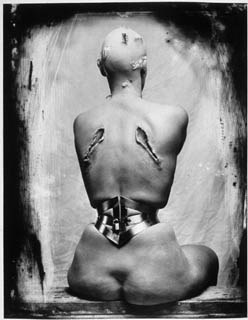 In my draft essay on fascism, I listed several important elements of fascism as I had understood them from my own experience growing up with a fascist father. One aspect of fascism that I missed in my remembrance was that of disgust--at the world, at oneself, at others. ...
I recently came across a work by Martha Nussbaum, a philosopher whose work on emotions has to be the most relevant and insightful work by a thinker in America for the last half-century. The book that has piqued my interest the most is her work on disgust, as it related to women's bodies but also more generally as it plays itself out on the wider social scale, especially in the law.
In the introduction to that work, Nussbaum writes:What I am calling for, in effect, is something that I do not expect we shall ever fully achieve: a society that acknowledges its own humanity, and neither hides us from it nor it from us; a society of citizens who admit that they are needy and vulnerable, and who discard the grandiose demands for omnipotence and completeness that have been at the heart of so much human misery, both public and private. To that extent, its spirit is less Millian than Whitmanesque: it constructs a public myth of equal humanity, to substitute for other pernicious myths that have long guided us. Such a society remains elusive because incompleteness is frightening and grandiose fictions are comforting. As a patient of Donald Winnicott's said to him (in an analysis that I shall analyze in detail in chapter 4), "The alarming thing about equality is that we are then both children, and the question is, where is father? We know where we are if one of us is the father."20 It may even be that such a society is unachievable, because human beings cannot bear to live with the constant awareness of mortality and of their frail animal bodies. Some self-deception may be essential in getting us through a life in which we are soon bound for death, and in which the most essential matters are in fact beyond our control. What I am calling for is a society where such self-deceptive fictions do not rule in law and in which--at least in crafting the institutions that shape our common life together--we admit that we are all children and that in many ways we don't control the world.
I must admit that disgust has informed some of my own aesthetic works, in terms of eliciting disgust as well as its relationship to the sublime and beautiful. I've always been fascinated by the work of Joel Peter Witkin. His photographic fanstasias play on this juxtaposition of disgust and the sublime--especially in relationship to myth.
Related Links
Read more!
1 comments
Labels:
disgust,
fascism,
fascist
Monday, May 29, 2006
Fear, Control, and the New Fascism
We face a historical watershed for the moment when the US is about to stray from democracy and become a fascist state. Perhaps the greatest assumption that underlies this watershed is that which assumes that America has a right to act as and be an empire. In the name of what morality or sense of justice known from our inherited Judeo-Christian heritage would lead you or me not to believe that the US' recent foreign adventures do not reflect that heritage but betray its very source? ...
I'll paraphrase Judith Shklar, a much underrated political philosopher. Shklar came to her views based on her experiences in Nazi Germany and the Nazi persecution and murder of Jews. For Shklar, the basis of any government is the use of fear. What a populace does in electing representatives is to give them the right to use deadly force in the name of the "people." As such, government is only able to maintain the people's trust when it shows that it does not misuse that weapon of fear and terror in unjust and inhumane ways.
Shklar is a skeptical liberal. This means that she is open to and cognizant of the many ways that humans use fear and terror for less than noble and humane reasons. Her model in this regard is Montesqieu, whose skeptical essays explore the diverse ways that people find to inflict pain and misery on their fellow human beings--whether it be by religious or political framework.There is no denying that greater equality of power would enhance the conditions for justice, but many of the plans offered for its achievement are flawed. The single most serious objection to them is not that they are radical but that they are often so paternalistic as to arouse a sense of injustice. Though they aim at a more perfect democracy, plans for the reform of existing institutions often require remaking the citizenry as well. And who exactly is competent to do so? (quoted in FEAR AND THINKING, by Peter Berkowitz)
Indeed, who can change or remake "the citizenry"? Following Shklar, I suggest, and will continue to say, that the only way for any political system to work is to support an environment in which fear is at a minimum. The campaign launched by Bush in retaliation for 911 was over-reactive and unnecessary. It bred as much terror and fear as it hoped to stem. The US response was not proportional in relationship to the threat. The outcome, of course, is that the objects of that state-sponsored terrorism gain the rightly felt identification of their co-religionists.
Indeed, Shklar's words have most recently been echoed by Iranian human rights activist and Nobel Peace-prize winner, Shirin Ebadi:Though democracy is inevitable universally, Ebadi argues that nations must be left alone to experience social crises, work through them and autonomously reach their historical imperative of free and democratic societies.Foreign interventions in the name of democracy, like the US occupation of Iraq, only delay the natural, inevitable disintegration of despotism, strengthen forces opposed to freedom and inspire hatred of external others, argues Ebadi.
The effects on the home front are just as disastrous. To carry out such a comprehensive foreign anti-terror program, the Bush administration has effectively brought on a constitutional crisis, threatened civil liberties, and bred a domestic environment of fear and distrust that undermines any legitimacy that the foreign intervention could have hoped to achieve. Instead of remaining the land of the free, America now stands on the verge of becoming the land of the fearful and paranoid.
One can only add to this laundry list of side-effects from the so-called “war on terror.” Perhaps the most disastrous effect has been the promulgation of hate-filled stereotypes and biases toward members of one of the world’s largest religions. Not only are these stereotypes untrue, they also effectively bolster the animosity on a basis that belies the religious tolerance which the US is noted for.
The stereotypes are untrue, for however much a significant minority of Moslems might say they support the Osama bin-Laden types, only a fraction of them actually think that terrorism is a viable tool for attaining their ends. Hamas and the Islamic Brotherhood are just two instances of a democratic trend that will gain momentum. Contrary to the caricature image of traditionalist Islam gaining the upper hand through the electoral process, the results in Iran—as well as countries as diverse as Pakistan, Morocco, Turkey, and so on--show that everyday Moslems want a moderate, mostly modern tolerance toward religious and political differences.
In such a context, then, what are the responsibilities of a world power? For Shklar, the ultimate criterion for any state is reducing the level of fear and terror in the world. Any country must do all it can to reduce the level of paranoia that only increases the deep-seated, mostly personal, animosities that individuals and ethnic groups have toward each other. Only a largely secularized and liberalized social framework can bring this about. But, again, such a framework must be built from the inside out, not from the outside in.
Summarizing Shklar’s views, Berkowitz writes (see URL above):Shklar's liberalism offers no greatest good, but [b]it insists that cruelty, and the fear that cruelty inspires, is the greatest evil[/b]. It regards government and its agents as the greatest perpetrators of cruelty, and [b]it pays special attention to the poor and the weak since they are the most likely to suffer[/b]. It requires not weak government but limited government, government that is strong enough to devise and to execute "public policies and decisions made in conformity to requirements of publicity, deliberation and fair procedures." It recognizes that citizens must exercise virtues such as self-restraint, respect for the claims of others, self-reliance, and moral courage, but it declares that "it is not the task of liberal politics to foster them simply as models of human perfection." It rejects the idea of rights as natural or fundamental, but it employs them "as just those licenses and empowerments that citizens must have in order to preserve their freedom and to protect themselves against abuse." It is wedded to representative democracy, the ideal of political equality, the institution of an independent judiciary, and a pluralism of political groups and interests.
[my emphases]
I suggest that the Bush admin, along with its neocon theoreticians, betrayed exactly those principles that Shklar discusses: government going beyond its bounds and bringing democracy to a world that instead must find these institutions for themselves.
Strangely enough, however, Shklar is silent about the social and personal impact of economic systems such as capitalism. It is perhaps here more than anywhere else that real change can and must occur. For economics make possible certain forms of life (most specifically along the lines of resentment and envy); and it is economic interests in liberalized societies whose control is often beyond both the citizen’s and the politician’s grasp and therefore must receive special attention.
Until the architectonics of capitalism are addressed and modified, the types of fear and terror that Shklar puts down to personal moral and character lapses will continue to foster an environment in which fear and terror are the dominant modes of control and political machinations.
For a picture of what foreign interventions create, consider the following description of Iraq from reporter Nir Rosen:Under the reign of Saddam Hussein, dissidents called Iraq "the republic of fear" and hoped it would end when Hussein was toppled. But the war, it turns out, has spread the fear democratically. Now the terror is not merely from the regime, or from U.S. troops, but from everybody, everywhere.
Read more!
Monday, May 22, 2006
Red-Neck, Trailer Park Rage Over Immigration
With the Congress' recent legislation on immigration and Pres. Bush's plan to send troops to help protect the border, much has been made in the rightist blogosphere about making sure that immigrants from Mexico not taint the purity of the American spirit.
I have maintained that much of the outrage expressed in the media and at the grass roots level emanating from the nativist undercurrent in American political life comes from a rage by dispossessed white Americans. ...
The socio-economic factors surrounding the enraged trailer redneck are paramount in understanding this rage. That rage is well-earned but it is misdirected. Their rage should be directed at a government that refuses to carry through on the promise of a revolution which was supposed to benefit everyone. The ugly fact is that the revolution has only benefited those at the top.
Bush and the Right has tried to deflect that rage by scapegoating--symbolically as you put it--the illegal immigrants. The problem is, the rage is so deep and the socio-economic disenfranchisement is so great that symbolic actions will not work. As these pundits exhibit, for the hardcore nativist nothing short of a military-style stand is enough.
One is right to note how the Bushites and the necons conned the religious right and the nativists. They played those cards, hoping to keep them at bay with largely irrelvant but ideologically powerful shadow plays.
Now, those factions want the promissory note paid. And Bush has to eat shit because he knows that if he pays them what they want, he'd look like the fascist fool many take him for anyway. The problem is the reality of his actions have not yet sunk in for Bush--he really thinks he's Gary Cooper or something. But the reality of his actions makes him out to be more like the Gene Hackman sheriff in Eastwood's Unforgiven. Witrh this issue on immigration, he's realizing the devil's pact he made with the nativists but which he thought he could wiggle out of.
On the other hand, the evangelical Xtians are pretty conflicted about the immigration issue, it seems. If true, then Bush is alienating some part of his evangelical base.
According to CBN News:But other evangelical Christians are torn between a biblical belief in law and order, and the commandment to love one's neighbor.
Read more!
When Marc Galli, the editor of Christianity Today, wrote an editorial praising illegal immigrants, he received a flood of angry emails.
Galli said, "The feeling was that if we allow illegal immigrants in and if we don't hold them accountable -- the illegal immigrants that are here -- we are going to have anarchy."
"What's concerning to some evangelicals,” said Tony Perkins of the Family Research Council, “is that immigration has gotten out of control. And there's the illegal side of immigration - not the legal side - that causes concern."
But in the end, Vallet believes her response to the immigration debate is in line with what Jesus would do.
She said, "There is law, of course, but there is also this thing called grace."
0
comments
Labels:
fascism,
fascist,
religion,
xtianity
Wednesday, March 08, 2006
Afghan Women Bare It All
In a letter from inside Pakistan, Afghan women celebrate international women's day...
in tears and ashes, fear and trembling as the fundamentalists and American sycophants continue the oppression, rape and abuse, robbery and degradation of their honor.
According to an email, the Revolutionary Association of the Women of Afghanistan (RAWA):Let’s rise united and resolute for liberation and against the fundamentalism!
Related Links
Read more!
Another Eighth of March has arrived but still the Afghan women are hostage to the fundamentalists’ claws. The continuation of traitor-loving policies of Mr. Karzai and his sympathetic friends by the indication of US government is still like spears entering deeper and deeper into the injured face of our unfortunate people. Whenever the criminal “Emirs” and their commanders commit another heinous crime, instead of being sued, they are rewarded and receive higher posts.
Murder, robbery, kidnapping and the rape of women and children has become the routine. There is a high rate of women committing suicide and an ever expanding cultivation and trafficking of narcotics, all while billions of dollars of foreign aid and public resources are squandered away. Unemployment and homelessness is on the rise. Opening of Kabul Serina Hotel and other hotels of this type in a country with the lowest rate of income per capita in the world doesn’t mean development but it is indeed providing sensual environment for criminals and mocking about the miserable life condition of majority of our nation. The compromising government is unable even to solve smallest of these issues. The country is in chaos.
The last four years of experience in our Afghan nation has confirmed the point that for the government of Karzai, the will of our oppressed nation is not the priority but it is the interests of criminals. Mr. Karzai doesn’t want to and can’t destroy the band of criminals from Afghanistan because the interests of both parties are intertwined.
In the presidential elections the majority of our people gave their votes to Mr. Karzai in the hope that he will prosecute and punish all the criminal fundamentalists for their crimes and atrocities. But he betrayed the vote of the people. That is why in the parliamentary elections, our deceived and hopeless people knew whether they vote or not, the composition of parliament will be made behind the scenes. Jehadi executioners were placed into parliament in order to guarantee the ability to pass and enforce laws that oppress the common people and the country, legitimize the signing of the "Strategic treaty between USA and Afghanistan" and other similar oppressive treaties.
RAWA has stated several times that the government, the court and parliament under the domination of the criminal “Northern Alliance”, the Taliban, Gulbuddini, Parchami and Khaliqi traitors, will never do any good for our bereaved people. Against the unsubstantiated accusations of collaborators that RAWA’s criticisms and attacks on government are always from a negative point of view, treacherousness and corruption has meshed around the roots of government so deeply that its nasty smell has not only been published in the world’s most respected publications; but even Habibullah Qaderi the so called minister of anti-narcotics and Ali Ahmad Jalali, former interior minister, have been forced to confirm that the government is dominated by the mafia.
It is clear in these circumstances, that the grant of more than 10 billion dollars promised during the London Conference will not be used for the masses, but instead like the previous 12 billion dollars, will fill the pockets of the “Northern Alliance” to buy their loyalty to the US.
In the situation when, by the support of criminals the innocent blood of Rahimas, Aminas, Nadias, Gulbers, Saimas and … pours on the ground, the presence of pro-fundamentalist women in the cabinet is nothing but a tool in the hand of government to say to the world and people, “Look at Afghanistan, Women have gained so much freedom!” The mentioned women, like most of the women in the parliament, are as much indifferent to the plight of Afghan people as Sayyaf, Rabbani, Qanonni, Gulbuddin, Mullah Omar and their partners.
The “Northern Alliance”, who gave shelter to Assadullah Sarwari until now, today they want that by punishing him to death, the Afghan peoples’ desire to prosecute the filthier criminals than him, will willow in despair and vanish forever.
Our people and especially the mournful women will not abandon the pursuit of the trial and punishment of religious fascist and Soviet puppets for any price or condition, because they have realized this now more than ever before, that until these unchaste felons are thrown off the throne, they will not be witness to the dawn of freedom, democracy and prosperity in their Afghanistan.
We are not alone in our difficult and tumultuous struggle against the “Northern Alliance” and their Gulbuddini, Talibi and Al-Qaeda brothers. Women of Iran, Kurdistan, Palestine, Turkey, Latin America and other countries are in combat for democracy and against the plague of fundamentalism and war. We sympathize with them and we must assist the movement of women in rest of the world by intensifying our decisive struggle against fundamentalism and their supporters in the region.
Regards to the imprisoned freedom-loving women in Iran and all over the world!
Long live the solidarity between the resilient women of Afghanistan and other countries!
Down with all fundamentalists, the most evil enemies of Afghanistan and human beings!
Hold high the glorious flag of RAWA and all organizations and persons supporting democracy against criminal fundamentalists!
Revolutionary Association of the Women of Afghanistan (RAWA)
March 8, 2006 – Kabul
0
comments
Labels:
fascism,
fascist,
iran-war,
rape
Wednesday, February 15, 2006
"18" Ascending
Fascism seems to have a life of its own. Communism used to be thought to be deadly to universal peace and happiness. But what passed for communism was just really fascist. Whatever the case, with the communism's death in the Soviet Union and Europe, its evil twin fascism has made its comeback from the land of the dead. ...
According to MOSNEWS.com:The man calls himself Tesak (machete) — “because I like knives” - and wears big black boots and a short, padded jacket.
Read more!
“At the moment in Russia we’re not very organized, there is no single leader. We just have groups of five or 10 people who go out to kill Armenians, Chinese, Tajiks,” he said.
His group Format 18 — the numbers one and eight represent the initials of Adolf Hitler — posts videos of its attacks on its Web site. One clip shows a group of young, muscular men in their uniform of jeans and boots beating a Tajik trader in a market before it ends with the slogan of “White Power”.
0
comments
Labels:
fascism,
fascist
Monday, January 30, 2006
Treatise on Fascism: Draft
Fascism is a term that has almost no meaning in today's world. The reality of this political, social, and economic system had its heyday before and after WWII. Its rawest and most evil products were the holocaust and the Spanish Civil War. Its most recent avatars include the various petty dictators and demagogues that arose in the ruins of the former Yugoslavia.
Overused and abused by leftists of all brands to denote any system that they oppose, disregarded by conservatives because the mirror image terrifies them, the term finally signifies nothing. Yet, it is useful to revisit words and concepts whose meaning, though sucked dry of meaning and pith, still evoke things, places, and events that otherwise you could not begin to comprehend.
Fascism is a needful term because, unlike other forms of authoritarian ideologies like capitalism or communism, it describes socio-cultural and economic realities that have proved hard to slough off. .Indeed, perhaps fascism is the ur-ideology. One could say that its proto-forms in ancient Mesopotamia, Greece, Judaism, and Rome prove it a perennial political structure that can adapt to diverse spatio-temporal contingencies.
As with many incidents in daily life, there are insoluble mysteries. These questions revolve around the meanings that give the answer to why I do or am what I am, what are the reasons I can’t get a girl, marry or why am I poor and that guy’s rich? Dealing with these questions brings to life many choices and reactions. What characterizes the fascist reaction is the resolution of the order of the world to a variation on control and violence.
From my own experience as a child of a father who always verged towards fascism, I can understand the strong appeal of those life answers. At the same time, I am appalled at the seamy and ugly way that these people see themselves and others. Reduced to nothing more than animals rutting in the barnyard—as my father most tellingly described sex to me one time—the world seen through fascist eyes is a struggle for existence that involves fighting for everything you have and only the strong deserve to have anything. If anyone else has something they do not, then that’s just one more reason to justify your own outrage and resentment.
My father is a self-described Nazi—I say self-described, because I have never known him to participate in any US Nazi Party activities. Then again, I don’t know that he hasn’t. From the earliest days, several things struck me about my father and they still stick out now. First, there was the overwhelming sense of fear I felt in his presence. Even when he was trying to be loving (something that always seemed strained and weird), I never felt much beyond the fear that he wanted to hurt me.
Second, he always tried to toughen me up. He always spoke about the need to be the strongest, to fight just to fight, the need to like to hurt. This was no doubt part of his bullying behavior towards me and my mother. True to his word, though, he always sought out bar fights.
Third, there was the racism. Whether it was directed at blacks or Jews, his hatred for other people was a constant during my early teenage years. At least those days that he spent at home and not at the bars.
Fourth, there was the resentment and envy of those who had more than he had. He always seemed conscious of what the other person had and hated them for it. Of course, as a blue collar worker, some of this class consciousness was just a matter of realism. But his emotions and thoughts ran to hating those who had more than he had.
Fifth, he always had a problem with being different. While a lone wolf type himself, he always went out of his way to impress on me the need to not seem “weird.” Given my propensity to books and endeavors of the imagination, he always thought it necessary to critique and make me understand that I was a sissy and odd—different from his own working-class milieu.
Sixth, the need for a story that puts it all together. Given the many crises in his life, he needed something to make sense of the tragedy of his marriage failing, the death of his youngest daughter, and personal setbacks. He needed a narrative that made sense of it all. This narrative would explain why these things happened. It is obviously simpler to blame something or someone onto whom he could project those real-life people who had crossed him. Marginalized groups or people who were different from him became easy targets for this hatred.
-------------------------
One of the things that I believe people are prone to is grotesquerie of evil and infamy. An example of this is the common belief that Hitler was insane—before, during, and after his rise to power. Pigeon-holing Hitler into the easily digestible and quickly dismissible category of insanity deprives the reality of who Hitler was, how he was able to come to power, and why people followed him.
I have written about this before in the way that children are often incapable of imagining evil. They expect monsters and ogres but evil often has the smiley face of a clown. Hannah Arendt focused on this phenomenon in what she called the banality of evil. That is, in the Nazi leaders she studied, she found that these were normal, every day folks with families, a dog, and a good work ethic.
There’s as much danger in dismissing fascism as a thing of the past as there is in over-intellectualizing the experience of fascism. What I think will be lost on those who do not spend their lives trying to reconstruct the past by studying history is the mind-set and emotional armature that fascism creates and thrives on.
If we can’t pin emotions and thoughts on to those we know and experience every day, then we won’t recognize it when it crops up again. And it has cropped up again recently and perhaps right now, close to home. In Rwanda and the former Yugoslavia, the fascist life-form came to life.
-------------------------
As many historical studies show, German Nazis bullied and beat up opponents on their way to power. They intimidated through bullying anyone who might oppose them. In the US, of course, gangs are well-known. Yet, it is not just gang behavior that exhibits bullying tactics. For even within a child’s everyday school experience, there are various types of physical, emotional, and social bullying tactics.
Fascism is a way of life that sees violence as the only way to find the truth and establish justice. This can be seen in US cop shows. In most of these, you find the use of bodily threats or violence as the crisis point that brings out the truth that solves the crime. As these plots unfold, moments of crisis usually end up being resolved by a threat of force.
While you might expect this from the criminals in these shows, even the “good guys” more often than not resort to these threats. The implication here is that force for the good side is right. Yet, the moral ambivalence of many of these situations surely bypasses many who are ethically immature. All they see is: in instances of crisis resort to bullying.
From eavesdropping to other forms of hidden intrusion and spying on the secrets of others, the threat of fear that someone is looking over your shoulder or reading your emails grows every day. Fear is one of those phenomena that covers a vast amount of physiological, social, and psychological territory. For the fascist, fear is both something to overcome in oneself and something to inspire in others. Fear as a fact of life is something that is normal—in the struggle that is supposed to characterize everyday life, those who are fittest will overcome this fear and will be able to wield fear as a weapon efficiently and effectively.
Again, there are many forms of fear. One form of fear that a fascist dreads most is being different from others. Overcoming this fear means creating institutions and practices that celebrate sameness, thereby ensuring certainty and overcoming the anxiety that difference inspires. Conformism is an easy way to guarantee this sameness and certainty. From the first days that a child enters school, they are expected to conform to certain ways o acting. While this is normal for any society, the extreme of fascism entails all-encompassing conformism to the needs of the group or society.
For a fascist--like wolves--there is always an alpha male—a leader whose purity (recognized as the ability to act ruthlessly and mercilessly for goals that rise above simple personal goals) is widely acknowledged by all to be greater than all others. Given the general struggle for dominance in society, the natural-born leader will eventually show himself. Once he does, then he must be paid absolute allegiance since the overall goal is the solidarity of the group. All self-interest must be sacrificed to the group and its overall health and prolonged existence.
A proto-fascist is often an outsider looking in. They find themselves ostracized for experiencing and living in what they see as their normal, natural selves. The reasons for this ostracism can be multifarious, so reducing them to one variable is overly simplistic, if not dishonest. Possible reasons for why one might feel on society’s margins include economic, psychological, nationalistic, or religious. And so on.
Something of this feeling of being left out and ostracized can be seen in the way that many Christian evangelicals see the surrounding secular culture. For these people, they are not allowed to express their innermost feelings and experiences without encountering some form of sarcasm and perceived rejection.
In response, Christian evangelicals attack this secular mind-set as political correctness and counter it with a call to return to traditional values. They point to the overall alienation and social ills as reasons for why their ethical program should be accepted. Yet, should they succeed, their own version of correctness would enforce a ban on discussion that restricts all conversation to strictly limited terms.
Judith Shklar has recently suggested that all politics boil down to the propagation and use of fear to enforce control. The Enlightenment project hoped to overcome people’s fear through reason, as Kant argued forcefully. Since the beginning of the 20th century, however, and with the rise of regimes like Nazism, the effectiveness of the Enlightenment project came into question. From one perspective you can say that the Enlightenment products of scientific investigation themselves became tools for fascist control.
It has become more and more apparent that appeals to reason simply do not reach the existential depths of human anxiety and despair. While it is no doubt an oversimplification to characterize all religions as irrational, it does appear that religion itself can be used in the interests of a fascist-dominated ideology. Islamic, Jewish, Xtian, and Hindu extremisms exhibit exactly these features.
What seems to separate fascism from an authoritarian ideology like communism is the need to identify with a group that separates out those who are in and those who are out. Communism promised the same universality as Xtianity, Buddhism, and Islam—religions that did not simply appeal to ethnic, cultural or racial characteristics to identify believers.
Given the failure of communism, in the US this was seen as the validation of capitalism’s truth, as well as representative government. For the religious, atheist communism’s defeat was a sign that divine providence had worked its will. For politicians and others wishing to control in the US, the belief system of the religious right serves numerous purposes. It provides a mythology that easily codifies those inside and those outside.
Just as neatly, the Xtian belief system easily provides a way of instilling a fear in a centralized authority whose power emanates from a seemingly other-worldly source. Yet, this source has a worldly representative in a savior figure whose purity of purpose will cleanse the profane world and make right-living possible again.
Conclusion
People say it can’t happen here. We live in a democracy, it’s said. But we live in a democracy where the majority of the voters who are eligible to vote do not. Indeed, if you work out the numbers, the present President rose to power on the vote from only 28 percent of those eligible voters. How is that a democracy? Hitler himself rose to power with 36 percent of the vote. What this shows is that a highly motivated minority within a country can use democratic processes to forward its own policies.
Related Links
Read more!
0
comments
Labels:
fascism,
fascist,
religion,
xtianity

 Posts
Posts