There are few characters in world literature as evil as Shakespeare's Richard III. Yet, to see his evil unfold we run the risk of assuming that the evil will manifest itself in words and gestures that are too easily discovered. Richard's personality and actions belie this easy perception. And that is, perhaps, the genius of Shakespeare's artistic rendering of this evil. In many ways, Richard is the paradigmatic evil modern man. His power machinations, while wholly Machiavellian, exhibit spiritual qualities that Shakespeare's study points to.Gloucester: Now is the winter of our discontent
One can ask whether Richard is not simply a study of Machiavellian cynicism and vertu. Based mostly on the common understanding of Machiavelli's book, The Prince, this understanding sees the politician as a rapacious individual willing to go to any extreme to satiate his or her thirst for power. (I will not go into historigraphical studies that add a more nuanced reading of Machiavelli, especially his republican writings, as expatiated by Skinner and Pocock.)
Made glorious summer by this sun of York;
And all the clouds that lour'd upon our house
In the deep bosom of the ocean buried.
Now are our brows bound with victorious wreaths;
Our bruised arms hung up for monuments;
Our stern alarums changed to merry meetings,
Our dreadful marches to delightful measures.
Grim-visaged war hath smooth'd his wrinkled front;
And now, instead of mounting barded steeds
To fright the souls of fearful adversaries,
He capers nimbly in a lady's chamber
To the lascivious pleasing of a lute.
But I, that am not shaped for sportive tricks,
Nor made to court an amorous looking-glass;
I, that am rudely stamp'd, and want love's majesty
To strut before a wanton ambling nymph;
I, that am curtail'd of this fair proportion,
Cheated of feature by dissembling nature,
Deformed, unfinish'd, sent before my time
Into this breathing world, scarce half made up,
And that so lamely and unfashionable
That dogs bark at me as I halt by them;
Why, I, in this weak piping time of peace,
Have no delight to pass away the time,
Unless to spy my shadow in the sun
And descant on mine own deformity:
And therefore, since I cannot prove a lover,
To entertain these fair well-spoken days,
I am determined to prove a villain
And hate the idle pleasures of these days.
Plots have I laid, inductions dangerous,
By drunken prophecies, libels and dreams,
To set my brother Clarence and the king
In deadly hate the one against the other:
And if King Edward be as true and just
As I am subtle, false and treacherous,
This day should Clarence closely be mew'd up,
About a prophecy, which says that 'G'
Of Edward's heirs the murderer shall be.
Dive, thoughts, down to my soul: here
Clarence comes. -- Act I, Sc. 1
I think there's much to the common-sense perception of Richard's evil. Its portrayal in art can be very powerful and chilling to see unfold. Yet, like much art, the freezing of evil in a moment or series of moments often exaggerates features of evil that make it grotesque and ultimately deceptive. As much fiction does, art can even sexify evil. This statement does not apply to fiction alone, though. Even news accounts can present evil in such a way that it takes on this attractive quality.
Simone Weil and Kierkegaard discuss this often overlooked tendency of literature. Without going into an analysis, I think Kierkegaard's statement about the "sympathetic antipathy" to the strange and weird makes sense. Writers can exploit this feature of the human psyche to varying degrees, depending on talent and ethical concerns. Kierkegaard himself uses the full panoply of fear and horror to create a spiritual space where the reader finds possibilities open up for different ethical and religious stances toward life.
Something of the horror that great artists can evoke is shown in the following speech of Richard III in Henry VI.
The entire production here is geared to heighten the terrifying aspects of the speech. While highly effective and aesthetically pleasing, the performance and production is so grotesque that it pulls one out of the ordinary in such a way that it is otherworldly. Obviously, this can be the purpose of art: to open up realms of possibility that give insight into our own and others' psyches.
Yet, the obverse of this type of production is that it makes evil or life in general so unreal that we cannot see evil in its mundane everydayness. This can go so far that, as Weil points out, evil becomes alluring and "sexy." From the Marquis de Sade to Anne Rice, the attraction of such artistic renditions obscures the ethical questions posed by the actions portrayed. Commenting on de Sade, for example, the Polish poet Czeslaw Milosz noted that his de Sade's work is effectively a manual on criminality.
For his part, Georg Lukacs theorized that the reason for much of this failure in ethics is the result of artistic presentation that disregards sociological, historical, and philosophical questions. For Lukacs, the realistic novel addresses these deficiencies. Basing him or herself on an understanding of historical awareness, the novelist can bring in elements that undermine the tendency of art to spectacle and moral indifference.
I will not go into the theoretical aspects of these questions in the following sections. Instead, I will look at the opening scene from Shakespeare's Richard III, specifically his opening speech. I will first do so from within the context of these comments. I will then end with comments by Kierkegaard that places the psychological type of Richard as indicative of an aspect of modern capitalist false consciousness.
Read more!
Tuesday, January 15, 2008
"Now Is the Winter of Our Discontent" I
0
comments
Labels:
capitalism,
drama,
kierkegaard,
literature,
richardIII,
shakespeare

Monday, January 14, 2008
"Now Is the Winter of Our Discontent" II: Invisibility
The question about illusion and reality, the inside versus the outside of why a person acts morally or not goes back to Plato. In Republic, Glaucon--one of Socrates' questioners--asks the Greek wise man how we could ever know whether someone is really good. We can't really look into someone's soul--or whatever--after all, so how can we ever know that someone "means it" when they act justly? They might do something good, or apparently so, but that act could be part of a series of acts that end in something bad. After all, Hitler did bring Germany out of economic and social catastrophe, right?
Plato's question about the "really" good is further elaborated in the dialog when Glaucon asks about the nature of justice and suggests that if we could follow people "in imagination," we'd see that their motives were far from pure or sincere. Glaucon tells Socrates:But as for the second point, that those who practise it do so unwillingly and from want of power to commit injustice--we shall be most likely to apprehend that if we entertain some such supposition as this in thought: [359c] if we grant to each, the just and the unjust, licence and power to do whatever he pleases, and then accompany them in imagination and see whither his desire will conduct each. We should then catch the just man in the very act of resorting to the same conduct as the unjust man because of the self-advantage which every creature by its nature pursues as a good, while by the convention of law1 it is forcibly diverted to paying honor to 'equality.' The license that I mean would be most nearly such as would result from supposing them to have the power [359d] which men say once came to the ancestor of Gyges the Lydian. -- Plato, Republic
The allusion to Gyges refers to a man who discovers a ring that makes him invisible. Glaucon notes that people--everyone, it is assumed--, once released from social conventions and laws, would exploit this situation and commit forbidden and immoral acts.
The myth about the ring of Gyges is a variant of the proverbial fly-on-the wall. Were we to become flies and observe others, what hypocrisy and dissimulation would we find? Wouldn't we want to visit Ms. Goody-two-shoe's apartment and see whether she's as good as she puts out in public? In a world with stories of church leaders and good husbands who turn out to be serial killers, the shadowland that most people inhabit when it comes to dealing with their passions, faults, fantasies, and frailties belies the idea that people can act purely and without self-interest.
The relationship with how art depicts reality is pertinent here. The artist can plumb the imagination and bring to light those secret passions that others might not wish to see exposed. Great artists like Shakespeare portray the dialectic between act and motive, and the disjunction between the two becomes great art in their hands. While the question is a favorite theme of aesthetic theoreticians and even of artists like Borges, the relationship that the question has to morality is often elided if not disregarded altogether. Borges, for example, often takes his Schopenhauerian aesthetics for granted and simply sees the metaphysical conundrum posed by reality and fiction as subsuming ethical questions in the aesthetic experience of terror and paradox.
Shakespeare's Richard III (Earl of Gloucester) seems to be a complete study in this disjunction between reality and illusion. Richard is the Magus of reality--the sleight-of-mind artist who can divert attention from his true intent and put a dagger in the ribs as your attention is diverted. He is a master psychologist and knows how to play the heart strings of gullibility and vanity, disgust and shame, pride and cowardice. Yet it is too simplistic to characterize Gloucester's actions in only utilitarian terms. I will argue later that a Kierkegaardian analysis provides more insight into this character's actions. In this regard, I hope to elicit a broader perspective on Gloucester's brand of evil than the utilitarian or even the Machiavellian vs. Christian framework allows.
There is a chilling scene in Ian McKellen's portrayal of Richard that brings the "looking into the mind" of evil to birth in the viewer in a powerful way. The beginning words of the play are staged in such a way that--unlike in Olivier's version for example--we are moved from an objective, public speech listening to Richard speak to himself in the public restroom. The final words of the speech are spoken by McKellen in front of the public bathroom mirror.
The idea that this should occur in a bathroom is a stroke of genius on the director's part, I suggest. It displaces the viewer from the grand and mighty festivities of the jet set, omni-powerful and beautiful in the prior scenes and relegates it to the most plebeian space that everyone recognizes. The place where many of our bodily functions are in full display in all their disgust and privacy, where our full humanity exposes itself to us in its mundane shame and animality, where we can't hide from ourselves, is a powerful image.
This links to many subthemes that Richard's own rage at his humanity play on. In an extraordinarily powerful way, we see Richard, a man who has seen human disgust and shame at work in his very existence, reveal himself in his true milieu. In the place where we dread to tread, where we have to face ourselves in all our nudity and animality, Richard sharpens his plan and his blade of bitterness gleams brightly.
I have written before about the theme of disgust, especially in relationship to Martha Nussbaum's book on that subject. One of her theses is that disgust originates in a primitive reaction to our own humanity or animal nature. While it might seem that Richard has in some way transcended this disgust at his own deformity, I will argue later that it his rage at his own physical defects that drives him to destroy not only others but himself. This analysis will eventuate in a reference to Kierkegaard's work, The Sickness Unto Death, especially his schematic on despair.
The scene in the bathroom displays another feature. It comes while Richard speaks to his own image. Then in a truly harrowing gesture, he looks behind his shoulder, finally recognizing the presence of the observer--us. For me, at least, this scene is harrowing because I was sucked into the film convention that gives us the illusion that we, the audience, see them but they do not see us. The short moment of recognition that we have been seen by the observed object is disconcerting to say the least.
This gesture of recognition on Gloucester's part: does it make us confidants or co-conspirators? Are we to witness evil take place to learn its secret machinations or to live out in fantasy those secret desires for vengeance we might all harbor? On a deeper level, are we Gloucester's confreres because we ourselves not only find shame in our secret deformities--whether physical, psychological, or social--but also seek to avenge them on a world and a power, nature, that has made us so?
Gloucester is the epitome of illusion--of performing evil while doing apparent good. The scene depicted here clues us into the secret of Gloucester's intent. Like the fly-on-the wall we will witness evil as it unfolds, confidant to its inner workings, geared in to its windings and turns as it maneuvers through the world. The question becomes, however, whether we simply watch Richard's bloody deeds as though they are just another instance of a monster or whether we find in ourselves those same desires and deception that motivate his vast power project of illusion.
As witnesses to this project, we must decide how much the illusion redoubles itself in our own imaginations. Do we let the acid of the picture as it is etched in our souls reveal those secret reservoirs of resentment and revenge that we nurture so secretly and often unconsciously?
The idea of a nation of voyeurs and spectators goes back to Plato. In his famous allegory of the Cave, Plato describes the uninitiated and ignorant masses as living lives of passive spectatorship in a world populated by shadows. Philosophy breaks the chains of this slavery and ultimately leads the seeker to see the Real. Simone Weil update the allegory in political terms, likening the slaves to modern day film goers undergoing indoctrination via propaganda.
It is debatable that Shakespeare had such intentions in mind in his use of the soliloquy. It is not simply a literary technique in his hands, however, and in Richard III we find it used to powerful psychological effect. The fact that we watch Richard's evil plans unfold, as though looking over his misshapen shoulder, makes us complicit in a way that expands Aristotle's notion of catharsis in a profoundly disturbing way.
Kierkegaard analyzed the spectator society in depth. Basing his analysis on sociological concepts, he sees the spectator as a phenomenon endemic to modern capitalist false consciousness. Kierkegaard sees the psychological foundations for this in the human propensity to identify with others and thereby form self-identity. In modern society, the result of this is envy and much of modern psychological resentment and other ethical and moral behavior originates in this envious viewing.
The idea that we can be invisible to others, thereby losing ourselves in a world where moral culpability is lost has many sources. For Kierkegaard, Richard III epitomizes the modern self-conscious ego in its violent ferocity rebelling against the facts of environmental and genetic givenness. The existential situation we all face, in all our fragility, drives us to seek anonymity and invisibility from the stare of others. We seek to cloak ourselves in a secret world of envious self-deceit.
Richard's self-consciousness of his faults and his rebellion against the facts of his physical and social condition is simply the condition of the modern human writ large. For Kierkegaard, this complex of psychological, social, moral, and political concerns is schematized as despair. In the following, I will expand on this concept and describe further how Richard's actions render despair in a prototypical manner.
Read more!
0
comments
Labels:
deception,
drama,
evil,
kierkegaard,
richardIII,
shakespeare
Sunday, January 13, 2008
"Now Is the Winter of Our Discontent" III: The Architecture of Despair
The idea of invisibility seems to be something primitive enough to the human psyche as to ask what it is that seeks to hide, from whom, and why. In the preceding sections, I noted that Shakespeare's Richard III exploits the chasm between what others see someone do and say and the underlying reasons or motives that might be impelling to do so. The notion of an interior space or thing existing apart from an external world has come under philosophical attack.
Without going into the details of this important debate, I will simply assume in the following that the chasm exists, in whatever way it does. In doing so, I will continue focusing on Gloucester, but this time from Kierkegaard's reflective psychology. This psychology breaks from the traditional notion of a separate entity that somehow exists apart from social, biological, and political forces active in human life.[I]t is inconceivable that it has not already happened that by a generatio aequivoca [self-procreation] our generation has itself given birth to its hero, the demon, who ruthlessly puts on the dreadful theatrical piece that makes the whole generation laugh and forget that it is laughing at itself. Indeed, what other value does existence have than to be laughed at--when one has already attained the highest by the age of twenty. -- Kierkegaard, Fear and Trembling, trns. Hongs, p. 101
Gloucester is a man eaten to the core by resentment and hatred of those whose image of him makes into a less-than-human stump of a man. Cursed by life itself with a deformity that moves others to laugh in secret, Gloucester marshals his formidable self-awareness and profound understanding of psychology to turn that comic effect he produces in others onto the laughers themselves. He attacks human hypocrisy and social convention, turning it on its head, gutting the seamy underbelly of self-deception and lies that people tell themselves.
Within the microcosm of the play, it is difficult to apply the ferocity of Gloucester's actions in their social, political, and individual dimensions. What is especially difficult is seeing how the individual act embodies these dimensions in such a way that we are for the most unconscious of their influence. Gloucester's self-consciousness can be frightening in this respect. Perhaps gaining insight from his position at the margins of society, as well as his being the brunt of jokes and ridicule, he
In some ways, Gloucester is the prototypical Shakespearean fool, a person who sees the hypocrisies and vanities of life and turns his insight into jokes and irony. While it is true that Gloucester laughs at existence, his immense Machiavellian skills and thirst for power turn his actions into a horrible and terrifying joke that would threaten to turn creation itself into a farce. He wants to harness that laughter and derision thrown at him throughout his life and turn it back onto others not simply as bon mots or fool's wit but siege engines undermining the foundations that support the very beliefs we tell use to organize and channel reality into easily understood concepts and values.
Something of the farce that Gloucester tries to make of life and the continuing joke he sees life as comes, I think, in the following scene depicting his death.
Gloucester has seen into the nothing, that abyss at the core of existence where all is allowed and nothing is real except the stand a human takes. It is Kierkegaard who has schematized these psychological processes. Contrary to much of western philosophy, Kierkegaard's analysis of self-formation in relationship to social, religious, and ideological constructs undermines the notion that these are somehow eternal. The self, or whatever it is that human consciousness of itself is to be called, is a task that finds no certainty in anything other than its own desire for or flight from the freedom to exist.
Gloucester demolishes the crutches and sophistry we depend on to keep ourselves from seeing that abyss or appropriating the responsibility to make ourselves who we are. For Kierkegaard, the tendency of most humans is to react in terror at the thought that the social conventions that support us are only provisional constructs. While we are attracted to this freedom, we also fear it and run as far away as we can in the opposite direction, grasping at every banister or jetsam and flotsam that might float our way to keep us from having to face this freedom. We then lose ourselves in innumerable ways in mindless and senseless behavior.
These remarks about Gloucester lead in a direction that some might find unexpected, at least from within the psychology of capitalism (more about this later) that Kierkegaard undertakes. That is, Kierkegaard takes this notion of absolute freedom as a preliminary stage in living an authentic life. Anything less is simply one or another form of self-deceit, according to Kierkegaard.
Kierkegaard recognizes the genius that is Gloucester. Yet, as he is more than willing to admit, this genius is demonic. It is so not because it's a dumb or ignorant person who has no self-awareness. Instead, it is a demonic genius that is self-aware not only of its foibles but of the very freedom and power that gives it this self-awareness.
For Kierkegaard, humans are bio-psychic assemblages which can be constructed in varying degrees of adaptation to the social and physical environments. What brings these pieces together, so to speak, is a sense or awareness that the freedom to put them together resides in the person whose various components--the biological, historical, and physical processes--form not just the world outside but our own attitude to that world.
For Kierkegaard, this self-awareness of the various sides to what is to be human is called the self. It is a recognition and understanding of the relationship between the physical and psychological sides of human being. A key aspect of this awareness is the need to maintain a balance between these elements. They represent not only the very biological processes known from empirical study but also the values and beliefs that one builds up based on experiences of limitation and freedom, dream and reality, possibility and necessity. This self attempts to balance the various needs, desires and memories into a viable being in pursuit of happiness.
But the self is not simply a combination of the physical and psychological. There is also the very background against which this self acts and finds itself. For the various elements described above will lead only to a fragmented being without a guiding pattern, without the love and friendship that complete the whole. This pattern or guiding pattern is the other in whose face I find myself being seen and recognized for who I want to be and believe I am. Much like the android in the movie Blade Runner, the creature wishes to know its creator. For humans, these are family. When they are left, those we look to to acknowledge us and to whom we look to gain status and patterns of molding our behavior are friends and heroes.
The disrelationship of any of these elements causes despair. This notion is often associated with situations where we have no recourse to attaining something, whether that be safety, health, or goods. For Kierkegaard, however, the spiritual dimension of despair relates to the entire relationship humans form with their world, others, and themselves. Since the self is a relationship of various elements, internal and external, despair can occur at any level. People exhibit more and more despair and therefore suffer more the higher one attains consciousness of the factors comprising the self and the responsibility you have in coordinating them.
I will discuss the notion of an image and the role in plays in forming the self in the following section. This is significant especially in the context of political and historical factors that contribute to who we are. In the process, I hope to show how Gloucester exhibits that type of despair that is prototypical in a capitalist society.
Read more!
0
comments
Labels:
anxiety,
demonic,
despair,
kierkegaard,
richardIII
Friday, January 11, 2008
"Now Is the Winter of Our Discontent" IVa: Despair and Tabula Rasa
The last section left open the question about how or why Gloucester might be in despair. Even were the schematic of anxiety and despair that Kierkegaard constructs true, whether Gloucester is in despair is highly questionable and counter-intuitive. Isn't he a dynamo of anger? Isn't he in constant motion to destroy and wreak havoc?
Granted, maybe, he acts like a man possessed by envy and hatred, even evil. His control of his circumstances and his manipulation of reality and illusion is immensely conscious and disturbing. But despair--doesn't despair mean someone who is the victim of circumstances rather than their master?
Laurence Olivier's portrayal of Gloucester emphasizes this world-domineering, Machiavellian Gloucester. In the following clip, you find the deformed Gloucester laying out his plan for assuming royal power in cold, almost clinical detachment. His passion rises to heaven but it is a the passionate outburst of a ravening objective beast that only humans can be.Hence it is that there can be two forms of despair properly so called. If the human self had constituted itself, there could be a question only of one form, that of not willing to be one’s own self, of willing to get rid of oneself, but there would be no question of despairingly willing to be oneself. This formula [i.e. that the self is constituted by another] is the expression for the total dependence of the relation (the self namely), the expression for the fact that the self cannot of itself attain and remain in equilibrium and rest by itself, but only by relating itself to that [p]ower which constituted the whole relation. Indeed, so far is it from being true that this second form of despair (despair at willing to be one’s own self) denotes only a particular kind of despair, that on the contrary all despair can in the last analysis be reduced to this. If a man in despair is as he thinks conscious of his despair, ... and if by himself and by himself only he would abolish the despair, then by all the labor he expends he is only laboring himself deeper into a deeper despair. -- Kierkegaard, The Sickness Unto Death1
This notoriously difficult statement from Kierkegaard's pseudonym, Anti-Climacus, contains an algebraic description of the despair that Gloucester manifests. As Kierkegaard notes, we often assume that someone in despair is a victim. They suffer at the hands of external events. They cry out from the depths for help. Whether by their own decision or by accident, they suffer pain and for no fault of their own. They suffer passively.
Yet Kierkegaard also says that those who act to mold and shape events can be in despair. 2 Counter-intuitively, it seems, a person in despair can indeed act from despair in a way that gives the impression, the illusion one could say, that they are in control of events. When I am in control I bring to bear the resources of the psyche to shape the world of things into a place where I find security and prosperity, shelter from mortality. The man of action, the usurper seems intensely in control and s/he is master of fortune, seducer of men and women, molder of history itself.
For sure, it's not uncommon to say that someone acts out of despair. If I face financial ruin, I might embezzle funds out of despair to save myself. Or I might kill myself to forestall further physical or psychological pain. This appears in Kierkegaard's quote above. Suicide is a way out for a self that is in disrelationship with the side of its social being, where it undergo the pain and suffering associated with social opprobrium.
Kierkegaard is keen to point out that it's the self--the process that relates the two sides of human being and attempts to balance them--that is in imbalance, out of whack. This being out of whack, though, occurs not simply because I am unrealistic by placing too much emphasis on imagined possibilities, for example, whereas my circumstances constrain and impose limitations. The imbalance occurs because the way that the self takes this fantastic being and relates to others outside my self in a fantastic way. And as long as I do so, I live in a fantasy world of my own creation.
The person considering suicide wants not just to be rid of their physiological being; they want to be rid of their self. In another place, Kierkegaard emphasizes that it is this self, what we have come to understand as our psychological side, that the suicide despairs over, not the physiological being per se. I despair of being the person I am, not who or what I want to be. I want to be happy but events overwhelm me. I want to be rich but I am poor. I want to be beautiful but I am not. Who I want to be, which ultimately means who I am, and the fact that I am not that person causes me to despair.
The monitoring and coordinating process, the self, can be conscious at various levels of awareness of those things that come into play to help me or derail me from being who I want to be. We can see this in the fact that things influence us in ways that we don't at first recognize. After these experiences we understand that we were not conscious of determining factors--whether psychological or external--things and their role in forming me.
After a crisis, for example, I see that I acted for reasons that were self-deceptive or short-sighted. While there are different levels or degrees of consciousness; while I can understand why I do what I do in varying degrees of rational and emotional clarity, I can never understand outside of space/time, as many scientists and philosophers trying to be scientists seem to imply we can. We cannot, contrary to della Miradola's ecstatic theo-philosophy become either angels or gods. This lack of ultimate distance is cause for despair. I realize that i do not have the control that i though I did in determining who I am.
We are always in time/space, always engrossed by the world, enmeshed in a play of various forces that encompass external and internal dimensions. Crises bring this inability to grasp the world in its entirety to the fore. In cases where these crises cause suffering or where what I thought might happen and what does actually occur clash, I find that the entity I call my self stands questioned to its core.
In cases of extreme crisis, where this rupture between self-understandings is most catastrophic, I find that I cannot abide the person I am or have become. I might therefore seek to be rid of the self that I am but don't want. The underlying assumption here is that there is a self that is given, a being that somehow exists before I was born. We are beings given, as noted, in biological, historical, and environmental factors.
We often forget about the givenness, the social, cultural, and other facts of our existence that determine how we think and act. The Enlightenment notion that I am born a blank slate, a tabula rasa, is so prevalent as an underlying assumption for how I relate to who and how I am that it informs what choices and decisions I can make in being who I am.
This conception of a self infinitely varied and changeable forms a foundation stone of the modern state and its cultural background. We grow up believing that all we have to do to be happy is to change ourselves, gain some means of self-transformation and thereby redefine myself, as the pop psychology so prevalent in consumer culture puts it.
In the context of Richard III, we see this notion of change and rebellion against the givenness in full play. Gloucester is a man who is misshapen from birth. Yet through intelligence, will, and imagination he has designed a plan to demolish all obstacles such as accidents of birth that stand in the way of his gaining the crown. He understands the variability of human nature, knows how to simulate love when he hates, feign sorrow when he exults over someone else's suffering, play the fool to distract from the knife that lays bare in his hand.
He will do anything and everything to attain power. Yet, if the preceding is correct, he is not simply an unleashed force of nature that does what it is naturally designed to do, as a Nietzschean might say, but is instead manifesting a state of being that is ultimately self-deceptive about itself.
In the next section, I will continue this discussion about despair, relating it to the Enlightenment notion of the tabula rasa and the politics of despair.
Friday, January 04, 2008
Underestimating the Xtians
Conventional wisdom of the talking heads is that Huckabee's win seems a fluke. Many of these commentators on the left, like Chris Matthews, say that unlike Iowa, the rest of the country has less evangelical voters. Therefore, Huckabee will not do as well and is probably just a one-hit wonder.
Chris Matthews laughed at Huckabee's lack of current affairs knowledge last night on MSNBC. I think Huckabee might have the last laugh here. For it seems that Matthews is as blind as a bat when it comes to understanding the breadth and depth of the evangelical population. For instance, just in April, the NYT reported:Johnson and his fellow Christian right activists speak of "values voters," but most of these voters are evangelical Protestants. Evangelicals have a disproportionate part in what pollsters call the "God gap" between the two parties. They make up a quarter of the population—around 75 million people—and a far higher percentage of them are frequent churchgoers than are mainline Protestants and Catholics. Furthermore, the group as a whole has for a decade voted Republican in much greater proportion than the other two groups. In 2000, 68 percent of evangelicals voted for George Bush; in 2004, 78 percent of them did. Last summer, polls showed that the war in Iraq, corruption, and the administration's response to Hurricane Katrina had brought the evangelicals' approval ratings for Bush and the GOP down by twenty points in just two years. But on the last Election Day they turned out in their usual numbers, and over 70 percent of them voted for Republican congressional candidates. White evangelicals have, in other words, become the GOP's most reliable constituency, and they normally provide about a third of the Republican votes.
Where do people like Matthews think all of these people live? I imagine that he and others think they are distributed throuout backwoods and rural America, so-called Red America. It is my experience, though, that the evangelical movement is far and wide and includes urban areas as much as those traditionally believed by the Left to be "religious."
Perhaps someone has done more in-depth demographic analysis of the geographical distribution of evangelicals. I am open to correction and perhaps will do some research on it myself in the next few days.
Matthews and others like him seem to have no clue about Huckabee's appeal. I think Howard Fineman gets it, He even coined a phrase that I imagine he will begin using in his articles, :the politics of intimacy." Huckabee is a charming, disarming person in his interviews. He diverts attention away from polarizing stereotypes and runs hits at the center of the humanity of his questioners.
This is a new take and powerful tack on how to deal with the media and seems especially suited to media-centered coverage. For now, I will coin my own term for Huckabee's approach. He is the "Being There" candidate. Much like Chauncey Phillips in the novel and film of that name, he evokes a sense of sincerity and disingenuousness that belies cynicism so rampant among the media pundits.
Update via Washington Note: Not exactly an objective view but effective anti-Huckabee ad.
Read more!
0
comments
Labels:
religion,
religion-politics,
xtianity
Monday, October 29, 2007
Eviscerate the Beast and Discard Its Remnants in the Pit of Hell
The following words from Chalmers Johnson (in the midst of reviewing a book on the inteelectual apparatus leading up to the putsch that overthrew the US) deserve repeating:
There is, I believe, only one solution to the crisis we face. The American people must make the decision to dismantle both the empire that has been created in their name and the huge, still growing military establishment that undergirds it. It is a task at least comparable to that undertaken by the British government when, after World War II, it liquidated the British Empire. By doing so, Britain avoided the fate of the Roman Republic -- becoming a domestic tyranny and losing its democracy, as would have been required if it had continued to try to dominate much of the world by force.Then again, wasn't it the British--trying to feel a little bit of empire in its stones/ovaries that contributed a bit to Bush's delusions of grandueur? be that as it may, Johnson's analysis is imp[ortant for the way it understands how deep the changes to the present system need to go. Read more!
Wednesday, October 24, 2007
Don't Say It's About! It's about the Oil...
As I wrote several years ago, the question of why the US is in Iraq is about oil. Though the many innocent and trusting faces of people don't wish to believe this, well... read Alan Greenspan or any other knowing clone. It is about the oil, was about the oil, and will continue to be about the oil. And if you think that Hillary Clinton or any other Democrat will leave Iraq for humanitarian reasons, you are barking up a dead tree.
I have been thinking that the Bushistas may indeed have won and that I and my paranoia about getting out of Iraq were simply self-delusive. Why I haven't had time to elucidate these inchoate intimations is another story. Needless to say, some wits and bright bulbs have beat me to the punch. They do see that Bush et al indeed have won their war, and (as Rupert Murdoch would say) at minimal cost to highly fungible resources.
Robert Holt writes (via Empire Burlesque):
Presiding over this Balkanised Iraq will be a weak federal government in Baghdad, propped up and overseen by the Pentagon-scale US embassy that has just been constructed – a green zone within the Green Zone. As for the number of US troops permanently stationed in Iraq, the defence secretary, Robert Gates, told Congress at the end of September that ‘in his head’ he saw the long-term force as consisting of five combat brigades, a quarter of the current number, which, with support personnel, would mean 35,000 troops at the very minimum, probably accompanied by an equal number of mercenary contractors. (He may have been erring on the side of modesty, since the five super-bases can accommodate between ten and twenty thousand troops each.) These forces will occasionally leave their bases to tamp down civil skirmishes, at a declining cost in casualties. As a senior Bush administration official told the New York Times in June, the long-term bases ‘are all places we could fly in and out of without putting Americans on every street corner’. But their main day-to-day function will be to protect the oil infrastructure.It's not about the oil. It is the oil. Whatever that means. Read more!
This is the ‘mess’ that Bush-Cheney is going to hand on to the next administration. What if that administration is a Democratic one? Will it dismantle the bases and withdraw US forces entirely? That seems unlikely, considering the many beneficiaries of the continued occupation of Iraq and the exploitation of its oil resources. The three principal Democratic candidates – Hillary Clinton, Barack Obama and John Edwards – have already hedged their bets, refusing to promise that, if elected, they would remove American forces from Iraq before 2013, the end of their first term.
Among the winners: oil-services companies like Halliburton; the oil companies themselves (the profits will be unimaginable, and even Democrats can be bought); US voters, who will be guaranteed price stability at the gas pump (which sometimes seems to be all they care about); Europe and Japan, which will both benefit from Western control of such a large part of the world’s oil reserves, and whose leaders will therefore wink at the permanent occupation; and, oddly enough, Osama bin Laden, who will never again have to worry about US troops profaning the holy places of Mecca and Medina, since the stability of the House of Saud will no longer be paramount among American concerns. Among the losers is Russia, which will no longer be able to lord its own energy resources over Europe. Another big loser is Opec, and especially Saudi Arabia, whose power to keep oil prices high by enforcing production quotas will be seriously compromised.
Wednesday, October 10, 2007
Xtian-Fascism Awareness Week
 I've been critical of Leiter on his views of Derrida and Foucault. But let's let bygones be bygones. He's got something going here with his idea of holding a Xtian-Fascism Awareness Week in response to David "I Lied Before the PA Legislature" Horowitz's proposed plan for an Islamo-Fascism week.
Leiter quotes from an excellent article by Chris Hedges--whose work I have linked to several times--that sums up perfectly what it is that a Xtian-Fascist represents. In the article Hedges quotes a Harvard professor of his who worked with Dietrich Bonhoeffer, Karl Barth, and Albert Schweitzer to undermine the Nazi terror machine. Hedges writes:
Adams understood that totalitarian movements are built out of deep personal and economic despair. He warned that the flight of manufacturing jobs, the impoverishment of the American working class, the physical obliteration of communities in the vast, soulless exurbs and decaying Rust Belt, were swiftly deforming our society. The current assault on the middle class, which now lives in a world in which anything that can be put on software can be outsourced, would have terrified him. The stories that many in this movement told me over the past two years as I worked on "American Fascists: The Christian Right and the War on America" were stories of this failure -- personal, communal and often economic. This despair, Adams said, would empower dangerous dreamers -- those who today bombard the airwaves with an idealistic and religious utopianism that promises, through violent apocalyptic purification, to eradicate the old, sinful world that has failed many Americans.I bet you never heard about this in your history classes. Nor will you ever hear about in the so-called free press. Read more!
These Christian utopians promise to replace this internal and external emptiness with a mythical world where time stops and all problems are solved. The mounting despair rippling across the United States, one I witnessed repeatedly as I traveled the country, remains unaddressed by the Democratic Party, which has abandoned the working class, like its Republican counterpart, for massive corporate funding.
Friday, October 05, 2007
Dirty Secrets (n): A Continuing Laundry List
If you want to know what's wrong with the media coverage of this so-caled war, you can't do worse than look at this story. I posted on the subject almost two years ago. Only today, however, have I heard anything about the subject, and it comes from NPR. Well, at least they have the courage (I guess) to cover a story that's been out there for two years.
Then there's the statistic that makes the soul reel and the gorge rise in bitter gall: over 28% of US women soldiers report incidents of sexual misconduct, mostly rape. That's from their own comrade in arms. Where do you start when it comes to this kind of hypocrisy?
NPR reports:
A 2003 survey of women using the Veterans Administration health care system reports that 28 percent experienced at least one sexual assault during military service.I was just thinking about this last night. If there's one thing I hate it's a rapist. Someone who preys on women and takes advantage of them. I still remember scenes from Romero where the young nun is taken out and gang raped and then shot and left dead in the garbage dump. The rape camps of the former Yugoslavia have made their way into my poems and nightmares. The stories that Ken Knange did on the women raped in civil war seared my soul.
I have n irony for this kind of thing. I have no sarcasm left. This either strikes too close to home or I am simply sick of the bestiality that people breed in their souls. And my most lasting bile will be spit in the direction of the men and women who put our daughters and loved ones in these circumstances.
You want to know what betrayal is, Rex Judas? It is that wherein you send people to war and have your shining lies betray them with scars that will never die, never fade, because they are invisible. Read more!
Friday, September 28, 2007
The Dead Will Laugh George Bush to Hell: The Historian Reviews the Lie that Is Bush's Iraq
Martin van Creveld likes to tell it like it is. He said Bush's invasion of Iraq was the worst military decision in 2,000 years and now he says the US and the world can live with a nuclear Iran. As pinpointed repeatedly thruout this blog, this view only echoes expert assessments that a nuclear Iran threatening world peace is a nightmare propagated by people who want Iranian oil fields. The US Army war College itself has written extensively about this issue.
Creveld--an Israeli military historian whom some consider the greatest war historian alive--echoes these views when he writes:
Since 1945 hardly one year has gone by in which some voices — mainly American ones concerned about preserving Washington’s monopoly over nuclear weapons to the greatest extent possible — did not decry the terrible consequences that would follow if additional countries went nuclear. So far, not one of those warnings has come true. To the contrary: in every place where nuclear weapons were introduced, large-scale wars between their owners have disappeared.But like everything else in this environment of PR and propaganda, such informed and rational views may go unheeded until it is too late.
General John Abizaid, the former commander of United States Central Command, is only the latest in a long list of experts to argue that the world can live with a nuclear Iran. Their views deserve to be carefully considered, lest Ahmadinejad’s fear-driven posturing cause anybody to do something stupid.
There's a tinge in Creveld's opposition to the Israel/US position vis a vis Iran. They come out in a statement like the following:
And behind Prime Minister Ehud Olmert stands President Bush — the same President Bush who four years ago needed no reason at all to take on Iran’s neighbor to the west and demolish it to the point where it may never rise again.For a historian who knows the way words can deceive, such a statement is a big deal coming from such an eminent historian.
Creveld's comments should be seen as a commentary on the following description provided by journalist Nir Rosen concerning the true reality of post-Bush Iraq:
What will happen to Iraq? Think Mogadishu, small warlords controlling various neighborhoods, militias preying on those left behind, more powerful warlords controlling areas with resources, such as oil fields, ports, and lucrative pilgrimage routes and shrines. Irredentist Sunni militias will attempt to retake their lost land, but they will be pushed into the Anbar Province, Jordan, and Syria, where they may link up with local Islamist militants to destabilize Amman and Damascus. Some will look to fight elsewhere; unable to continue the jihad in Iraq they will find common cause with Palestinians, Lebanese, Syrians, and others alienated from their societies and hateful of Shias. The new rump Shia statelet, including Baghdad and the South, will be quarantined by the Sunni states in the region and pushed inexorably into Iranian hands whether Shia Iraqis want this or not. It will be isolated and radicalized, and Shia militias loyal to Muqtada al Sadr, Abdul Aziz al Hakim, Muhamad al Yaqubi, and others will battle for power.All hail Rex Judas. All hail hell and the poor souls George Bush will hear laughing at him on his way to hell.
There is no “surge.” At best it can be called an ooze, a slow increase of American occupying forces by a mere 15 percent, consisting of few new soldiers and many whose terms of service have been merely extended. Yet the U.S. has doubled the size of its mission, announcing it will also take on the Shia militias as well as the Sunni ones. On the ground, that means American soldiers secure areas and then hand them over to Iraqi security forces who impose a reign of terror on the inhabitants. In the Iraqi civil war the army and police are not the solution; they are combatants, fighting on behalf of Shia-sectarian Islamist parties. The vaunted efforts to train Iraqi security forces have merely trained better death squads. The Americans continue to imprison thousands of Iraqis, and kill many others. Meanwhile, humanitarian organizations that would normally demand that the United States comply with international law and hand over imprisoned Iraqis to the “sovereign” Iraqi government are not doing so, knowing that their treatment at the hands of the government would be far worse than anything they would endure while in American captivity. The occupation is not benign. It is profoundly painful, humiliating, and lethal.
UpdateWar and Piece recently noted that HaAretz reports that Israeli Foreign Minister Livni writes:
Foreign Minister Tzipi Livni said a few months ago in a series of closed discussions that in her opinion that Iranian nuclear weapons do not pose an existential threat to Israel, Haaretz magazine reveals in an article on Livni to be published Friday.Explain to me again why the US press does not report these things. Read more!
Livni also criticized the exaggerated use that Prime Minister Ehud Olmert is making of the issue of the Iranian bomb, claiming that he is attempting to rally the public around him by playing on its most basic fears. Last week, former Mossad chief Ephraim Halevy said similar things about Iran.
The article also reveals for the first time a document Livni prepared and sent to Olmert a few months after the Second Lebanon War proposing a new division of labor between the two. "Enclosed is a proposal for work procedures between us, with the aim of providing an answer to Israel's strategic needs and facilitating early planning and the formulation of coordinated Israeli positions ... within the framework of cooperative relations, full transparency and continuous mutual updates," wrote Livni. ...
0
comments
Labels:
apocalyptic,
iran-war,
iraq
Wednesday, September 26, 2007
Workers Stand Up to Big Biz (for a day)
That's bad enough. But what's worse is the idiocy of the so-called Left press and blogosphere--ie, Raw Story, I Cite, Weblog, An und Fur Sich, Larval Subjects (the prize in my eye when it comes leftism)--who have nary a one-zero about the UAW strike against GM.
Not one...
Leave it to Lenin, a freakin Limey, to at least look and sound like a Leftist.
You wankers and screaming kitten petters (or whatever it is that limeys call female wanking).
Read more!
Monday, September 24, 2007
Dear Mr. President
I really like this. Takes the edge off of some of my comments though. But it's time we started looking at each other--in one last ditch effort--as humans.
Thursday, September 20, 2007
In Other Words
Much of what has been said in the Rex Judas study is echoed in statements voiced by Paddy Ashdown (via Empire Burlesque):
"Our problem is that we have chosen the wrong mindset, the wrong battlefield, the wrong weapons and the wrong strategies to win this campaign. We have chosen to fight an idea, primarily with force," Ashdown said, in remarks that were released before the speech.While these comments reflect my own, as documented in numerous posts on thsi blog, I now think that they don't go far enough. They do not evince or begin to describe the evil nature of the actions undertaken by the US plutocracy and its technocratic machinery.
As the Guardian reports, Ashdown "suggest[ed] that the threat has been exaggerated if compared with 19th-century anarchism or the bombing campaign of Irish republicanism in the 70s, two threats that had not led to the current erosion of civil liberties. Lord Ashdown is currently jointly chairing a committee of inquiry into terrorism with the former defence secretary Lord Robertson."
"The west seeks to control territory; they seek to capture minds," Ashdown declared. "We have chosen language and means which unite the moderates in Islam with the fanatics, when we should be uniting with the moderates in Islam against a common enemy. We have adopted methods, or connived at their adoption, which undermine the moral force of our ideas and strengthen the prejudices of our opponents.
"We are seeking to win a battle of values by sacrificing our most precious and most potent value, our freedoms and our civil liberties. We concentrate almost all our efforts on the short-term struggle to prevent the next outrage, and almost none on the long-term task of winning the hearts and minds of moderate Islam."
It's noteworthy that Empire Burlesque points to Ashdown's "moderate" political credentials. He juztaposes this with those with "critics of the Texas Twerp as wild-eyed radicals suffering from "Bush Derangement Syndrome." "
Perhaps my study of Bush as Rex Judas fits that bill. I have attempted to give the man every possible mitigating consideration. I held off expressing everything except mild skepticism when he decided to invade Iraq. I tried to believe that he might be right, that Hussein had WMD. But over the ensuing months, the travesty of that decision became and more apparent. And as it did, my own skepticism turned to irony as the human devastation visted on Iraq grew.
Perhaps I am an extremist in my views. I believe that those who support this war and this President intend imposing extremist forms of ethos and practices that will not build a better future for my children or anyone else's chiuldren except perhaps their own.
In opposing an illusion and a fraud, it is often important to take Martin Luther King's words seriously, when he says in his Letter from Birmingham Jail:
But though I was initially disappointed at being categorized as an extremist, as I continued to think about the matter I gradually gained a measure of satisfaction from the label. Was not Jesus an extremist for love: "Love your enemies, bless them that curse you, do good to them that hate you, and pray for them which despitefully use you, and persecute you." Was not Amos an extremist for justice: "Let justice roll down like waters and righteousness like an ever-flowing stream." Was not Paul an extremist for the Christian gospel: "I bear in my body the marks of the Lord Jesus." Was not Martin Luther an extremist: "Here I stand; I cannot do otherwise, so help me God." And John Bunyan: "I will stay in jail to the end of my days before I make a butchery of my conscience." And Abraham Lincoln: "This nation cannot survive half slave and half free." And Thomas Jefferson: "We hold these truths to be self-evident, that an men are created equal ..." So the question is not whether we will be extremists, but what kind of extremists we viii be. We we be extremists for hate or for love? Will we be extremist for the preservation of injustice or for the extension of justice? In that dramatic scene on Calvary's hill three men were crucified. We must never forget that all three were crucified for the same crime---the crime of extremism. Two were extremists for immorality, and thus fell below their environment. The other, Jeans Christ, was an extremist for love, truth and goodness, and thereby rose above his environment. Perhaps the South, the nation and the world are in dire need of creative extremists.The notion of being an extremist has its temptations. To remain wary of these is important. Yet staying clear-eyed about the true nature of evil is more important than worrying about what the herd might think or say. Read more!
Sunday, September 16, 2007
Excursus: Original Sin and Politics
 In response to the following comments by Dr. Sinthome@Larval Subjects,
All of this, of course, is a variant of the theory of original sin. There are certainly secular and theological variants of such a position. Social conservatives will often remind us that man fell as a result of pesky woman (personally I like it when women try to get me to do things I’m not supposed to do, but that’s me), and that for this reason it is sheer arrogance or pride (sin of sins!) to imagine that we could improve this world. Tend your garden, be devout, and wait for the next. Secular variants might make some appeal to human nature or innate biology as that which renders us intrinsically inimical to such arrangements. Nevermind what ethnography might show about alternative economies and social arrangements. “Nonsense!” screams the self-assured biosociologist. Of course, those bio- psychologists and sociologists never bother much with ethnography or anthropology– After all, humans are biologically identical regardless of when and where they live, demonstrating that human nature is the same in all possible universes.I wrote: As to your comments on original sin, drive, and the political: a Kierkegaardian religious understanding of this would suggest that you can’t have a free and just society until there’s equality. Given sinfulness, though, and human finitude, that is impossible. Only God has the ability to see each in an equal way, without socio-cultural accretions occluding one’s view.
The rhetorical dimension of these arguments are clear enough. By appealing to a fundamentally flawed nature, we bar any attempt to transform society a priori. All social transformation is necessarily doomed to failure and horror because humans are necessarily flawed and horrible. Often I’m inclined to agree. Between what I’ve heard from my patients– you do learn a thing or two about people in analysis –and what I’ve observed, we’re a pretty vile lot. Nonetheless, I am not convinced by claims that such social transformations are doomed to horror. I do, however, find myself wondering whether psychoanalytic political theory does not end up unwittingly repeating this narrative of human nature. Is not the psychoanalyst saying precisely the same thing when he claims that there’s an irreducible real, that there’s always the swerve of drive, that we’re always duped by the unconscious? As a result, is not psychoanalysis an inherently conservative ideology? The question isn’t rhetorical.
On the other hand, through an awareness and continuing awareness of sinfulness and the attempt to stay on guard vis a vis that sinfulness, one can begin to follow the commandment to love neighbor and enemy. This only occurs, of course, when one realizes that given other circumstances and contingencies I would or could indeed be in the same situation as that other. Yet, it’s only with an awareness of something that provides a transcendent horizon, where nothing is ever final and ultimate in this life except death that I can find the motivation to realize the ethical and moral imperatives of that awareness.
Death is the horizon within which all things in some way gain a proper perspective. Kierkegaard doesn’t so much see death as a drive, as he does as a shirking of responsibility in one regard, an easy way out in another. This lines up with one aspect of despair, but only the passive despair that despairs of ever being oneself. Because we can’t be who we are, especially who we think we should be, then we want to die.
Westphal in his book on God, Guilt and Death, marshals Freud and Kierkegaard, throwing in Heidegger to boot, to examine the relationship between the transcendent desire to be who I am–eg, a good person, a fulfilled person–and the facing of death. In face of that, there’s a form of resentment that forms and humans begin to take out their resentment on themselves and others. Using this framework, Westphal analyzes Freud’s atheism in terms of his father’s sheepish responses to antisemitism.
Westphal has noted in another work that Kierkegaard’s political attitude begins from within the notion that all is questionable and nothing is absolute. He calls it Religiousness C, which is a form of ideology critique that takes to task any ideology that might set itself up as absolute and beyond question. At the same time, the motivation behind such critique is the awareness of sinfulness and that this brings with it an identification with the persecuted other.
Others have taken the Kierkegaardian insights in secular directions: early Marcuse, Heidegger, Sartre, Habermas, and Matustik. Most demythologize sinfulness and replace it with supposed secularized cognates. Matustik is the most consistent and most Kierkegaardian.
In her analysis of how Heidegger (mis)appropriated Kierkegaard, Patricia Huntington notes that Heidegger de-ethicizes Kierkegaard’s category of authenticity. He turns it into an ontological category, eschewing the ontic, and by doing so identifies the authentic self with an ethical substrate borne by culture and social institutions, as well as wayward ontologies. In doing this, Huntington, argues, Heidegger abstracts authentic being and thereby identifies coming to know myself as who i truly am with fate. In this regard, only some are born to be great and true selves, while others are minions of the great They.
Kierkegaard does not ontologize authenticity in this way, aware as he is that sinfulness is an individual event of personal history. The task of regaining a true self is never identified with that realm of historical sin which he recognizes as original sin and which, it seems, Heidegger inappropriately identified as a form of necessary historical unfolding.
I would suggest that the Xtian Right makes the same category mistake that Heidegger did. That is, they ontologize original sin, thereby making the problem of modernity a problem of ethos. Therefore, you want to change what’s wrong with America or the world, you must change the ethos. They do not follow, obviously, Heidegger’s route of destruktion, but instead do so via various strands of natural theology, whether Thomistic or Calvinist/Lutheran.
--------------------------------------------------
Unlike thinkers before or after him, Kierkegaard understood the compelling nature of thinking through problems about what it means to be a human being. He also understood the passion that is faith and how it can bring peace and understanding in a world where all values and traditions have become empty.
For Kierkegaard, sinfulness is a state in which we are prone or motivated to sin. This state psychological in the sense that sinfulness occurs when we relate ourselves to others and the world through thoughts, desires, and behavior. The way we desire something determines how we think about others and what we do in the world to accomplish those things that will bring us happiness.
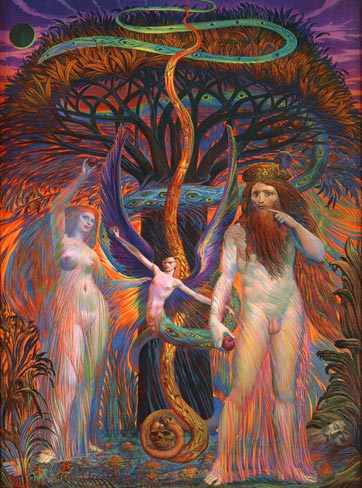
In Christian theology, the main source of human unhappiness is original sin. According to this way of thinking, the reason we can't be happy is because we are prone to sin; this means that we ultimately short-circuit all those things that might bring us happiness. Supposedly, this goes back to the original man, Adam, and his mate Eve. When they ate of the tree of knowledge of Good and Evil, which God said not to do, they sinned and were kicked out of Eden, or Paradise.
It is this original sin that some theologians say stains our personalities from birth. We are born in original sin. We are genetically engineered, so to speak, to sin, according to this view. There's some type of psycho-genetic disposition hardwired into us to do evil.
Kierkegaard disagrees with this theological understanding of sin. The origins of sin begin and end with each person. We are not hardwired to do evil. We are, though, born into a world of sin. This is the result of sins by people that have accumulated over time and in history.
For Kierkegaard, the springboard for individual sin occurs when people are afraid to face and oppose this world of sin. The world as we know it conditions who we are. While genetics plays a large part in who we are, so does the influence of society, culture, family and so on. But there is something built into the human spirit that can see the deception and hypocrisy, the evil in the world. This is what Kierkegaard calls the Nothing.
The Nothing is where we see our freedom to be who we are. It is the "possibility of possibility." We see an infinite world of possibility and we are dizzied by the things we see and could be. The world, ourselves, and those around us change and become either larger or smaller in comparison to this great world that could either be or not be. That it will be--for us at least--depends on our letting it be in one way or another.
In crises such as adolescence and other significant stages in personal growth, we realize that we have the freedom to either accept or refuse to accept society's rules and customs. We are not predetermined in the whole-sale way that some scientists might say we are. We are not simply biological cyborgs with "wet computers" as brains.
We have the natural capacity to form a distance from our environments and societies. We do not need to be what society or family or friends say we have to be. Indeed, we can to a very large extent shape and mold the very material conditions that life has thrown our way. Biology and genetics are materials to be used in fashioning a self that exhibits independence and joy.
But there is an inherent anxiety that accompanies this process. It's a risky endeavor fashioning a self from nothing. It takes courage and hard work. It takes standing up to people whom you love and respect and perhaps telling them that their way of looking at the world is either not your way or perhaps even wrong.
This creates anxiety, because people find support and safety in the rules and restrictions imposed by their societies. But by not thinking about whether these rules and customs are right or wrong, I simply join the crowd like everyone else. I do not form any relationship to the world except one that everyone else agrees with. They are not mine. Potentially I can wander aimlessly through life, never facing life's problems honestly and authentically. Life's problem is no problem as I let what others think provide the answers.
For Kierkegaard, this is an abuse of the freedom we have to choose responsibly. This type of choice is important, because if I don't do this then I am not acting ethically; I am not using the freedom to be who I am responsibly. In doing this, I also cannot be the type of human being who knows what it means to live as an individual. I only know how to live in a crowd. But crowds are notoriously amoral entities.
An ethical and moral environment is one wherein people associate with each other as individuals. For it is only as individuals who have understood themselves separately from the sinful world that they can come together to address the injustices created by that sinfulness.
The demonic arises when you reject the freedom to act in a free and responsible way, ethically, to the situations that life throws your way. The freedom to choose makes you anxious because there are no textbook answers to the way that you should respond to events. There's no recipe book on how to act ethically. If you have not cultivated the individual awareness that not only are you motivated at times by self-deceit and unconscious desires and motives, you will take the easy way out and run away from the problem.
This outlandish, if not absurd, claim comes in Kierkegaard's book on original sin, sinfulness, and the demonic. The work is a psychological look at how people gain an awareness of themselves as individuals. In doing so, they must face their freedom to be who and what they are.
As I have argued (following Kierkegaard) a main form of despair is the person who is aware they have an eternal side to them but who want to reject it and instead make something out of themselves that spites God. This person is in defiance against God because they are not happy with their place in life or with their
The reason that many who make the argument for the President's courage and going against public opinion sometimes invoke Kierkegaard's name is because he seems to assert something of the same kind. That is, the individual, one who really believes in what they are doing because they know it is right and true, will do everything in their power to accomplish that. Yet, as Kierkegaard noted, it is only within the confines of religious belief and the relationship that someone has with God that this view makes sense.
Following what either others tell you to do or giving in to self-deceit. The Christian way of life, according to Kierkegaard, is to recognize this sinful disposition and to inculcate a way of encountering the world that is ethical because responsible. Responsible because self-critical, self-critical because I have identified the freedom that comes from critical awareness of the socio-cultural norms that breed injustices and inequality.
Back to Index Read more!
0
comments
Labels:
bush,
demonic,
kierkegaard,
nihilist-politics,
religion
Friday, September 14, 2007
Texas George Rex Judas (4c)
 I ended the preceding section on the idea that humans do not act in a vacuum; that all human actions and self-understandings are done in terms of social conventions and structures that have determined us from the time we come from the womb. The Great Man theory, however--one supported by Pres. Bush and his followers--supposes that we do indeed act as separate entities, as though our individualness is somehow isolatable from a socio-cultural environment.
I have argued that not only is this impossible but that it is dishonest and can lead in some instances to a form anti-ethical action that Kierkegaard describes as "demonic." The problem with most theories of individualism is that they isolate some essence that seems to be private and independent of others. Kierkegaard is sometimes interpreted this way, as I noted above. But what Kierkegaard discusses is not an isolated individual essence but rather a psychological state that critically assesses the values and customs of any socio-cultural matrix.
There is nothing like a soul or ineffable substance that does this. Instead, we as psycho-biological entities develop the capacity to critically understand our environments in a way that shows both inter-dependence and independence. As this shows, my own independence comes from interdependence just as my interdependence relies on my independence.
The soul is one aspect of the duality that we as bodied entities are. When I formulate who I am in terms of possibility and necessity, imagination and genetics, I take an attitude towards these two poles of my (past and future) history. This way of seeing or understanding the world is a third element whose nature is neither body nor soul. Its existence exists to evaluate how the two other elements interact and how one balances them. It does so by way of various actions and linguistic formulations that bring cognitive awareness as much as they do behavioral alignment. That is, through a process of formulating in words what it is I want to be and how I will accomplish that, I undertake to do what it is that I have formulated linguistically.
This way of putting the situation is obviously inadequate. It only gives a simplistic skeletal description of the way that we as humans act and think. Yet it points up several important dimensions for understanding what the nature of the Bush "revolution" is about. That is, these considerations show that like Genet and others, Bush et al. attempt to define their missions and actions in terms of isolated entities whose overall perspective is destructive of community.
This is so, because individuals are not isolated in this way, and when they act as though they are, they become ghosts and wraiths of real selves. Consequently, any society built around such actions and understandings will eat at the very foundations of any viable community.
Kierkegaard tries to outline a mode of facing life with courage and self-knowledge that short-circuits the this demonic way of seeing or understanding life means. As I noted in the previous section, one way of denying one's responsibility that Kierkegaard was keen on combating is to put the onus of responsible choice onto history.
This means that I say that I had no choice, that history and circumstances forced me to do such and such. This type of rationalization will go so far as to say that the choices I make are somehow substantiated by history to be; that history will somehow bear me out, that I will be vindicated by historical events.
In this context, Kierkegaard pointed to the politician who appeals to history to defend his or her decision. Kierkegaard writes:
When a headstrong person is battling with his contemporaries and endures it all but also shouts, "posterity, history will surely make manifest that Is poke the truth, then people believe that he is inspired. Alas, no, he just a bit smarter than the utterly obtuse people. he does not choose money and the prettiest girl or the like; he chooses world-historical importance--yes, he knows very well what he is choosing. But in relation to God and the ethical, he is a deceitful lover; he is also one of those for whom Judas became a guide (Acts 1:16)--he, too, is selling his relationship with God, though not for money. And although he perhaps reforms an entire age through his zeal and teaching, he confounds pro virili [to the very extent of his powers], because his own form of existence is not adequate to his teaching, because by excepting himself he establishes a teleology that renders existence meaningless. (Kierkegaard, Postscript, trns. Hong, pp 136-137)It is this notion that one is only responsible to some abstraction like "history" that displays Bush's ultimate Judas self-perception. The impending chaos and meaninglessness of human life implied in such statements and view have become apparent, I think, in the destruction and human suffering currently visited upon Iraq by this man's actions. But these considerations--in the light of Kierkegaard's comment call for further analysis, which I take up in the next section.
Back to Index Read more!
0
comments
Labels:
bush,
kierkegaard,
nihilist-politics,
religion
Tuesday, September 11, 2007
Texas George Rex Judas (Table of Contents)
 This provides a serialized listing of the posts on Texas George Rex Youda.
Index of Postings on Texas George Rex Judas
- Texas George Rex Judas (1)
Texas George Rex Judas (2a)
Texas George Rex Judas (2b)
Texas George Rex Judas (3)
Texas George Rex Judas (4a)
Texas George Rex Judas (4b)
Texas George Rex Judas (4c)
Excursus: Original Sin and Politics
There's a lot of Kierkegaardian background to this analysis. I have tried to keep the jargon to a minimum. Yet, the background noise of so much of modern life requires a reworking and attunnement to things that one might otherwise miss. Kierkegaard is a good dissolvent for what I once heard someone call "cognitive dissonance."
Just as a side-note: It's interesting how a person can become a phenomenon. Bush as a person is probably a minuscule thing. As President, he becomes an amorphous thing that can be pulled and tugged into all kinds of silly-putty configurations (consider 1 and 2). For example, at Pat Lang's blog, I gave the following analysis:
One of my favorite scenes in Lawrence of Arabia is when the commanding field surgeon enters the Damascus "hospital" housing dead and dying Turks. The conditions are so horrendous he berates 'awrence, shouting at him "Outrageous! Outrageous." Then the nurses and others move in to clean up the crap and mess left by 'awrence's nostalgic trip to being Alexander.And who's the REAL Bush? That is indeed the question. Why it matters should really only be of importance to himself. That it concerns all of us at this time is unfortunate. As I say, the meat of these postings is not so much an attempt to get at the real George Bush as it is to identify a state of mind that afflicts many more than Bush himself. The scary thought, of course, is that might not be a REAL George Bush.
I just wish Petraeus and others (perhaps even a Senator or 2) would act in this way towards the crap-house Bush has created in Iraq. While I admire a guy like Petraeus who's willing to clean out the latrines as part of his duty, I am hoping that at the same time he's pointing out to Der Deciderer what a real f*-up he is.
Following on the attempt to psychoanalyze Bush in a previous post, I'd note that Narcissism from a Freudian analysis occurs at the same time as potty training. The Narcissist is pathologically fascinated by his/her own bodily functions and by-products. In a strange way, they see it as somehow themselves. (Need I mention the rumored predilection of Bush for flatulence jokes?)
One wonders how much Mama Bush changed baby Bush's nappies. As he went along in life Der Deciderer could certainly count on Mama and Papa Bush to clean up his messes. Then he met up with Rove, another person willing to clean up the mess--or at least smear it in ways that made Der Deciderer look like he was a prom queen and not Carrie.
Anyway, part of the message to Bush and others are things that Petraeus and Gates have left out of their quantitative analysis of Res-Iraq: over 2 million refugees; the lie that is falling body count; the ethnic cleansing.
And yes, the fact that nature indeed does hate a vacuum, and the vacuum of Iraq is sucking in all the ill-winds that the modern nation-state and colonialism tried to bottle up.
Update: I Cite points to an article at truthout that captures the tenor of the betrayal discussed in this series of posts. While the writer seems shaken by an impending sense of catastrophe, I think that he's on to something that must be stated much more clearly I suggest below that what has taken place is a betrayal of the very principles that make community possible. This can be seen as a form of soft fascism, as Richard Sennett sees it; but it is something more fundamental at work, something that ranges from seemingly innocuous things like more mistrust among people towards strangers to a cynical manipulation of public perception via distorted news stories about what's really happening.
William Rivers Pitt writes:
The joke: people say Bush and his people want to raze the core nature of the country itself by wrecking the Constitution, and they're correct. People say Bush and his people are enriching their friends beyond dreams of avarice at our actual expense, by way of war-inflated oil prices; war-captured Iraqi oil infrastructure; the orgiastic plunder of Treasury money through calamitously unsound tax cuts for Bush's pals; and through an Iraq war profiteering scam so unutterably corrupt that it bends the very light. That, and more besides, is what people say, and they're correct.JDean at I Cite adds her very academic and perhaps over-intellectualized take on what Pitt is talking about. I try to take a more pragmatic approach, using concepts and language that still hold meaning for people, though that meaning itself may be indefinable. By providing ana analysis using this mythology one can perhaps gain an insight into phenomea that are profpund just because they are so obvious. Obvious and yet insidious because they threaten unravel a social fabric and pit people against each other in fratricidal warfare.
But all that, along with everything else the Bush crew has done, just isn't enough for them. What Bush and his people really seek, at bottom, is to destroy the basic definition and literal existence of reality itself. They want to destroy reality, rebuild it according to their own blueprint, so the sum and substance of this new reality will accept as axiomatic the idea that lying, stealing and wholesale carnage are badges of integrity and moral clarity. In other words, our comprehensively understood reality today would be replaced by whatever madcap anti-reality currently exists within the walls of 1600 Pennsylvania Avenue.
Update: (via Born @ the Crest of the Empire) -- From AP
Just over half of the white evangelicals who attend church at least weekly said the war was the right decision and the extra troops were helping, while about four in 10 said the war is a success — well more than Catholics and Protestants measured in the survey.
Slight majorities of conservatives saw success in Iraq, a troop increase that is working and a war that was the right choice, a third of them or more answered each question negatively.
Related Links
- Hard-liners for Jesus By Harold Meyerson
0
comments
Labels:
atheism religion,
bush,
demonic,
nihilist-politics,
religion
Friday, August 31, 2007
In Memoriam: Julie
Before I move on to posting more of my politically naive diatribes, I want to note the death of a woman I wish I had known better. Julie died yesterday after a bout with a very horrible disease, systemic sclerosis, that travestied her body and made her last days on earth a daze induced by pain-suffocating drugs.
But this end does no justice to the light that this woman shared with all while she lived. It is that light which I only experienced for a few short hours and that I will remember and hope that all her family never forgets.
Julie was my ex-fiancee's aunt. I came to know Julie at several holiday gatherings and momentary stop-overs at her home, which she kindly opened up to me and my son when we had to catch a 6am plane.
From the bits and pieces that I know about her, Julie's life was not easy. She raised a son by herself. He was a handful. Later in life he gravitated to drugs and caused great hardship for her with various criminal activities that it seemed Julie invariably took upon herself to pay for. This even ended in her having to give up her house to get him out of trouble.
A less forgiving parent might have simply disowned a son like that. And, no doubt, they'd be right in a prudent way. Yet, not only did Julie display the unconditional love of a mother, but perhaps she exhibited that love that goes beyond even the natural and biological love. She never gave up on her son, something that will perhaps be to her credit should a final accounting have been made in whatever other reality exists beyond this one.
Julie worked as a head cook in a hospital kitchen. From this position she gained the wisdom to see that hospitals were money-making institutions just like any other in America. She also saw that the interests of hospital management and those of the less skilled and educated hospital workers had to fight for respect and a decent standard of living.
From this position, she rose to become president of her local hospital worker's union. Over the years, she saw the nature of healthcare change and as it changed so did the pressures on hospital workers to reduce their pay. She became quite adept at seeing through the many lies and strategems that hospital management tried to use to undermine worker solidarity. Until the end, she remained committed to workers and their dignity. She was a fighter.
Before her long illness sapped her strength, she had begun to work with street walkers close to her home. Non-judgmentally and completely on her own, she first created a bond of trust with these naturally distrustful individuals and began coaching them on ways to see get out of the brutality and vicious cycle of drugs and physical and mental abuse of pimps.
Perhaps in working with prostitutes, she was trying to exorcize some of her own demons. Perhaps she felt that helping someone in dire straits would make up for what she may have felt were her own failures with her son.
I never had a chance to go deep with Julie about her motivations, but then we have all have demons and judging others is supposed to be done with a measuring rod that begins with your own life. There's much in my own life that tells against being presumptuous in this regard.
Yet, there were also triumphs. Her courageous stand in rescuing my ex-fiance from a home where she was sexually abused by her mother's boyfriend for years is one such instance. Julie took her into her home and raised her like her own daughter. She was successful in teaching my ex- survival skills that enabled her to live on her own in an independent and self-sufficient manner.
Julie was a courageous and strong woman. It is people like her that should fill our history books. I only hope that these few, hastily jotted words do not exaggerate either her humility or her innate genius. For me, at least, she was a person to know for who she was--strengths and weaknesses alike. For it is through our weaknesses that we are strong, the Apostle Paul once wrote. And it is through our humble strengths that we show forth the spark that can move mountains.
Read more!
Thursday, August 30, 2007
Coming War with Iran (Updated)
The Bush admin has done an admirable job of selling the coming war with Iran. Popping every trial balloon like it was just bubbles of fantasy, it has made such a war appear less and less likely. Simultaneously, it has made those who see the writing on the wall of such a war look like so many Chicken Littles.
Excellent job, you guys in disinformation and psyops. You really have played this game superbly.
So all the talk about Condi working for a diplomatic settlement and Cheney in the doghouse was so much dust in our eyes. Or perhaps Dick has wormed his lovable way back into the deciderer's heart. Who knows?
As it is, the signs that such a war with Iran is imminent becomes more more compelling by the hour. There is still a huge armada in the Persian Gulf. AF personnel are well-rested and do not suffer from the fatigue that the ground troops do. The naval and AF ordnance and resources are stacked high and ready.
Then, of course, you have George, Rex Youdas, displaying apocalyptic fantasies once again in public. Yesterday, for example, in a little-covered speech (that's what floating all those bubbles does, see, it makes such speeches seem like trivialities and old hat, nothing important, just a bunch of verbiage), almost made it a fait accompli.
Born at the Crest of the Empire picked these choice quotes:
(AFP) "The United States demanded Tuesday that Iran end any support for extremists in Iraq "at once" and raised the specter of a "nuclear holocaust" in the Middle East if Tehran gets atomic weapons."Those are fighting words and this guy is in a corner, facing the oblivion of history or the glory of being the one to save the world from evil. Which would you choose?
(Speech text) "I want our fellow citizens to consider what would happen if these forces of radicalism and extremism were allowed to drive us out of the Middle East. The region would be dramatically transformed in a way that could imperil the civilized world."
And if that weren't sobering enough, consider the following remarks from Col. Lang, a guy whose instincts and experience on these matters I think you should trust:
In fact such a strike would be merely the opening battle in yet another long war fought against a major piece of the Islamic World.Then again, don't we deserve this in some weird, twisted way? Didn't most of us applaud George and facilitate his egomania as the guy in the white hat who fights the evil ferners who're out to kill us all?
The current IO [Information Operations, i.e., the Defense Department's propaganda wing] campaign against Iran makes it seem more and more plausible that such an onslaught will be attempted.
What or who's going to stop them? The Democrats will not, no matter how many dollars pour into their campaign troughs. They're up to their eyeballs in dining with the AIPAC and Defense Dept. military-industrial technocrats.
Update In response to a post at Lang's blog, I noted the following:
The Dems will not in any way tie Bush's hands on Iran. AIPAC is too strong in both parties. And it's AIPAC and its minions who are pushing hard this idea of hitting Iran.Updates: Fer "evil ferners" see the comment left by Davie on my very successful post, "Kill All Muslims." (more of which in a second)
Dick has what he wants, I think, in Iraq. I wrote several months ago that he and Rumsfeld were telling Der Deciderer that things were sufficiently "contained" in Iraq to go after Iran. Obviously he couldn't make the appearance of that stick in the popular press.
Now, however, with Petraeus conveying confidence and almost spouting success, the perception that Iraq is indeed contained can gain more credence. I say this after listening to two people on NPR talk about Iraq in terms that made Iraq sound like it was on the verge of entering the Emerald City.
This is a liberal talk show and if the impression given by the host and her speakers is so sanguine, then how do you think Der Deciderer feels?
What broke my growing euphoria, though, was a statement during the news break that Condi Rice is sounding the Cheney fight song. It sounds like she's given in and is now on-board with Dick
Col. Lang has kindly linked to an article explaining further the IO plan of operations vis a vis the Iranian War.
Also see this from Chris Floyd.
Related Links
Read more!
2
comments
Labels:
future visions,
iran-war,
neoconservatives

 Posts
Posts